
A software escrow agreement is a tri-party contract where a licensor deposits source code and related materials with an independent escrow agent, who releases them to the licensee only if specific, pre-agreed conditions occur. Those conditions typically include vendor bankruptcy, abandonment of the product, or failure to maintain support obligations. The mechanism exists for one reason: to give licensees a contractual fallback if the company they depend on for critical software disappears or stops performing.
The traditional model, built around a single zip file of source code, no longer covers how software actually gets delivered. A modern SaaS or AI vendor relationship depends on infrastructure, credentials, and trained models, not just static code sitting in a repository.
- Who it protects: licensees exposed to vendor failure, and licensors who want to close deals with risk-averse enterprise or government buyers
- When it applies: vendor insolvency, discontinued support, breach of maintenance obligations, or change of control
- What's changed: SaaS and AI deployments now require deposit of infrastructure-as-code, deployment credentials, container images, and in some cases model weights and training-data documentation
Key Takeaways
Software escrow agreements protect business continuity only when deposit scope, verification, and release triggers are drafted with equal precision, not just the release clause alone.
| Point | Details |
|---|---|
| Deposit scope drives outcomes | List every component needed to rebuild the system, including build scripts, IaC, and credentials for cloud deployments. |
| Verification separates real protection from paperwork | Push for build or cloud deployment testing on mission-critical systems, not just a readability check. |
| Release triggers must be objective | Draft bankruptcy, abandonment, and breach conditions as provable events with a defined evaluation timeline. |
| Insolvency risk needs upfront planning | Confirm the escrow agent holds clear title to deposits and check the vendor's jurisdiction before signing. |
| Beyondhorizons supports the full lifecycle | The firm drafts and negotiates escrow clauses and advises on insolvency exposure through fixed-fee or retainer engagements. |
Table of Contents
- How Software Escrow Agreements Work: Parties, Deposits, and Verification
- Key Clauses and Contract Language Every Escrow Agreement Should Include
- SaaS, Cloud, and AI Escrow: What Changes Contractually
- Release Events and What Beneficiaries Can Legally Do Afterward
- Fees, Cost Allocation, and Negotiation Levers
- Insolvency, Enforceability, and Jurisdictional Risk
- Practical Drafting Checklist and Negotiation Playbook
- What Business and Legal Professionals Consistently Underestimate
- Beyondhorizons: Clause Review, Negotiation, and Cross-Border Enforcement Support
- Sources
How Software Escrow Agreements Work: Parties, Deposits, and Verification
Three parties sit inside every escrow arrangement, each with distinct obligations. The licensor deposits the materials and keeps them current. The licensee, often called the beneficiary, pays fees and monitors compliance. The escrow agent, an independent third party, holds the deposit and controls release, acting neither as the vendor's lawyer nor the customer's advocate.
Source code escrow is defined precisely as the deposit of source code with a third party who releases it only when contractually agreed conditions occur, whether that's bankruptcy, cessation of maintenance, or a failure to support the product. That definition sounds simple. The drafting behind it rarely is.
Getting the deposit scope right determines whether an escrow arrangement is worth the fee or a false sense of security. Counsel should insist on:
- Complete source code in a specified language, version, and compiler or interpreter dependency list
- Build scripts and configuration files needed to compile a working system, not just raw code
- Technical documentation covering architecture, APIs, and data schemas
- Infrastructure-as-code and deployment credentials where the software runs in the cloud
- A defined update schedule, tied to material releases rather than an arbitrary calendar date, with certification from the licensor confirming what changed since the last deposit
Deposits that sit untouched for two years while the vendor ships four major releases are worthless in a crisis. Change management matters as much as the initial deposit.
Verification services close the gap between "something was deposited" and "something usable was deposited." Providers now offer tiered verification, from a basic readability check confirming the files open and match a manifest, up to full build and compile testing, and increasingly, cloud deployment verification that spins up the deposited materials in a sandbox environment. Automated, periodic deposits pulled directly from a vendor's Git repository have also become standard among escrow providers, reducing the administrative burden that once made deposits fall out of date.
Pro Tip: Never accept a deposit certificate alone as proof the escrow works. Ask for at least a build verification report before signing off on any mission-critical agreement, and budget for it as a line item, not an afterthought.
Key Clauses and Contract Language Every Escrow Agreement Should Include
Escrow agreements follow a recognizable structure across providers and jurisdictions. Standard clause sets typically cover identification of the software, deposit obligations, release conditions, escrow agent responsibilities, verification, and fees. Treat each as a discrete drafting problem rather than boilerplate to skim.
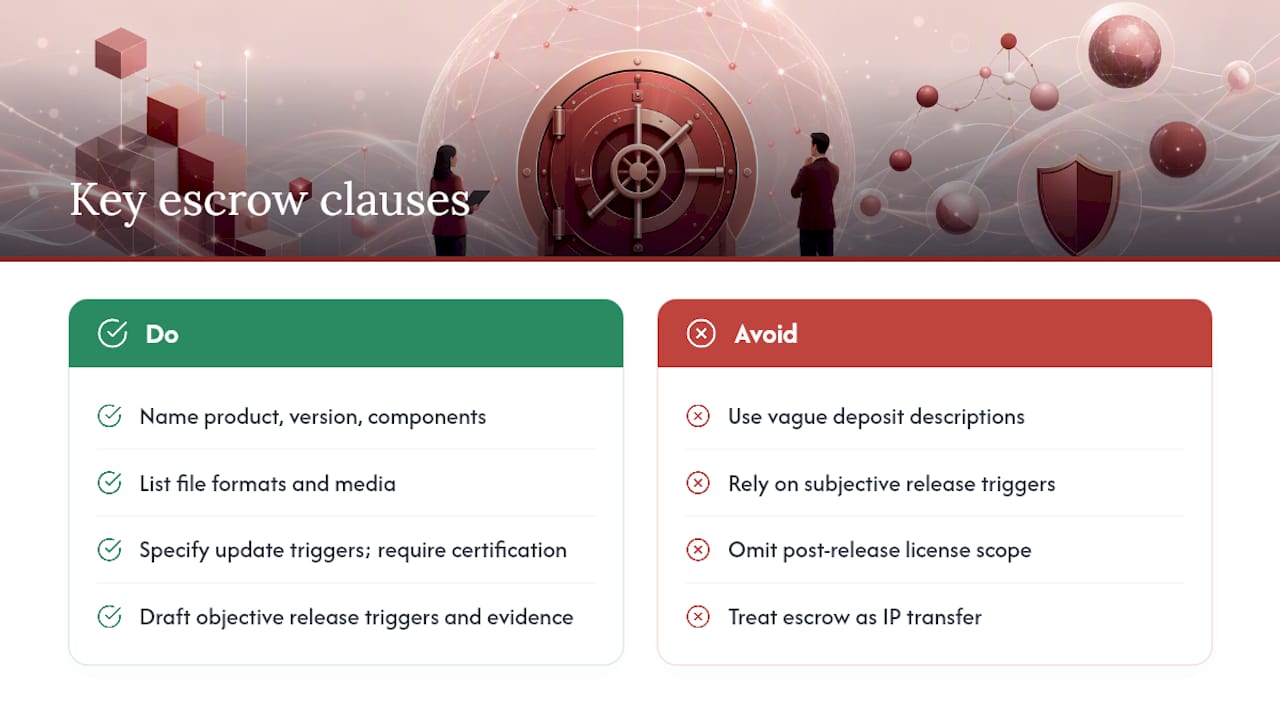
Identification and scope of deposit materials. Name the specific product, version, and every component required to reconstruct it. Vague language like "the software and related materials" invites disputes later about what should have been included. List file formats, acceptable media, and any third-party or open-source components bundled into the deposit.
Deposit and update obligations. Specify triggering events for updates (major release, patch, quarterly cycle) and require a certification of currency from the licensor with each deposit. Without a certification requirement, there's no accountability mechanism if the vendor deposits an outdated build.
Release conditions. This is the clause most likely to generate disputes, so it deserves the most precision. Draft triggers as objective, provable events rather than subjective standards like "material breach" with no defined threshold. Bankruptcy filing, cessation of business operations for a specified period, or documented failure to cure a support breach within a stated cure period all work better than open-ended language. Specify exactly what evidence the beneficiary must submit and the timeline the escrow agent follows to evaluate a release request.
Post-release rights. State plainly whether the beneficiary receives a license limited to internal maintenance of existing deployments, or a broader right to modify and further develop the code. Silence on this point creates ambiguity precisely when clarity matters most.
IP ownership and reservation. Escrow release should never be read as a transfer of ownership. Include express language confirming the licensor retains all intellectual property rights, and the beneficiary's rights are limited to the license grant defined in the release terms.
Escrow agent duties and liability. Define the agent's obligations narrowly: hold materials securely, verify deposits per the agreed protocol, and release strictly according to contract terms. Cap the agent's liability and require confidentiality obligations equivalent to what the underlying license agreement imposes on the licensee.
Termination, governing law, and dispute resolution. Address what happens to deposited materials if the underlying commercial agreement terminates, which jurisdiction's law governs interpretation, and whether disputes over release conditions go to arbitration or court.
A study of standard escrow templates shows the release-conditions clause and the verification clause are the two most frequently negotiated provisions in commercial deals, because they carry the highest financial consequence if drafted loosely.
Every one of these clauses interacts with the others. A tightly drafted release trigger is meaningless if the deposit-scope clause left out the build scripts needed to actually compile the code once released.
SaaS, Cloud, and AI Escrow: What Changes Contractually
Traditional escrow assumed a licensee could take a zip file, install it on their own servers, and run the business again. That assumption collapses for a cloud-native product, and it collapses further for anything involving machine learning.

A SaaS product depends on infrastructure configuration, managed database services, third-party API integrations, and credentials that live inside the vendor's cloud account, not in a source repository. Escrow providers now list infrastructure-as-code, container images, virtual machine images, database backups, and admin credentials as standard deposit categories for cloud-hosted software, recognizing that source code alone cannot restore a running system.
For AI-powered products, the deposit list needs to extend further still:
- Trained model weights and the specific framework version required to load them
- Training data provenance documentation, including licensing terms for any third-party datasets
- Fine-tuning scripts and hyperparameter configurations used to reproduce model behavior
- Inference pipeline code separate from training code, since production inference often runs on different infrastructure
Beneficiaries facing a cloud-hosted vendor failure have three practical paths, each with different cost and complexity trade-offs. Basic recovery escrow gives access to deposited infrastructure code and credentials so the beneficiary's own team can rebuild the environment, which takes time but costs less. A secondary cloud environment maintained in parallel shortens recovery time substantially but adds ongoing hosting costs. Managed live continuity, where a provider actually keeps a running instance available for a defined period, commonly around 90 days, gives near-instant continuity but carries the highest price tag.
Pro Tip: For mission-critical SaaS dependencies, push for a verification protocol that includes an actual cloud deployment test, not just a code readability check. A vendor's deposited credentials that no longer work because they were rotated eight months ago will not help you at 2am during an outage.
Every AI licensing agreement should specify who bears responsibility for keeping model weights and training documentation current as the vendor iterates. Model versions change quickly, and a stale deposit is functionally no different from no deposit at all.
Release Events and What Beneficiaries Can Legally Do Afterward
Release conditions only work if they trigger cleanly and everyone knows what happens next. Common triggers include a formal bankruptcy filing, cessation of the vendor's business operations, documented and uncured failure to provide contracted support, or a change of control that materially affects service continuity.
- Confirm the trigger occurred by submitting the evidence specified in the agreement, whether that's a court filing, written notice of discontinued support, or a certified breach notice following an unremedied cure period
- Escrow agent evaluation against the agreed evidentiary standard, typically within a fixed window (commonly 5 to 15 business days depending on the provider)
- Release of verified materials, ideally accompanied by a build verification report if verification services were part of the arrangement
- Beneficiary triage, assessing what's usable immediately versus what needs rebuilding, and engaging a replacement development team where internal capacity falls short
- Preservation of forensic records documenting the release process, in case the original licensor disputes the trigger after the fact or reappears post-bankruptcy with a competing claim
What the beneficiary can actually do with released materials depends entirely on how the post-release license was drafted. Maintenance-only language permits bug fixes and security patches to existing deployments but blocks new feature development or resale. Broader development rights allow the beneficiary to modify, extend, and potentially transfer the code, subject to whatever IP reservation language survives release.
Never assume release equals ownership. Every well-drafted agreement preserves the original licensor's underlying IP rights even after materials change hands, so beneficiaries need affirmative permission language covering exactly what they intend to do next, not silence they hope courts will interpret favorably.
Fees, Cost Allocation, and Negotiation Levers
Escrow costs break into several discrete components, and negotiating each independently tends to produce better outcomes than treating the whole arrangement as a single line item. Setup fees cover initial deposit intake and documentation. Annual custody fees cover ongoing storage and account maintenance. Verification fees apply per test cycle if verification services are included. Release processing fees apply if a release event actually occurs, and build or recovery assistance fees apply if the beneficiary needs hands-on technical help reconstructing a working system from deposited materials.
Who pays what varies by negotiating leverage more than by convention. Licensors often absorb the base setup and custody fees as a cost of closing enterprise deals, while beneficiaries insisting on verification services, particularly the more expensive build and cloud deployment tests, frequently pay for that layer themselves.
Three levers move the price meaningfully:
- Narrowing deposit scope to genuinely mission-critical components rather than the vendor's entire codebase
- Reducing verification frequency from every deposit to an annual or semiannual cycle
- Capping escrow agent liability in exchange for lower annual fees, or accepting higher liability caps at a premium
Weigh every cost against realistic downtime exposure. A cost benchmarking review of corporate legal services in the region shows escrow arrangements for non-critical internal tools rarely justify the premium tier of verification, while systems tied directly to revenue generation usually do.
Insolvency, Enforceability, and Jurisdictional Risk
Escrow agreements exist largely to address vendor failure, which means insolvency law sits directly in the path of every release event. Bankruptcy proceedings and creditor claims can complicate or block a release outright, particularly where the deposited materials are treated as an asset of the insolvent estate rather than materials already contractually earmarked for the beneficiary.
- Structure the agreement so the escrow agent holds clear title to administer the deposit independent of the licensor's other assets, reducing the risk a bankruptcy trustee claims the materials belong to the general estate
- Draft release triggers with enough precision that a court or trustee cannot argue the condition was ambiguous or subject to interpretation
- Specify governing law and enforcement forum explicitly, since a beneficiary in one jurisdiction attempting to enforce release rights against a vendor in another can face conflicting insolvency regimes
- Consider escrow-specific dispute resolution, such as expedited arbitration, for disagreements over whether a release trigger occurred, since ordinary litigation timelines defeat the purpose of a continuity mechanism
Pro Tip: If the licensor operates in a jurisdiction with debtor-friendly insolvency law or an unfamiliar restructuring regime, escalate to specialist restructuring and insolvency counsel before signing, not after the vendor files for protection. The clauses that matter most in a crisis are the ones nobody reads carefully during a routine contract negotiation.
Cross-border deals raise the stakes further. A conflict check and cross-border counterparty review before signing helps confirm the vendor's corporate structure and jurisdiction won't undermine enforceability if things go wrong years later.
Practical Drafting Checklist and Negotiation Playbook
Counsel reviewing or drafting an escrow agreement benefit from a sequence, not a checklist scattered across clause types. Beyondhorizons approaches these engagements the same way it structures other cross-border commercial reviews: scope first, risk allocation second, enforcement mechanics last.
- Scope the deposit against what's actually needed to rebuild the system, not what the vendor prefers to hand over
- Set the update cadence tied to material releases, with a certification obligation attached
- Draft release triggers as objective, evidence-based events with a defined evaluation timeline
- Negotiate verification proportional to how mission-critical the software is to your operations
- Confirm post-release license scope in writing, distinguishing maintenance rights from development rights
- Check insolvency exposure in the vendor's home jurisdiction before finalizing governing law
- Plan the transition operationally, including who receives credentials, who performs the first build, and what knowledge-transfer sessions happen in the first 30 days after release
The single most common drafting failure isn't a missing clause. It's a release trigger written so loosely that both sides can argue about whether it fired, precisely when a beneficiary has no time left to argue.
Red flags in counterparty drafts include escrow agent liability caps set unrealistically low, release evaluation timelines left undefined, and deposit obligations with no certification requirement attached. For mission-critical systems, insist on fallback language requiring cloud deployment verification rather than accepting a basic readability check as sufficient.
What Business and Legal Professionals Consistently Underestimate
Most guidance on escrow agreements treats the release trigger as the clause that matters, and everything else as procedural filler. That's backward. In practice, the deposit-scope clause fails licensees far more often than the trigger does, because nobody's ever actually tried to rebuild the system from what was deposited.
Conventional advice tends to treat escrow as an insurance policy you buy once and forget. It's closer to a maintenance obligation. An agreement with a pristine release-conditions clause but a two-year-old deposit is a false comfort dressed up as protection.
If there's one priority worth fighting for above the rest, it's verification, specifically build or cloud deployment verification, not the cheaper readability tier. Escrow without verification tells you materials exist. It tells you nothing about whether they work. For mission-critical dependencies, that distinction is the entire point of the exercise, and it's the one most negotiating teams trade away first when trying to cut costs.
Counsel who treat escrow drafting as a static template exercise miss where the real risk sits today: SaaS and AI deployments where the "code" is a fraction of what's needed to actually restore operations.
— HL
Beyondhorizons: Clause Review, Negotiation, and Cross-Border Enforcement Support
Beyondhorizons reviews and drafts escrow-related contract language as part of its commercial contracts practice, with particular depth in the technology, robotics, and AI sectors where deposit scope and release triggers get complicated fastest.
The firm's lawyers, trained at Magic Circle and US white shoe practices, combine commercial drafting experience with Singapore-rooted cross-border capability, which matters when your escrow agent, your vendor, and your own operations sit in three different jurisdictions with three different insolvency regimes. That combination covers the full lifecycle: initial clause drafting and negotiation, IP ownership questions tied to release rights through the firm's IP and data privacy practice, and insolvency exposure review before you sign with a vendor whose financial position is uncertain.
Engagements run on fixed-fee clause review packages for straightforward agreements or retainer-based support for ongoing vendor negotiations, so cost stays predictable regardless of engagement shape. If your organization is negotiating a new escrow arrangement or reviewing an existing one for insolvency exposure, request a clause review or escrow risk assessment before the next renewal deadline arrives.
Sources
- Source code escrow - Wikipedia
- What is Software Escrow? The 2026 Guide to SaaS and AI - Escode
- Can you escrow SaaS software? Continuity for AWS, Azure or Google - The Escrow Company
- Source Code Escrow Agreement: What is it? Key Sections - ContractsCounsel