
A commercial agreement in contract law is a legally binding contract between two or more business parties that defines their rights, obligations, and remedies within a commercial relationship. Unlike consumer contracts, these agreements operate between parties with comparable bargaining power, which means negotiated terms carry the full weight of the deal. For business professionals and legal practitioners across Singapore and the APAC region, understanding what a commercial agreement requires, how it is structured, and where it can fail is not optional. It is the foundation of every transaction you close.
What is a commercial agreement in contract law?
A commercial agreement is defined by four core elements: offer, acceptance, consideration, and the intention to create legal relations. All four must be present for a contract to be enforceable. Without consideration, for example, a promise to perform is merely that. Without clear intention, courts may treat the arrangement as a social or informal understanding rather than a binding obligation.
Commercial contracts differ from consumer agreements in a critical way. Consumer contracts rely heavily on statutory protections. Commercial contracts rely on what the parties actually negotiated. That distinction shifts the burden of risk management squarely onto the drafting table.
The primary legal goal of a commercial agreement is risk allocation. Well-drafted agreements become legal assets that protect businesses rather than sources of legal exposure. Every clause you include, or omit, defines who bears the cost when something goes wrong.

What are the key elements and typical clauses of commercial agreements?
B2B contracts typically cover six or more key areas: warranties, indemnification, limitation of liability, dispute resolution, intellectual property ownership, and force majeure. Each area addresses a specific category of risk. Together, they create a complete picture of each party's exposure.
The most consequential clauses are often the ones business teams skip in early drafts:
- Warranties: Statements of fact about the product, service, or party that, if false, trigger liability.
- Indemnification: Allocates responsibility for third-party claims, losses, or damages arising from the contract.
- Limitation of liability: Caps the financial exposure of each party, typically at the contract value or a fixed amount.
- Dispute resolution: Specifies whether disputes go to litigation, arbitration, or mediation, and in which forum.
- Governing law: Identifies which jurisdiction's law applies to interpret and enforce the contract.
- Confidentiality: Protects sensitive information shared during the commercial relationship.
- Termination rights: Defines the conditions under which either party may exit the agreement, with or without cause.
Clear termination rights and limitation of liability clauses are the most effective tools for preventing costly disputes and preserving business relationships. Ambiguity in either clause is where litigation begins.
Pro Tip: Draft your limitation of liability clause to specify both a cap amount and the categories of loss excluded, such as consequential or indirect damages. A cap without exclusions often fails to deliver the protection parties intended.
How are commercial agreements structured in ongoing business relationships?
Most commercial relationships do not operate on a single contract. They involve repeated transactions, multiple work orders, and evolving terms. Master Service Agreements, or MSAs, are the industry-standard framework for managing this complexity. An MSA establishes the baseline terms that govern all subsequent transactions between the parties.
The practical benefits of an MSA are significant:
- Reduced negotiation time: Parties agree on core terms once, then execute individual statements of work or purchase orders without renegotiating the full agreement.
- Cost efficiency: Fewer legal hours per transaction means lower transaction costs over the life of the relationship.
- Consistency: Every transaction operates under the same liability, confidentiality, and dispute resolution terms, reducing the risk of conflicting obligations.
- Flexibility: Statements of work can be customized for each project while the master terms remain fixed.
Framework agreements like MSAs enable effective risk allocation across multi-year partnerships. That is why they are the preferred structure for technology services, logistics, and professional services engagements across APAC.
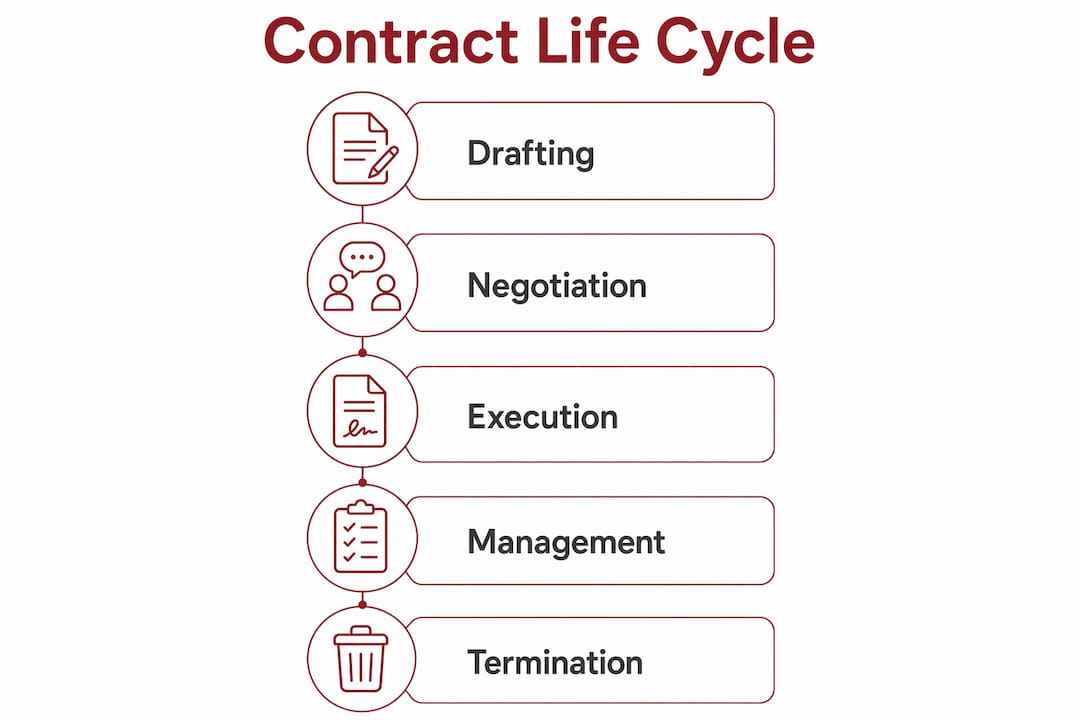
Effective contract management goes beyond signing. The table below outlines the key phases of a commercial contract lifecycle and what each phase requires.
| Phase | Key activities |
|---|---|
| Drafting | Define scope, obligations, and risk allocation clauses |
| Negotiation | Align on liability caps, warranties, and dispute mechanisms |
| Execution | Confirm authority to sign and proper execution formalities |
| Performance tracking | Monitor deliverables, milestones, and payment obligations |
| Renewal or termination | Assess performance and exercise rights per termination clause |
Each phase carries its own legal risks. Contracts that are well drafted but poorly managed still generate disputes.
What legal principles and jurisdictional considerations apply in Singapore and APAC?
Singapore contract law is rooted in English common law principles, including freedom of contract, good faith in performance, and the objective test for intention. Courts in Singapore apply these principles with commercial pragmatism. Courts seek to uphold existing commercial deals wherever possible, interpreting ambiguous terms in light of the parties' ascertainable intent rather than applying overly technical readings.
This approach has a practical implication. If your contract contains a gap, a court will try to fill it with what reasonable business parties would have intended. That is not always the outcome you want. Explicit drafting is always preferable to judicial interpretation.
For cross-border agreements in APAC, the governing law clause is not a formality. When governing law is not explicitly stated, courts look to the country most connected to the agreement or where characteristic performance occurs. In a region with as many legal systems as APAC, that ambiguity creates real enforcement risk.
Key considerations for cross-border commercial contracts in the region include:
- Governing law selection: Singapore law is widely chosen for APAC contracts due to the jurisdiction's neutrality, predictability, and enforceability of judgments.
- Jurisdiction and forum: Specify whether disputes go to Singapore courts or an arbitral body such as the Singapore International Arbitration Centre (SIAC).
- Enforceability of foreign judgments: Not all APAC jurisdictions enforce foreign court judgments automatically. Arbitral awards under the New York Convention have broader enforceability.
- Statutory overlays: Some jurisdictions impose mandatory consumer or employment protections that override negotiated terms, even in B2B contexts.
"Courts will not make contracts but seek to uphold existing commercial deals wherever possible, construing ambiguous terms in favor of ascertainable commercial intent rather than technical readings." — LexisNexis, Halsbury's Laws of England
International arbitration clauses are particularly valuable in APAC contracts where counterparties operate across multiple legal systems. An arbitral award is easier to enforce across borders than a court judgment.
Oral and implied contracts are legally recognized but carry serious evidentiary risks in high-value deals. Proving the terms of an oral agreement in litigation is expensive and uncertain. Written contracts with comprehensive terms are the standard for any transaction that matters.
What are best practices for drafting and negotiating commercial agreements?
The most common source of commercial disputes is not bad faith. It is poor drafting. Vague scope definitions, missing governing law clauses, and unbalanced indemnification provisions create disputes that written clarity would have prevented.
Comprehensive coverage of key clauses reduces misunderstandings and business disputes. The following practices reflect what experienced practitioners apply consistently:
- Define terms precisely: Every defined term in the contract should have one meaning. Avoid using the same word in different senses across clauses.
- Scope obligations clearly: Describe what each party must deliver, by when, and to what standard. Scope creep is a contract problem before it becomes a project problem.
- Balance indemnification provisions: One-sided indemnities are a negotiation red flag. Aim for mutual indemnification tied to each party's own acts or omissions.
- Cap liability at a realistic level: Uncapped liability provisions deter counterparties and create unquantifiable exposure. Tie the cap to contract value or insurance coverage.
- Include a clear dispute resolution ladder: Start with negotiation, then mediation, then arbitration or litigation. This structure reduces the cost of resolving minor disputes.
- Specify termination triggers: Define both termination for cause, such as material breach, and termination for convenience, with appropriate notice periods.
- Review governing law and jurisdiction together: The governing law clause and the jurisdiction clause must be consistent. Mismatches create enforcement problems.
Pro Tip: Before signing any commercial contract, run a clause-by-clause risk review against your organization's standard risk tolerance. A contract that looks balanced on its face may contain a single indemnification clause that creates unlimited exposure.
Legal review is not a cost center. A lawyer who identifies a missing limitation of liability clause before signing saves multiples of their fee in avoided litigation. For cross-border transactions, engaging counsel familiar with both the governing law and the counterparty's jurisdiction is the standard of care, not a luxury.
Key Takeaways
A commercial agreement in contract law is only as strong as the clarity of its terms, the completeness of its risk allocation clauses, and the enforceability of its governing law and dispute resolution provisions.
| Point | Details |
|---|---|
| Four core elements required | Every enforceable commercial contract needs offer, acceptance, consideration, and intention to create legal relations. |
| Six key clause categories | Warranties, indemnification, liability caps, dispute resolution, IP ownership, and force majeure define the risk profile of any B2B deal. |
| MSAs reduce transaction costs | Master Service Agreements establish baseline terms once, cutting negotiation time and legal costs across multi-year relationships. |
| Governing law must be explicit | In cross-border APAC contracts, an unstated governing law clause forces courts to decide, creating unpredictable enforcement outcomes. |
| Written contracts are non-negotiable | Oral and implied contracts carry evidentiary risks that make them unsuitable for any high-value or complex commercial deal. |
The clause that no one reads until it's too late
After years of working on cross-border commercial transactions across APAC, the pattern I see most often is not parties who drafted bad contracts. It is parties who drafted incomplete ones. The limitation of liability clause gets negotiated hard. The indemnification clause gets argued over. And then the termination clause, the one that actually determines how the relationship ends, gets copied from a template and signed without a second look.
That is where deals unravel. A termination for convenience clause with a 30-day notice period sounds reasonable until your counterparty exercises it mid-project and you have no recourse for sunk costs. A termination for cause clause that does not define "material breach" with specificity becomes a litigation trigger rather than an exit mechanism.
The other pattern I find underappreciated is the gap between governing law and enforcement. Practitioners in Singapore and across APAC often select Singapore law as the governing law, which is sensible. But they then fail to specify SIAC arbitration as the dispute resolution mechanism. The result is a Singapore law contract that requires enforcement through local courts in a jurisdiction where foreign judgments may not be recognized. The governing law clause and the dispute resolution clause must work together. They are not independent choices.
The commercial contracts that hold up are the ones where the lawyers and the business teams sat in the same room and asked: what happens when this goes wrong? That question, asked before signing, is worth more than any boilerplate clause.
— HL
Beyondhorizons' commercial contract expertise for APAC businesses
Beyondhorizons is a Singapore-headquartered law firm with lawyers from Magic Circle and US white-shoe firms, ranked on Chambers, Legal 500, and Asia Legal Business.

The firm's commercial contracts practice covers the full range of B2B agreements, from MSAs and framework agreements to complex cross-border transactions across APAC. Beyondhorizons combines deep commercial law expertise with cross-border corporate counsel capabilities, advising US-listed companies, Singapore government-linked entities, and regional banks on drafting, negotiation, and dispute resolution. For business professionals who need contracts that hold up across jurisdictions, Beyondhorizons offers the legal depth and regional reach to get it right.
FAQ
What is a commercial agreement in contract law?
A commercial agreement in contract law is a legally binding contract between business parties that defines their rights, obligations, and remedies. It requires offer, acceptance, consideration, and intention to create legal relations to be enforceable.
How does a commercial agreement differ from a consumer contract?
Commercial agreements operate between parties with comparable bargaining power and rely on negotiated terms rather than statutory consumer protections. This distinction means the parties bear full responsibility for the risk allocation they agree to in writing.
What is a Master Service Agreement and why does it matter?
A Master Service Agreement is a framework contract that establishes baseline terms governing all subsequent transactions between two parties. It reduces renegotiation time, cuts legal costs, and ensures consistency across multi-year commercial relationships.
Why is the governing law clause so important in APAC contracts?
Without an explicit governing law clause, courts determine the applicable law based on the country most connected to the agreement. In APAC, where legal systems vary significantly, that ambiguity creates serious enforcement risk.
Are oral commercial agreements enforceable in Singapore?
Oral contracts are legally recognized in Singapore but carry significant evidentiary risks. For any high-value or complex commercial deal, written contracts with comprehensive terms are the required standard of practice.