A conflict check is the mandatory, systematic process a lawyer conducts to identify potential conflicts of interest before accepting any new client or matter. Under the American Bar Association's Model Rules of Professional Conduct and Singapore's Legal Profession (Professional Conduct) Rules, every law firm must complete this review before providing substantive legal advice. For businesses and individuals operating across APAC's complex corporate structures, a conflict check lawyer is not a formality. It is the first line of defense against disqualification, malpractice claims, and regulatory sanctions.
What does a conflict check lawyer actually do?
A conflict check lawyer performs a systematic search before any substantive advice or consultation begins. The goal is to prevent the accidental receipt of confidential information that could later trigger disqualification. Starting the check before the first real conversation is the standard that protects both the firm and the prospective client.
The scope of the search is broader than most clients expect. A thorough attorney conflict check covers:
- The prospective client and all related individuals
- Opposing parties and their counsel
- Witnesses and experts named in the matter
- Related entities such as parent companies, subsidiaries, joint venture partners, and sometimes spouses or business partners
Failing to check related entities is one of the most common sources of undetected ethical breaches. A Singapore holding company may share beneficial ownership with a Cayman Islands vehicle that the firm already represents on a separate matter. Without checking the full corporate tree, that connection stays invisible.
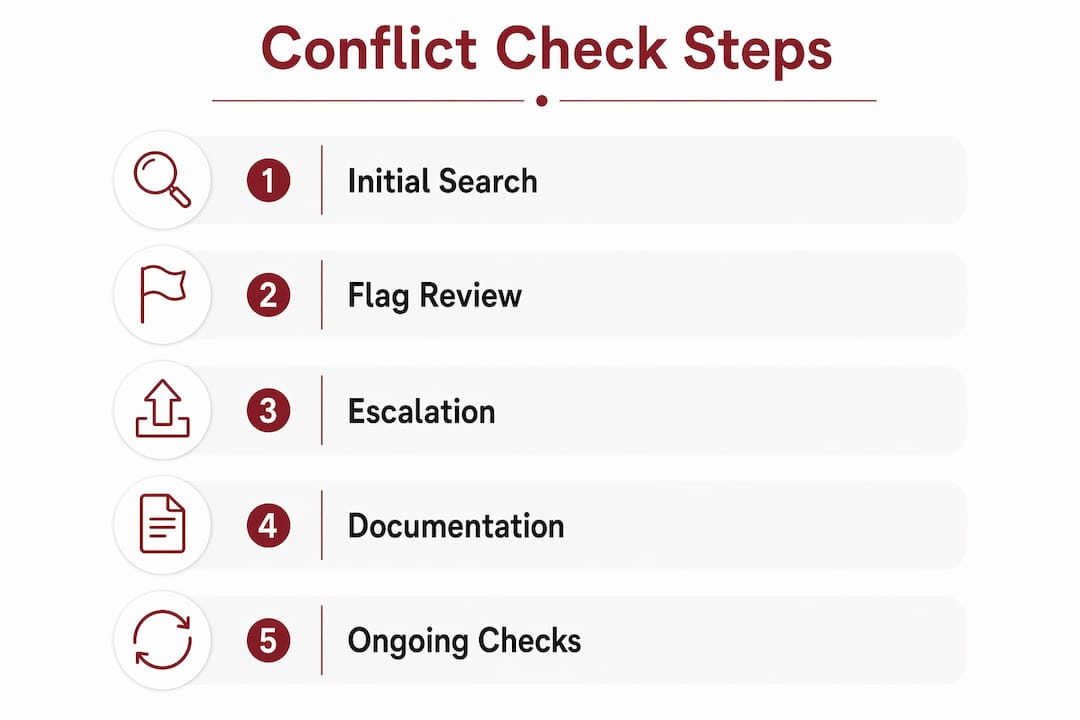
Once the search is complete, a flagged result does not automatically end the engagement. Escalation to a designated attorney or ethics committee is required before any final clearance decision is made. The person who runs the initial search should never be the same person who decides whether the conflict is waivable. That separation of roles is a governance standard, not a suggestion.

Pro Tip: Always run the conflict check under multiple name variations for each entity. A search for "BH Capital" will not surface "BH Capital Pte. Ltd." unless your system is configured to catch partial matches.
Why an immutable audit trail is non-negotiable
Maintaining a comprehensive and immutable audit trail of every conflict check protects a firm from malpractice claims and disciplinary investigations. The documentation must capture four specific data points to be defensible:
- Who conducted the search — the name and role of the person who ran the check
- When the search was run — the exact date and time, not just the matter opening date
- What search terms were used — every name variant, entity alias, and related party searched
- What results were returned — including cleared results, not just flagged ones
A cleared result is as important to document as a flagged one. If a regulator or opposing counsel later challenges whether a check was performed, a log showing zero hits on a specific date and search string is direct evidence of due diligence. A verbal assurance that "we checked" is not.
Technology plays a decisive role here. Automated conflict check systems create tamper-proof records as a byproduct of the search itself. Manual logs in spreadsheets or email threads can be edited, deleted, or simply lost. Firms that automate conflict checks in their workflow are significantly more successful at preventing disqualification and malpractice risks than those managing them manually. That gap in outcomes is not surprising. An automated system cannot forget to log a search. A busy associate can.
How ongoing checks protect you throughout representation
A legal conflict check is not a one-time event at matter opening. Conflict checks are a continuing obligation and must be repeated whenever significant circumstances change. The following events each trigger a mandatory re-run:
- A new party joins the litigation or transaction
- A cross-claim or counterclaim is filed that names a new adverse party
- A lateral hire joins the firm and brings prior client relationships
- The firm merges with or acquires another practice
- A client's corporate structure changes materially during the engagement
The consequences of missing a triggered re-check are severe. A firm that continues representing a client after a disqualifying conflict arises faces court-ordered disqualification, fee forfeiture, and potential disciplinary proceedings. In cross-border matters, the risk compounds because a new party added to a Singapore arbitration may be a subsidiary of an entity the firm advises in Hong Kong or Jakarta.
Conflict checks must be dynamically updated on lateral hires and mergers to detect newly created conflicts among the firm's active and historical matters. The practical solution is to build re-check triggers directly into the matter management workflow. When a new party is added to a file, the system should automatically prompt a conflict search before the update is saved.
Cross-border conflict checks: where complexity multiplies
Cross-border corporate matters in APAC present conflict detection challenges that domestic practice rarely encounters. A single transaction may involve entities registered in Singapore, the British Virgin Islands, Indonesia, and Japan, each with names rendered differently across jurisdictions and languages.
The limits of manual methods
Manual conflict checking using spreadsheets is a documented malpractice risk. Standard spreadsheet search functions perform exact or near-exact string matching. They will not connect "Acme Corp" with "Acme Corporation" or "PT Acme Indonesia" with its Singapore parent. In APAC transactions, where entity names routinely appear in English, Mandarin, Bahasa Indonesia, and Japanese within the same deal, that limitation is not a minor inconvenience. It is a structural failure.
The same problem applies to regulatory compliance workflows that rely on manual document review. When entity names must be verified across multiple languages and jurisdictions, a systematic translation and verification process is as important as the conflict search itself.
What effective cross-border checks require
Effective law firm conflict checks in complex APAC matters require three capabilities that manual methods cannot reliably deliver:
- Multilingual entity name matching that catches romanized, localized, and abbreviated versions of the same legal name
- Relationship mapping that traces ownership chains across jurisdictions, not just direct counterparties
- Integration with global expertise so that lawyers familiar with regional corporate structures can interpret ambiguous results
Beyondhorizons handles cross-border matters for clients with operations across APAC, including US-listed companies and regional banks. That client base means the firm's conflict check process must account for corporate structures that span multiple regulatory regimes simultaneously.
Pro Tip: When onboarding a new client for a cross-border transaction, request a full corporate structure chart at the outset. Checking the chart against your matter database is faster and more reliable than reconstructing the ownership chain from public filings after the engagement starts.
Key Takeaways
A thorough conflict check, run before engagement and updated throughout representation, is the single most effective safeguard against disqualification and malpractice in cross-border legal matters.
| Point | Details |
|---|---|
| Check before first contact | Run the conflict search before any substantive advice, not after the client relationship begins. |
| Search the full corporate tree | Include parent companies, subsidiaries, joint ventures, and related individuals, not just the primary client name. |
| Document every search | Log who searched, when, what terms were used, and what results appeared, including cleared results. |
| Re-check at every trigger | Lateral hires, new parties, and firm mergers each require a fresh conflict search on all active matters. |
| Automate where possible | Automated systems create tamper-proof audit trails and catch naming variations that manual methods miss. |
Why I think most firms underestimate the conflict check
The most common failure I see is not malice. It is complacency. A senior partner assumes they would remember if a new client were adverse to an existing one. A junior associate runs the check but only searches the client's primary trading name. The matter opens, work begins, and six months later a disqualification motion lands.
Conflict checks feel administrative until they fail. Then they feel catastrophic. The firms that treat the process as a genuine risk management function, rather than a box to tick before billing starts, are the ones that avoid the worst outcomes. That means investing in systems that catch naming variants, building re-check triggers into workflow software, and training everyone who touches a new matter on why the process exists.
Clients in APAC often misunderstand what a conflict means. Conflicts of interest are mandatory safeguards, not accusations of wrongdoing. When a firm declines a matter or asks a client to waive a conflict, it is acting with integrity, not incompetence. Explaining that clearly at the outset builds trust rather than confusion.
The future of conflict checking in this region will involve AI-assisted entity resolution that maps corporate relationships across jurisdictions in real time. Firms that build that capability now will have a structural advantage as APAC deal volumes grow and regulatory scrutiny of legal ethics increases. The technology exists. The question is whether firms will treat conflict management as infrastructure or as an afterthought.
— HL
How Beyondhorizons approaches conflict checks for APAC clients
Beyondhorizons brings Magic Circle and US white shoe firm experience to every engagement, and that background shapes how the firm handles conflict management from day one.

The firm's cross-border corporate counsel practice covers transactions across Singapore, Southeast Asia, and beyond, where complex ownership structures make thorough conflict checks a prerequisite, not an option. Beyondhorizons uses AI-enabled legal tools to support entity resolution and audit trail documentation, reducing the risk of missed connections in multilingual, multi-jurisdictional matters. For businesses entering APAC markets or managing cross-border employment relationships, the firm's cross-border employment counsel team applies the same disciplined conflict management process to every new instruction.
FAQ
What is a conflict check in legal practice?
A conflict check is the process a law firm uses to identify any existing relationships or interests that could create a conflict of interest before accepting a new client or matter. It covers the prospective client, opposing parties, related entities, and all current and former firm clients.
When must a lawyer run a conflict check?
A lawyer must run the check before providing any substantive legal advice or receiving confidential information. Starting after the first consultation creates disqualification risk if a conflict is discovered.
What happens when a conflict is flagged?
A flagged conflict must be escalated to a senior attorney or ethics committee for a final decision. The person who ran the initial search should not make the clearance call independently.
Why are spreadsheets inadequate for conflict checks?
Spreadsheets fail to detect naming variations and complex corporate relationships, making them a malpractice risk. A search for one entity name will not surface related entities or alternate spellings without manual cross-referencing.
Do conflict checks need to be repeated during a matter?
Yes. Conflict checks are a continuing obligation and must be re-run whenever new parties join a matter, a lateral hire joins the firm, or the firm undergoes a merger or structural change.