
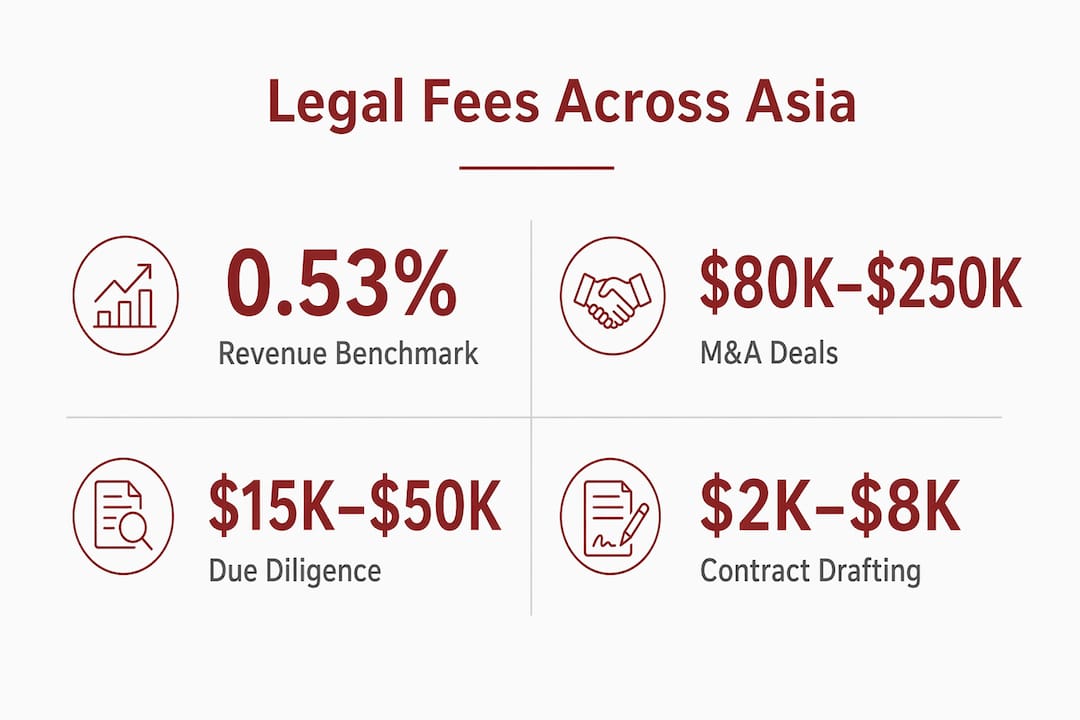
Corporate legal fees across Asia typically run $150–$600 per hour at international firms, with fixed-fee packages for common transactional work ranging from $2,000 to $50,000+ depending on jurisdiction, matter complexity, and firm tier. The most defensible CFO-facing anchor is legal spend as a percentage of revenue, where the global median sits at approximately 0.53% of revenue. For most corporate buyers in Asia, the single most effective step is to benchmark by matter type, then negotiate stage-based caps or fixed fees for any work that is document-driven and repeatable.
The global median legal spend is approximately 0.53% of revenue. APAC departments often operate under tighter proportional budgets than their global peers, making matter-level benchmarking and panel consolidation the two highest-return procurement moves available.
Country-level ranges vary significantly. Singapore and Hong Kong carry premium pricing comparable to London or New York for top-tier work; India and Southeast Asian markets offer substantially lower rates for the same seniority. The sections below translate that headline into jurisdiction-specific ranges, matter-level budgets, pricing model trade-offs, and a step-by-step procurement playbook.
Pro Tip: When presenting legal spend to a CFO, always pair the raw dollar figure with the percentage-of-revenue metric and a matter-type breakdown. A flat number without context invites cuts; a benchmarked number with peer comparisons invites a conversation.
Table of Contents
- How the APAC legal market is shifting pricing in 2026
- Pricing models you will encounter across Asia and when each fits
- What corporate legal fees look like across major Asian jurisdictions
- Concrete fee ranges for common corporate matters across Asia
- How prices vary and the contract clauses that actually control spend
- Practical procurement playbook: how to build and defend your APAC legal budget
- How the ranges in this guide were derived
- How Beyondhorizons applies these benchmarks in practice
- Key Takeaways
- The case for pricing discipline in cross-border legal work
- Beyondhorizons helps you control APAC legal spend from day one
- Sources and further reading
How the APAC legal market is shifting pricing in 2026
The APAC legal services market is growing, and so is the scrutiny on what it costs. CFOs and general counsel across the region are under pressure to justify every dollar of outside counsel spend, and the market is responding with structural changes that affect how firms price and how buyers should procure.
The most significant structural development is market bifurcation: global elite firms and well-positioned local champions are capturing premium mandates, while mid-tier firms face mounting pressure from AI economics and clients demanding fixed-fee pricing for commodity work. This bifurcation is not just about prestige. It directly affects where predictable pricing is available and where it is not.
Several trends are reshaping the cost of corporate legal services in Asia right now:
- Shift away from pure hourly billing. Fixed-fee, capped-phase, and outcome-based pricing are becoming standard requests in outside counsel guidelines (OCGs), particularly for document-heavy transactional work.
- Panel consolidation. Benchmarking data shows that the median panel firm count dropped from 14 to 10 in a single year among APAC legal departments that actively managed spend. Fewer firms means better volume leverage and lower relationship-management overhead.
- AI adoption and transparency. Clients now expect outside counsel to demonstrate AI tool fluency and pass efficiency savings through to fee estimates. Firms that resist this expectation are losing panel positions.
- CFO-driven budget scrutiny. Legal departments in APAC often run leaner than global medians. That gap creates pressure to produce benchmarked, defensible numbers rather than narrative justifications.
For a general counsel preparing to defend next year's legal budget, the data points that matter most are: legal spend as a percentage of revenue (benchmarked against industry peers), cost-per-matter by category, and panel firm count relative to spend concentration. These three metrics answer the questions a CFO is most likely to ask.
Pricing models you will encounter across Asia and when each fits
The pricing model you agree to shapes your cost exposure as much as the hourly rate itself. Across Asia, corporate legal work is priced under five main structures, and the right choice depends on matter type, risk profile, and how much billing volatility you can absorb.

| Pricing Model | Best For | Buyer Benefit | Key Risk | Negotiation Lever |
|---|---|---|---|---|
| Hourly billing | Complex disputes, novel regulatory work | Pays only for time used | Unpredictable total cost | Staffing caps, monthly budget alerts |
| Fixed fee | Document drafting, standard contracts, incorporations | Full cost certainty upfront | Scope creep voids the fix | Tight scope definition in the engagement letter |
| Capped-phase pricing | M&A due diligence, multi-stage transactions | Certainty per phase, flexibility overall | Caps can be set too high | Negotiate each phase cap separately before work starts |
| Retainer | Ongoing advisory, employment, compliance monitoring | Predictable monthly spend | Unused hours rarely roll over | Rollover clause, defined scope of included work |
| Blended / outcome-based | Litigation, regulatory approvals, high-stakes negotiations | Aligns firm incentives with outcome | Complexity in defining "success" | Define milestones and payment triggers precisely |
Hourly billing remains the default for complex disputes and genuinely novel regulatory work where scope cannot be defined in advance. The buyer's protection here is a staffing commitment (named partners and associates, with substitution rights) and a monthly budget-alert clause that requires written notice before spend exceeds an agreed threshold.
Fixed fees work best for document-driven, repeatable work: standard commercial contracts, employment agreements, company incorporations, and routine compliance filings. Singapore firms commonly put fixed-fee quotes in writing before chargeable work begins, and capped-phase pricing for contested stages is standard practice in well-run engagements.
Retainers suit companies with steady, predictable advisory needs. The critical clause is scope definition: a retainer without a defined list of included services is effectively an open-ended hourly arrangement with a monthly cap that the firm will quickly argue does not cover the work requested.
Blended and outcome-based models are gaining traction for litigation and regulatory approvals, where the firm shares upside or downside based on result. These require precise milestone definitions in the engagement letter; vague success criteria create disputes about whether the trigger was met.
Pro Tip: For any matter expected to run longer than 60 days, request stage-based caps in writing before work begins. Include a clause requiring written sign-off from your authorized representative before fees can exceed the agreed cap for any stage. This single clause eliminates the most common source of billing surprises in APAC engagements.
What corporate legal fees look like across major Asian jurisdictions
Rates across Asia span a wider range than almost any other professional services category. The figures below reflect typical USD-converted ranges for international and top-tier local firms, adjusted for matter type. All conversions use approximate mid-2025 exchange rates; local currency fluctuations can shift USD equivalents by 5–15% in either direction.
| Jurisdiction | Typical Hourly Rate (USD) | Common Fixed-Fee Anchors | Key Cost Driver |
|---|---|---|---|
| Singapore | $150–$600 | $3,000–$15,000 for standard contracts; $20,000–$80,000 for mid-market M&A | Regulatory complexity; international firm density |
| Hong Kong | $150–$600 | mid-six-figure to low-seven-figure USD range | IPO demand; international/PRC firm fee gap |
| Japan | $150–$600 | $80,000–$250,000 for mid-market transactions | Language requirements; specialist regulatory work |
| China (PRC) | $150–$600 | $5,000–$30,000 for standard corporate work | Tier-1 city premium; foreign firm restrictions |
| India | $150–$600 | $3,000–$20,000 for transactional work | Large lawyer supply; scale discounts available |
| Indonesia | $150–$600 | Variable; retainers scale with firm profile and scope | Jurisdictional complexity; firm reputation premium |
| Thailand | $150–$600 | $2,000–$15,000 for standard corporate matters | Foreign business restrictions; BOI advisory |
| Vietnam | $150–$600 | $2,000–$50,000+ depending on jurisdiction and matter | Regulatory change pace; translation requirements |
| Malaysia | $150–$600 | $3,000–$15,000 for corporate transactions | Dual legal system; Bumiputera compliance |
| Philippines | $150–$600 | $2,000–$10,000 for standard corporate matters | Foreign ownership rules; local counsel requirements |
Notes on specific markets:
- Singapore commands premium rates partly because it serves as the regional hub for cross-border structuring, arbitration, and regulatory work. Fixed-fee packages for startups and SMEs are widely available, with published packages starting around S$3,600 for foundational corporate documents.
- Hong Kong saw legal fees rise materially during the IPO boom, with mid-market fee increases of around 20% and large-cap IPO mandates reaching the mid-six-figure to low-seven-figure USD range. International firms charge substantially more than local PRC firms on headline deals.
- India offers the most significant scale discounts in the region. Large domestic firms handle high-volume transactional work at rates well below Singapore or Hong Kong equivalents, making India a natural choice for document-intensive due diligence phases.
- Indonesia shows wide variability. Jakarta corporate legal costs range from modest amounts for simple consultations to high multiples for large corporate transactions, with firm reputation and urgency both affecting the final number significantly.
- Southeast Asia broadly benefits from lower labor costs but adds complexity through translation requirements, local counsel mandates, and regulatory change pace that can extend timelines and increase total project cost.
Concrete fee ranges for common corporate matters across Asia
Jurisdictional hourly rates are a starting point. What most GCs and CFOs actually need are matter-level budgets: how much does a specific piece of work cost, start to finish?
M&A transactions (buy-side or sell-side): Mid-market deals in the $20M–$100M range typically run $80,000–$250,000 in total legal fees for a single-jurisdiction transaction, with multi-jurisdictional work adding $20,000–$60,000 per additional jurisdiction for local counsel coordination. Timeline: 8–16 weeks for a clean deal; longer if regulatory approvals are required.
Due diligence (standalone): A focused legal due diligence review for a mid-market acquisition typically costs $15,000–$50,000, depending on the number of jurisdictions, document volume, and whether translation is required. India-based LPO providers can handle document review at 40–60% below onshore rates, though internal management time must be factored in.

Commercial contract drafting and review: Standard commercial agreements (supply, distribution, licensing) run $2,000–$8,000 for drafting from scratch at a mid-tier firm; $500–$2,000 for review and markup. Complex technology or IP-heavy agreements can reach $10,000–$25,000.
Employment advisory: Standalone employment advice (policy drafting, termination guidance, cross-border secondment structuring) typically runs $1,500–$6,000 per matter. Multi-jurisdictional employment programs cost more; Singapore cross-border employment work often requires coordination across two or three APAC jurisdictions simultaneously.
Regulatory filings and approvals: Routine filings run $1,000–$5,000. Complex regulatory approvals (financial services licensing, foreign investment approvals, data protection registrations) can reach $20,000–$80,000 depending on jurisdiction and agency responsiveness.
Initial-stage litigation and dispute resolution: Pre-litigation advisory and demand letters: $3,000–$10,000. Commencing arbitration proceedings in Singapore (SIAC) or Hong Kong (HKIAC): $30,000–$100,000+ for the initial phase, before hearing fees. Litigation in PRC courts or Indonesian courts adds local counsel costs and translation fees that can equal 20–30% of the base legal fee.
Scope changes are the single largest driver of budget overruns in APAC corporate matters. A transaction that starts as a single-jurisdiction deal and expands to three jurisdictions mid-stream can double in total legal cost. Locking scope in writing at engagement and requiring written change orders for any expansion is the most reliable cost-control mechanism available to in-house teams.
How prices vary and the contract clauses that actually control spend
Understanding the headline rate is only half the equation. The other half is knowing which factors move cost materially and which contract clauses give you real protection against billing volatility.
Primary cost drivers:
- Firm tier and staffing mix. A Magic Circle or US white-shoe firm charges 2–3x the rate of a capable local firm for the same matter type. The question is whether the premium buys something your deal genuinely needs (cross-border network, regulatory relationships, lender recognition).
- Partner vs. associate staffing. Partner-heavy staffing on document-intensive work is the most common source of avoidable cost. Request a staffing plan before engagement and specify the maximum partner-hour percentage for each phase.
- Matter complexity and urgency. Urgent timelines (sub-48-hour turnarounds) typically attract a 20–50% premium. Multi-jurisdictional coordination adds both time and cost at every layer.
- Geographic scope. Each additional jurisdiction adds local counsel fees, coordination time, and often translation costs. These are usually pass-through disbursements, not included in the headline fee.
- Disbursements, taxes, and filing fees. Court filing fees, notarization, apostille, translation, and government approval fees are almost always billed separately. Firm pricing pages typically require explicit client sign-off before disbursements exceed an agreed threshold.
Negotiation levers that move economics:
- Stage-based caps with written sign-off requirements before each phase begins
- Fixed-fee bundles for commodity work (standard contracts, routine filings, employment templates)
- Staffing commitments: named lawyers, substitution rights, and a reverse-staffing clause that limits partner hours on associate-appropriate work
- Pass-through disbursement rules: require itemized billing and pre-approval for any single disbursement above a defined threshold
- Success fees for litigation or regulatory approvals, structured as a percentage of recovery or a flat milestone payment
Pro Tip: Audit invoices by comparing the staffing plan agreed at engagement against the time entries on each invoice. Overstaffing (multiple partners attending the same call, associates duplicating research) and scope creep (work not covered by the engagement letter) are the two most common sources of invoice inflation. A 30-minute monthly review of time entries catches both early.
Practical procurement playbook: how to build and defend your APAC legal budget
Building a defensible legal budget for Asia is a sequential process. The steps below are in order of operations for a GC or CFO preparing for the next budget cycle.
Step 1: Anchor to revenue percentage. Start with the global median of approximately 0.53% of revenue as your baseline. Adjust upward for regulated industries (financial services, healthcare, energy) and downward for mature, low-litigation businesses. This gives you a defensible starting number for the CFO conversation before you break it into matter categories.
Step 2: Build matter-type buckets. Divide your forecast legal spend into categories: transactional (M&A, contracts), regulatory/compliance, employment, disputes, and general advisory. Assign a per-matter budget to each category based on the ranges in this guide, then multiply by your expected matter volume.
Step 3: Evaluate your panel. Panel consolidation is the highest-return procurement move for most APAC legal departments. Fewer firms means better volume leverage, lower relationship-management overhead, and cleaner data for benchmarking. The right panel size depends on your jurisdictional footprint, but most mid-market companies operating across 3–5 APAC markets can be well-served by 4–6 panel firms.
Step 4: Decide where ALSPs fit. The alternative legal services market reached roughly US$24 billion globally in 2024 and is forecast to reach US$50 billion by 2033. Offshore LPO labor rates run 40–60% below comparable onshore lawyer rates for document review and contract abstraction. Flexible talent providers typically price at 60–75% of equivalent panel-firm rates. The savings are real, but they require a named internal owner to manage scope and quality. For contract-focused resourcing and interim coverage, specialist providers offer a practical middle ground between full panel-firm engagement and in-housing.
Step 5: Issue a structured RFP. Use outside counsel guidelines that require firms to answer specific questions before panel appointment:
- What is your standard staffing model for this matter type, and who are the named lawyers?
- Do you offer fixed-fee or capped-phase pricing for the work described? If not, why not?
- How do you use AI tools in your workflow, and do efficiency savings pass through to clients?
- How do you handle disbursements: itemized pass-through or bundled into the fee?
- What is your process for flagging scope changes and requesting budget increases?
- Can you provide cost-per-matter data from comparable engagements in the past 12 months?
Red flags in proposals:
- Refusal to name the staffing team or commit to substitution rights
- Vague disbursement policies ("billed at cost" with no threshold or pre-approval requirement)
- Resistance to any form of capped or fixed-fee pricing for document-driven phases
- No AI tool disclosure or a claim that AI is used but no efficiency savings are passed through
For procurement templates and RFP guidance for outside counsel, Beyondhorizons publishes practical resources for in-house teams navigating panel selection across APAC jurisdictions.
How the ranges in this guide were derived
The fee ranges and benchmarks in this guide draw on several sources, applied with conservative assumptions to produce figures that hold up in a CFO conversation.
| Data Source | What It Contributes | Coverage |
|---|---|---|
| APAC in-house benchmarking surveys | Legal spend % of revenue; panel firm counts; cost-per-matter medians | Regional; 2024–2025 data |
| Jurisdiction-specific firm pricing pages | Fixed-fee anchors; capped-phase structures; disbursement policies | Singapore, Indonesia |
| Published market analysis (ALSP sector) | ALSP market size; labor-rate savings ranges; management overhead norms | Global; 2024 data |
| Hong Kong IPO fee reporting | Hourly rate increases; international vs. local firm fee gap | Hong Kong; 2025 data |
| Beyondhorizons cross-border engagement data | Matter-level ranges for M&A, regulatory, employment, and compliance work | APAC; current |
Currency conversion: All USD figures use approximate mid-2025 exchange rates. Local currency amounts (IDR, SGD, HKD, JPY, INR) have been converted at those rates; actual USD equivalents will vary with FX movements. Singapore dollar amounts from published pricing pages are stated in SGD and converted at approximately SGD 1 = USD 0.74.
Assumptions and exclusions: Disbursements (filing fees, translation, notarization, government approval fees) are excluded from all headline fee ranges and treated as pass-through costs. The highest-complexity litigation (international arbitration at full hearing, cross-border insolvency) is excluded from typical transactional ranges. Figures reflect mid-tier to top-tier firm pricing; sole practitioners and boutique local firms typically price 30–50% below these ranges.
Calibration note: These ranges are benchmarks, not quotes. A company in a highly regulated sector (financial services, healthcare, energy) should expect to sit at the upper end of each range. A company with a mature, low-litigation profile and well-drafted standard contracts can often negotiate toward the lower end, particularly for commodity work.
The most reliable way to calibrate these ranges to your specific situation is to run a structured RFP with three or four panel candidates and compare their fee proposals against the benchmarks here. The gap between the highest and lowest proposals for the same scope is itself a useful data point for the CFO conversation.
How Beyondhorizons applies these benchmarks in practice
Beyondhorizons structures cross-border engagements around the same benchmarks and procurement principles described in this guide. The firm's approach to cost predictability is built on three operating practices: stage-based fee design, AI-assisted delivery, and transparent disbursement handling.
In a representative cross-border transaction, the firm breaks the engagement into defined phases (structuring and advice, document drafting, regulatory coordination, closing), assigns a fixed or capped fee to each phase, and requires written client sign-off before moving to the next phase. This structure means the client always knows the maximum exposure for the current phase and has a clear decision point before committing to the next. AI-enabled workflows reduce the time required for document-intensive phases, and those efficiency gains are reflected in the phase fee rather than absorbed as firm margin.
The team's credentials support the pricing discipline. Lawyers at Beyondhorizons come from Magic Circle and US white-shoe firms and are ranked in Chambers, Legal 500, and Asia Legal Business. Clients include US-listed companies, Singapore government-linked entities, and regional banks. The firm's sector depth spans aerospace, blockchain and digital assets, robotics and automation, and advanced air mobility, all of which carry regulatory complexity that affects legal cost in ways generic benchmarks do not capture.
For multi-jurisdictional matters, the firm manages local counsel coordination centrally, which eliminates the duplication of effort (and billing) that occurs when a client manages multiple local firms independently. Disbursements are itemized separately and require client pre-approval above agreed thresholds, consistent with the best-practice clause structures described earlier in this guide.
Pro Tip: When evaluating any cross-border counsel, ask for a sample engagement letter that shows how phases are defined, how fees are capped per phase, and how disbursements are handled. A firm that cannot produce this quickly is unlikely to manage your budget predictably.
The firm's cross-border corporate transaction practice and its sector expertise pages provide further detail on how specific matter types are priced and staffed.
Key Takeaways
Corporate legal fees across Asia are benchmarkable and negotiable: the global median legal spend of approximately 0.53% of revenue, combined with matter-type fixed fees and stage-based caps, gives any GC or CFO a defensible framework for the next budget cycle.
| Point | Details |
|---|---|
| Revenue-percentage anchor | Use the global median of approximately 0.53% of revenue as your CFO-facing baseline, adjusted for industry and litigation profile. |
| Jurisdiction ranges vary widely | Singapore and Hong Kong carry premium rates ($350–$800+/hr); India and Southeast Asia offer 40–60% lower rates for comparable seniority. |
| Stage-based caps reduce surprises | Negotiate fixed or capped fees per phase in writing before work begins; require written sign-off before any phase cap is exceeded. |
| Panel consolidation pays off | Reducing panel firm count from 14 to 10 produced measurable savings in APAC benchmarking studies; fewer firms means better volume leverage. |
| Beyondhorizons as cross-border counsel | Beyondhorizons structures APAC engagements with stage-based fees, AI-assisted delivery, and itemized disbursements to improve cost predictability. |
The case for pricing discipline in cross-border legal work
There is a persistent assumption in corporate legal procurement that premium firms command premium prices because the work is inherently unpredictable. That assumption is used to justify hourly billing for work that is, in practice, highly repeatable: standard due diligence checklists, employment policy templates, routine regulatory filings. The unpredictability argument is real for genuinely novel regulatory questions or high-stakes disputes. For the majority of corporate legal work in Asia, it is a billing convention, not a structural necessity.
The shift toward fixed-fee and stage-based pricing is not just a buyer preference. It is a response to the reality that AI tools have made the time-cost of document-intensive work measurably lower, and clients are right to expect that efficiency to show up in their invoices. Firms that resist this expectation are not protecting quality; they are protecting a billing model that no longer reflects the actual cost of production.
The practical implication for GCs and CFOs is straightforward: insist on fixed or capped fees for any work that can be scoped in advance, reserve hourly billing for genuinely unpredictable matters, and audit invoices regularly. The benchmarks in this guide exist to make that conversation easier. The goal is not to pay less for good legal work. It is to pay a predictable, defensible amount for it.
Beyondhorizons helps you control APAC legal spend from day one
Cross-border legal work in Asia does not have to mean open-ended hourly billing and end-of-month invoice surprises. Beyondhorizons offers corporate clients a genuinely different model: stage-based fees agreed in writing before each phase begins, AI-powered workflows that reduce document-intensive costs, and a single cross-border team that manages local counsel coordination, so you are not paying three firms to talk to each other.

The firm's lawyers come from Magic Circle and US white-shoe backgrounds and are ranked in Chambers, Legal 500, and Asia Legal Business. Clients include US-listed companies, Singapore government-linked entities, and regional banks operating across APAC's most complex jurisdictions. Whether you need cross-border M&A counsel, regulatory advisory, or a fractional general counsel arrangement for ongoing APAC work, the engagement model is built around cost predictability from the first conversation.
To discuss how Beyondhorizons can structure your next APAC engagement with transparent, stage-based pricing, contact the team directly at beyondhorizons.sg/expertise/corporate-transactions.
Sources and further reading
The benchmarks and ranges in this guide draw on the following primary sources. When presenting these figures to finance, cite the source and note the data period; CFOs respond better to attributed benchmarks than to unattributed ranges.
- Benchmarking legal spend in APAC: what good looks like in 2026 — Primary source for the 0.53% revenue median, panel consolidation data (14 to 10 firms), and APAC budget-constraint context. Quote the revenue percentage and panel-count reduction directly in CFO presentations.
- Law firm bifurcation in APAC: who wins, who loses, who quietly exits — Market-structure analysis explaining the pricing pressure on mid-tier firms and the shift toward fixed-fee commodity pricing. Useful context for panel strategy decisions.
- When to Use ALSPs: 2026 APAC GC Cost & Quality Guide — Detailed framework for ALSP deployment, including the US$24 billion market size figure, 40–60% labor-rate savings range, and management overhead considerations.
- Legal fees rise amid lawyer shortage in Hong Kong IPO boom — Source for the approximately 20% fee increase in Hong Kong IPO work and the international/local firm fee gap on large-cap deals.
- Legal Fees & Pricing in Singapore | A.W. Law LLC — Practical reference for Singapore fixed-fee structures, capped-phase pricing, and disbursement handling conventions.
- How Much Does a Corporate Lawyer Cost in Jakarta — Jurisdiction-specific guide to Indonesia corporate legal costs, illustrating the variability in Southeast Asian markets.
- Fixed-Fee Corporate Legal Packages for Singapore Startups & SMEs | Legally First — Published fixed-fee pricing for Singapore corporate packages, providing a concrete anchor for the lower end of the Singapore range.
- Corporate law firms alternatives: what GCs need to know — Beyondhorizons resource covering procurement alternatives and RFP guidance for in-house teams evaluating panel options.
How to use these sources in a CFO conversation: Lead with the revenue-percentage benchmark from the APAC benchmarking survey, then support it with the panel-consolidation data point. Use the ALSP market data to justify any alternative resourcing proposals. For jurisdiction-specific figures, cite the local guide and note the data period. Beyondhorizons can provide tailored benchmarking for your specific industry, company size, and jurisdictional footprint on request.