
An attorney in Singapore is a qualified advocate and solicitor admitted to the Singapore Bar, authorized to provide legal advice and represent clients in court across commercial, regulatory, and cross-border matters. Singapore operates a fused legal profession, meaning every admitted lawyer can act as both solicitor and advocate. This single-role model is rare globally and gives clients a distinct advantage: one qualified professional handles both advisory work and courtroom representation. For businesses and individuals navigating complex legal challenges, understanding how Singapore attorneys operate is the first step toward securing the right counsel.
What qualifications and regulatory standards govern attorneys in Singapore?
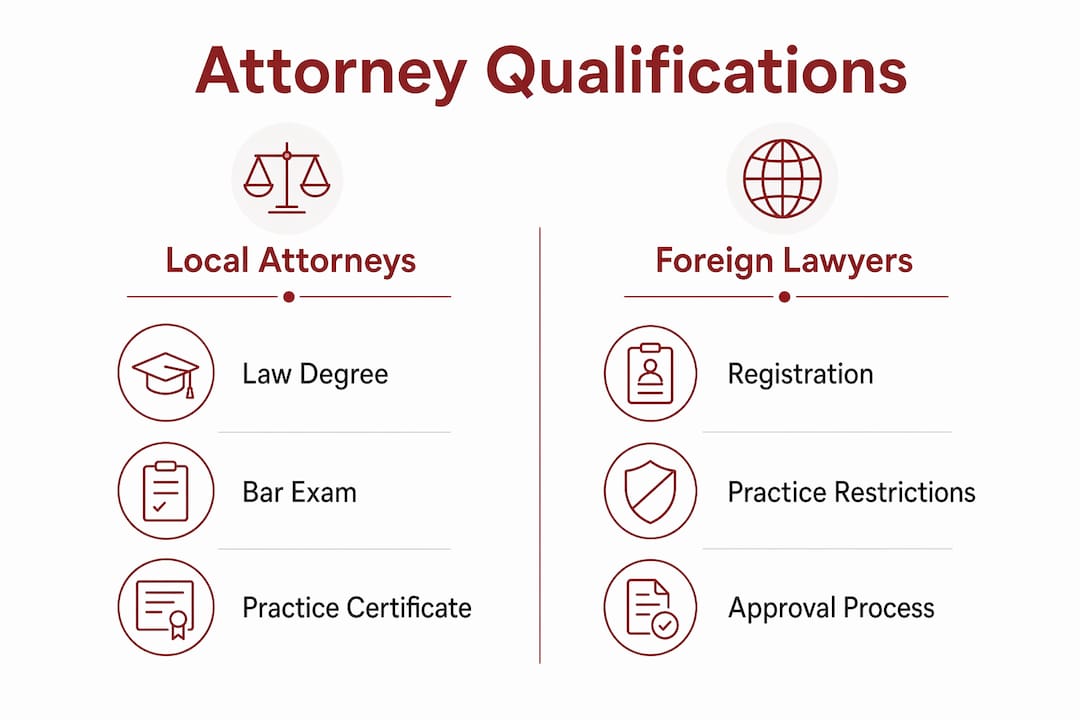
Becoming a practicing attorney in Singapore requires completing an approved law degree, followed by the Singapore Bar Examinations and a period of practical legal training. Candidates must then be admitted to the Singapore Bar by the Supreme Court of Singapore before they can legally represent clients or provide formal legal advice.

Once admitted, attorneys must hold a valid practicing certificate renewed annually. The Law Society of Singapore oversees professional conduct, offering practice resources and ongoing training to maintain legal standards across all career stages. The Supreme Court provides additional oversight, particularly in matters of discipline and fitness to practice.
Attorneys must comply with the Legal Profession Act, which sets binding ethical and professional conduct standards. Breaches can result in suspension or disbarment. This framework protects clients and maintains Singapore's reputation as a trusted legal hub in Asia.
Key requirements for practicing attorneys in Singapore include:
- A recognized law degree from an approved institution
- Completion of the Part B Bar Examinations administered by the Singapore Institute of Legal Education
- Practical Legal Training through an accredited provider
- Annual renewal of a practicing certificate issued by the Supreme Court
- Ongoing compliance with the Law Society's professional conduct rules
Pro Tip: When verifying an attorney's credentials, check the Law Society of Singapore's public register of practicing certificate holders before engaging any legal professional.
Foreign lawyers can register under the Legal Services Regulatory Authority to practice in Singapore, but they face specific restrictions on the areas of law they may advise on. This provision supports international legal cooperation while protecting local regulatory standards.
How do specialized attorneys support businesses in commercial and cross-border matters?
Specialized attorneys are the backbone of Singapore's commercial legal market. A general practitioner may handle routine matters, but businesses facing regulatory scrutiny, cross-border transactions, or complex disputes need attorneys with deep sector knowledge.
Commercial law attorneys focus on contract drafting and negotiation, corporate governance, shareholder disputes, and commercial dispute resolution. They help businesses structure agreements that hold up under scrutiny and resolve conflicts before they escalate to costly litigation. Attorneys skilled in international arbitration are particularly valuable in Singapore, which is one of Asia's premier arbitration seats.
Regulatory compliance counsel covers sectors including financial services, AI governance, healthcare, and transportation. These attorneys track regulatory changes and advise clients on how to adapt operations without disrupting business continuity. Singapore's regulators move quickly, and businesses that engage legal counsel proactively avoid costly penalties.
Cross-border corporate counsel plays a critical role in helping Singapore-based companies navigate complex foreign investment approvals, tax structuring, and supply chain regulations. This expertise is vital for companies operating in integrated economic zones like the Johor Special Economic Zone, where multi-jurisdictional rules intersect.
The sectors where specialized legal counsel adds the most value include:
- Financial services: MAS licensing, capital markets regulation, and fund structuring
- AI and technology: AI governance frameworks, data privacy, and platform liability
- Transportation and logistics: cross-border logistics counsel covering infrastructure, freight, and regulatory approvals
- Healthcare and wellness: MedTech compliance, clinical trial agreements, and digital health regulation
- Blockchain and digital assets: Token offerings, DeFi regulation, and crypto exchange licensing
Cross-border corporate counsel is especially critical for companies expanding into ASEAN markets. Tax structuring, foreign ownership restrictions, and bilateral treaty interpretation require attorneys who understand both Singapore law and the target jurisdiction's regulatory environment.
What defines Singapore's elite attorneys and legal market in 2026?
Singapore's legal market in 2026 features a recognized elite tier known as the Singapore A-List, comprising the top 100 lawyers and 25 Legal Icons excelling in commercial dispute resolution and corporate advisory. This recognition sets the benchmark for quality and marks attorneys who consistently deliver at the highest level.
Elite attorneys are distinguished not just by technical skill but by active engagement in the legal ecosystem. Leading practitioners speak at industry summits, advise on risk management in major infrastructure projects, and contribute to policy discussions. That level of engagement signals genuine market leadership, not just professional competence.
| Benchmark | What it signals |
|---|---|
| Chambers and Partners ranking | Peer-reviewed recognition of technical excellence and client service |
| Legal 500 listing | Editorial assessment of consistent high performance across practice areas |
| Asia Legal Business recognition | Regional standing and cross-border transaction experience |
| Singapore A-List inclusion | Top-tier status among the country's 100 best commercial lawyers |
| Legal Icons designation | Exceptional career achievement and sustained market influence |
Emerging practice areas are reshaping what clients expect from top attorneys. Infrastructure law, technology regulation, and advanced air mobility are growing rapidly. Attorneys who build expertise in these sectors early position themselves as indispensable advisors as the regulatory frameworks mature.
Pro Tip: When assessing an attorney's market standing, check their Chambers, Legal 500, or Asia Legal Business profile. Rankings reflect client feedback and peer reviews, not just self-promotion.
Singapore's fused profession model creates a uniquely efficient environment for commercial legal services. Clients benefit from attorneys who can advise on a deal structure and then represent them in arbitration if the deal goes wrong, without switching counsel.
How to select the right attorney in Singapore for your legal needs
Choosing the right attorney is one of the most consequential decisions a business or individual can make. The wrong choice costs time, money, and sometimes the outcome of a case or transaction.
Follow these steps to select an attorney suited to your specific legal challenge:
-
Define your legal need precisely. Commercial contract disputes, regulatory licensing, and cross-border M&A each require different expertise. Attorneys who specialize in commercial contracts may not have the depth needed for a complex regulatory investigation.
-
Check rankings and peer recognition. Chambers, Legal 500, and Asia Legal Business rankings reflect verified client feedback. An attorney listed in multiple directories across consecutive years demonstrates sustained performance, not a one-time result.
-
Assess sector-specific experience. Ask for examples of similar matters the attorney has handled. A lawyer who has advised on fintech licensing in Singapore and Malaysia brings practical knowledge that a generalist cannot replicate.
-
Evaluate engagement models. Singapore law firms range from large full-service practices to boutique firms focused on specific sectors. Boutique practices often offer deeper specialization and more direct partner access. Consider whether you need broad coverage or focused expertise.
-
Understand fee structures upfront. Hourly rates, fixed fees, and retainer arrangements each suit different client needs. Agree on billing terms before engagement to avoid disputes later.
-
Assess communication style and responsiveness. Complex legal matters require attorneys who explain issues clearly and respond promptly. A technically brilliant attorney who communicates poorly creates its own risks.
-
Consider cross-border capability. If your matter involves multiple jurisdictions, confirm the attorney has experience in those markets. Beyondhorizons, for example, draws on lawyers from Magic Circle and US white shoe firms with deep APAC experience, making them well-suited for regional mandates.
Pro Tip: Request a preliminary consultation before committing to an engagement. Use that meeting to assess whether the attorney understands your business context, not just the legal issue.
One often-overlooked factor is the attorney's familiarity with your industry's regulatory environment. An attorney who has advised employment matters across borders, for instance, understands the interplay between Singapore's Employment Act and foreign labor laws in ways that a purely domestic practitioner does not. That contextual knowledge reduces risk and speeds up advice.
Dispute resolution preferences also matter. If your contracts include arbitration clauses, confirm your attorney has experience before the Singapore International Arbitration Centre or the relevant tribunal. Attorneys who understand alternative dispute resolution processes can often resolve disputes faster and at lower cost than those who default to litigation.
Key Takeaways
Selecting the right attorney in Singapore requires matching verified specialization, sector experience, and cross-border capability to your specific legal challenge.
| Point | Details |
|---|---|
| Fused profession advantage | Singapore attorneys act as both solicitor and advocate, giving clients single-counsel efficiency. |
| Regulatory oversight | The Law Society of Singapore and the Supreme Court enforce strict conduct standards under the Legal Profession Act. |
| Specialization matters | Commercial, regulatory, and cross-border matters each require attorneys with verified sector-specific expertise. |
| Elite benchmarks | Rankings from Chambers, Legal 500, and the Singapore A-List identify attorneys with sustained, peer-verified performance. |
| Selection process | Define your legal need, check rankings, assess sector experience, and confirm cross-border capability before engaging. |
Why I think most clients engage attorneys too late
From years of working in and around Singapore's commercial legal market, the pattern I see most often is this: clients engage attorneys after a problem has already crystallized. A contract dispute has escalated. A regulatory inquiry has arrived. A cross-border deal has stalled because the structure was never properly reviewed. Early legal engagement almost always produces better outcomes and lower total costs.
The other observation I'd share is that specialization has become non-negotiable. Singapore's legal market has matured to the point where a generalist attorney handling a fintech licensing matter or an aerospace transaction is a genuine liability. The regulatory frameworks are too specific, and the commercial stakes are too high. Clients who insist on sector-specific counsel consistently get faster, more accurate advice.
The shift toward digital-first legal delivery is also real and accelerating. Attorneys who use AI-assisted research and document review are not cutting corners. They are delivering faster, more thorough work. Clients should ask prospective attorneys how they use technology in their practice. The answer reveals a great deal about their commitment to quality and efficiency.
— HL
Beyondhorizons: expert counsel for complex legal challenges
Beyondhorizons is a Singapore-licensed law firm built for clients who need high-caliber legal advice on commercial transactions, regulatory compliance, and cross-border expansion. Its attorneys come from Magic Circle and US white shoe firms and are ranked on Chambers, Legal 500, and Asia Legal Business.

The firm's cross-border corporate counsel covers foreign investment structuring, tax optimization, and multi-jurisdictional regulatory approvals across APAC. Clients include US-listed companies, Singapore government-linked entities, regional banks, and listed companies across sectors including aerospace, blockchain, robotics, and advanced air mobility. Beyondhorizons operates with a digital-first approach, combining legal depth with technology-enabled delivery. For businesses that need attorneys who understand both the law and the commercial context, Beyondhorizons offers the expertise to match.
FAQ
What is an attorney in Singapore?
An attorney in Singapore is a qualified advocate and solicitor admitted to the Singapore Bar, authorized to provide legal advice and represent clients in court. Singapore's fused profession model means one attorney handles both advisory and litigation functions.
How is a Singapore attorney different from a lawyer in other countries?
Singapore's fused legal profession combines the roles of solicitor and barrister into one. In jurisdictions like the United Kingdom, these functions are traditionally separate, requiring clients to engage two different professionals for advice and courtroom representation.
Can foreign lawyers practice as attorneys in Singapore?
Foreign lawyers can register under the Legal Services Regulatory Authority but face restrictions on the areas of Singapore law they may advise on. They are generally permitted to advise on foreign law and certain international commercial matters.
How do I verify that an attorney in Singapore is qualified to practice?
Check the Law Society of Singapore's public register of practicing certificate holders. A valid, current practicing certificate confirms the attorney is authorized to provide legal services in Singapore.
What sectors require the most specialized legal counsel in Singapore?
Sectors including financial services regulation, AI governance, transportation, healthcare, and blockchain require attorneys with deep sector knowledge. These areas involve rapidly evolving regulatory frameworks that generalist practitioners are unlikely to track with sufficient depth.