
What are the main alternatives to traditional corporate law firms?
The leading alternatives to traditional corporate law firms fall into five distinct categories: alternative legal service providers (ALSPs), legal process outsourcing and offshoring firms, temporary and contract staffing solutions, multi-disciplinary partnerships (MDPs), and technology-enabled or AI-native legal firms. Each model addresses a specific gap that conventional Big Law has consistently failed to close, whether that's cost predictability, speed, or specialized expertise in emerging fields.
ALSPs are the industry's standard term for organizations that deliver legal services outside the traditional law firm structure. They range from document review shops to fully integrated legal-technology platforms that combine senior attorney judgment with AI-driven workflows. The distinction matters because not all ALSPs are created equal, and the right choice depends heavily on the complexity and jurisdiction of your legal work.
Here is a quick map of the main categories:
- Legal process outsourcing (LPO) and offshoring firms: Handle high-volume, process-driven work such as contract review, due diligence, and e-discovery at significantly lower cost than domestic Big Law rates.
- Temporary and contract staffing providers: Supply contract attorneys and secondees to in-house teams facing workload spikes, without the overhead of permanent hires.
- Multi-disciplinary partnerships (MDPs): Blend legal counsel with consulting, finance, and technology advisory under one engagement, giving clients a single point of accountability for complex transactions.
- AI-native and technology-enabled law firms: Automate the drafting and review layer of legal work, reserving senior attorney time for strategic judgment. AI-first firms can handle up to 80% of routine drafting through automation, cutting turnaround on complex deals from weeks to hours.
- Specialist boutique and cross-border firms: Focus on narrow practice areas or specific jurisdictions, delivering depth that generalist firms rarely match. Beyondhorizons, for example, combines AI-enabled workflows with elite cross-border expertise across aerospace, blockchain, robotics, and emerging APAC markets and offers fixed-cost corporate legal solutions with same-day turnaround on many matters.
Cost-efficiency and specialized expertise are the two primary drivers pushing corporate legal departments toward these models. But the more durable shift is structural: general counsel are no longer treating these options as stopgaps. They are building deliberate legal service portfolios that mix providers by task type, risk level, and geography.
Table of Contents
- How corporate legal service models have evolved over time
- How outsourcing, offshoring, and temporary staffing work in practice
- How multi-disciplinary partnerships deliver integrated legal solutions
- Modern technology-enabled frameworks are changing what legal service delivery looks like
- How to evaluate alternative legal service providers effectively
- Pros and cons of traditional law firms versus alternative providers
- Regulatory and compliance considerations when using alternative providers
- Beyondhorizons offers a different path for cross-border corporate legal work
- Key Takeaways
How corporate legal service models have evolved over time
The traditional corporate law firm model traces its roots to the Cravath system, developed at Cravath, Swaine & Moore in the early twentieth century. That model standardized associate training, lockstep compensation, and hourly billing across the profession. For decades, it worked well enough. Large companies retained a handful of trusted firms, paid premium rates, and accepted that legal costs were largely opaque and unpredictable.
The cracks appeared in the 1990s, when corporate legal departments began growing in size and sophistication. General counsel started questioning whether every task genuinely required a $600-per-hour partner. The answer, increasingly, was no.
| Era | Development | Impact on Corporate Legal |
|---|---|---|
| Pre-1990s | Cravath system dominates; hourly billing universal | High costs, limited transparency, few alternatives |
| 1990s | Offshore LPO emerges; India-based document review centers launch | First cost arbitrage for high-volume tasks |
| — | Contract staffing and secondment agencies formalize | In-house teams gain flexible capacity without headcount |
| 2008 | Post-financial crisis cost pressure accelerates ALSP adoption | GCs mandate outside counsel guidelines and fee caps |
| — | MDPs and integrated legal-tech platforms emerge | Legal advice bundled with consulting and technology |
| 2022–2025 | AI-native firms launch; large language models enter legal workflows | Drafting and review automated; fixed-fee models become viable at scale |
The Thomson Reuters ALSP study documented the accelerating shift: corporate law departments and law firms alike were engaging ALSPs at growing rates, with document review, legal research, and contract management leading adoption. The 2008 financial crisis was a genuine inflection point. When revenue dropped and boards demanded leaner legal budgets, GCs who had been quietly piloting outsourcing went public with it.
The emergence of MDPs added another dimension. Accounting firms and consulting groups had long wanted to offer legal services alongside their advisory work, and regulatory changes in several jurisdictions opened the door. In the United States, the debate over MDP regulation remains active, but the practical reality is that many clients already receive integrated legal-and-consulting advice through informal arrangements that blur the traditional boundaries.
The current moment is defined by AI. What changed between 2022 and 2025 was not just the availability of large language models but the willingness of credentialed lawyers to build firms around them from the ground up, rather than bolt AI onto legacy structures.
Pro Tip: When evaluating an ALSP's track record, ask specifically when it was founded and what problem it was originally built to solve. A firm that started as a document review shop in 2005 has a fundamentally different DNA than one built in 2023 around AI-native workflows. Historical origin shapes current capability more than marketing language does.
How outsourcing, offshoring, and temporary staffing work in practice
Legal outsourcing means delegating defined legal tasks to an external provider, whether onshore or offshore, rather than handling them with in-house staff or a retained law firm. Offshoring is a subset: the work moves to a lower-cost jurisdiction, typically India, the Philippines, or Eastern Europe, where qualified lawyers perform the same tasks at a fraction of US billing rates.
Temporary legal staffing operates differently. Contract attorneys and secondees work inside the client's organization, often on-site or in a dedicated virtual workspace, filling capacity gaps without permanent headcount commitments.
Common corporate legal tasks suited to these models:
- High-volume contract review and abstraction
- Due diligence in M&A transactions
- E-discovery and litigation document review
- Regulatory filing preparation and compliance monitoring
- Intellectual property portfolio management
- Standard commercial contract drafting from templates
- Legal research and memo preparation
Outsourcing and offshoring can reduce corporate legal costs substantially, but the actual savings depend entirely on the quality of the oversight structure the client puts in place. Without clear quality control protocols, confidentiality agreements, and defined escalation paths, the cost savings can be eroded by rework, errors, and compliance exposure.
Temporary legal staffing fills short-term corporate legal needs efficiently, enabling scalability and flexibility in in-house functions. This model is particularly valuable during M&A surges, regulatory investigations, or product launches that temporarily spike legal workload beyond what a standing team can absorb.
The risks are real and worth naming directly. Confidentiality is the most acute concern: offshore providers handle sensitive commercial data, and data residency laws in some jurisdictions restrict where certain information can be processed. Regulatory compliance is the second risk. US companies operating in regulated industries, such as financial services or healthcare, must verify that their outsourcing arrangements satisfy applicable professional responsibility rules, including those governing attorney supervision under Model Rule 5.3 of the ABA Model Rules of Professional Conduct.
Quality control is the third risk, and the most commonly underestimated. The solution is not to avoid outsourcing but to treat provider selection and ongoing supervision with the same rigor you would apply to hiring a senior in-house attorney.
How multi-disciplinary partnerships deliver integrated legal solutions
Multi-disciplinary partnerships combine legal services with complementary professional disciplines, typically management consulting, financial advisory, tax structuring, or technology implementation, within a single engagement framework. The client gets coordinated advice from a team that shares information freely, rather than managing separate advisors who may not communicate with each other.
MDPs provide holistic solutions that combine legal advice with complementary business services, and the practical benefit shows up most clearly in complex transactions. A cross-border acquisition, for example, involves legal due diligence, tax structuring, regulatory approvals, and post-merger integration planning. In a traditional model, each workstream runs through a separate firm, with the client bearing the coordination cost. An MDP collapses that into a single team.
Core benefits of the MDP model:
- Single point of accountability across legal, financial, and operational workstreams
- Shared information architecture reduces duplication and miscommunication
- Integrated pricing structures replace multiple separate fee arrangements
- Faster decision-making when legal and business advisors work from the same facts
- Deeper contextual understanding of the client's commercial objectives
The contrast with pure outsourcing is instructive. Outsourcing disaggregates legal work into discrete tasks and routes each to the lowest-cost capable provider. MDPs do the opposite: they aggregate related advisory functions and route them to a coordinated team. Both models reduce costs compared to full-service Big Law, but through opposite mechanisms. Outsourcing wins on unit economics; MDPs win on coordination efficiency and strategic coherence.
The regulatory picture in the United States is more complicated than in other jurisdictions. The ABA's Model Rules of Professional Conduct have historically restricted fee-sharing between lawyers and non-lawyers, which limits the formal MDP structure available to US-licensed attorneys. In practice, many integrated advisory arrangements operate through contractual partnerships rather than formal entity structures, achieving similar coordination benefits within the existing regulatory framework.
Modern technology-enabled frameworks are changing what legal service delivery looks like
The most significant structural shift in corporate legal services over the past three years is not outsourcing or MDPs. It is the emergence of AI-native law firms that treat automation as the foundation of their service model rather than a supplementary tool.
The operating logic is straightforward; firms offering cryptocurrency litigation and crypto fraud lawyer services are part of this evolving legal landscape. AI-first firms automate up to 80% of routine drafting, allowing lawyers to focus on strategic review, cutting turnaround for complex deals to hours rather than weeks. Senior attorney time is reserved for judgment calls: negotiation strategy, risk assessment, jurisdiction-specific nuance, and client communication. The AI handles the drafting layer, the precedent search, and the initial markup.
What technology-enabled ALSPs typically offer that traditional firms do not:
- Fixed-fee or transaction-based pricing, replacing unpredictable hourly billing
- Same-day or next-day turnaround on standard corporate documents
- Direct client access to legal data and deal history without going through outside counsel as gatekeeper
- Embedded compliance monitoring and data intelligence tools
- Scalable capacity that adjusts to transaction volume without staffing delays
Early collaboration with AI-enabled legal service providers yields superior data quality and deal consistency, particularly in repeat-transaction environments like private equity portfolio management or recurring commercial contract cycles. The reason is architectural: when an AI system processes your first deal, it builds a data layer that informs every subsequent one. Starting mid-transaction means that layer never fully develops.
Traditional law firms' hourly billing is increasingly challenged by ALSPs offering fixed-fee and transaction-based pricing models with greater transparency. For general counsel managing legal budgets under board scrutiny, the ability to forecast legal spend with precision is not a nice feature. It is a procurement requirement.

Beyondhorizons operates within this framework, combining AI-enabled workflows with lawyers trained at Magic Circle and US white shoe firms. The firm's AI legal tools and cross-border expertise cover areas where traditional firms often lack depth: blockchain and digital assets regulation, AI code governance, robotics and automation law, and aerospace finance. For US companies expanding into APAC or managing cross-border regulatory exposure, that combination of technology and specialist knowledge addresses gaps that neither a domestic Big Law firm nor a pure outsourcing provider can fill.
Clients seeking specialist expertise in cybersecurity and emerging technology increasingly turn to firms like Beyondhorizons precisely because niche depth in areas like blockchain or AI governance is a genuine differentiator among alternatives to traditional law firms.
Pro Tip: Engage a technology-enabled legal partner at the term sheet or letter of intent stage, not after the deal structure is set. The data architecture built during early transaction phases compounds in value across subsequent deals, and retrofitting AI-driven workflows into a half-completed transaction recovers only a fraction of that benefit.
How to evaluate alternative legal service providers effectively
Selecting an ALSP requires a different evaluation framework than hiring a traditional law firm. The criteria that matter most for Big Law selection, such as firm prestige, partner relationships, and office locations, are largely irrelevant here. What matters is operational fit, technical capability, and risk management discipline.
Expertise and credentials
Verify that the attorneys involved hold credentials appropriate to the work. For cross-border matters, confirm jurisdiction-specific licensing and familiarity with the relevant regulatory bodies. Chambers, Legal 500, and Asia Legal Business rankings provide independent verification of expertise that marketing materials cannot replicate.
Technology infrastructure
Ask specifically how the provider uses AI and automation. A firm that claims to be "AI-enabled" but uses AI only for internal research has a fundamentally different capability profile than one that has built proprietary workflows around large language models. Request a demonstration of the actual tools, not a slide deck about them.
Pricing transparency
Fixed-fee and transaction-based models are the clearest signal that a provider has genuine confidence in its own efficiency. Hourly billing is not inherently wrong, but a provider that cannot offer any fixed-fee option for standard work is telling you something about its cost structure.
Data security and confidentiality protocols
For offshore and outsourced work, require documentation of data residency practices, encryption standards, and incident response procedures. For US-regulated industries, confirm that the provider's practices satisfy applicable professional responsibility rules.
Track record in your specific sector
General corporate capability is table stakes. The differentiating question is whether the provider has handled transactions in your industry, your deal size range, and your target jurisdictions. A firm with deep experience in cross-border M&A in APAC markets brings a different value proposition than one whose experience is concentrated in domestic US transactions.
Scalability and responsiveness
Test responsiveness before you need it. A provider that takes 48 hours to respond to a scoping inquiry will not perform better under deal pressure. Same-day turnaround on standard matters is a reasonable baseline expectation from a well-resourced ALSP.
Pros and cons of traditional law firms versus alternative providers
The honest comparison is not "traditional firms are bad, ALSPs are good." Both models have genuine strengths, and the right answer for most corporate legal departments is a deliberate mix.
Where traditional Big Law still wins
Full-service firms like those in the Am Law 100 carry advantages that are difficult to replicate. Their depth of relationships with regulators, judges, and counterparty counsel matters in high-stakes litigation and regulatory investigations. Their brand carries weight in certain deal contexts, particularly where counterparties or lenders expect to see a recognized firm name on the opinion letter. For bet-the-company matters, the reputational accountability of a major firm provides a form of insurance that an ALSP cannot easily substitute.
Where alternatives outperform
For the large majority of corporate legal work that is not bet-the-company, the calculus shifts. Contract drafting, compliance monitoring, regulatory filings, due diligence, and standard commercial transactions are all areas where ALSPs deliver faster, cheaper, and often more consistent results than traditional firms. The Fordham Law Review's analysis of ALSPs serving corporate clients documented this shift in detail, noting that corporate clients were increasingly disaggregating their legal work by task type and routing each category to the most efficient provider.
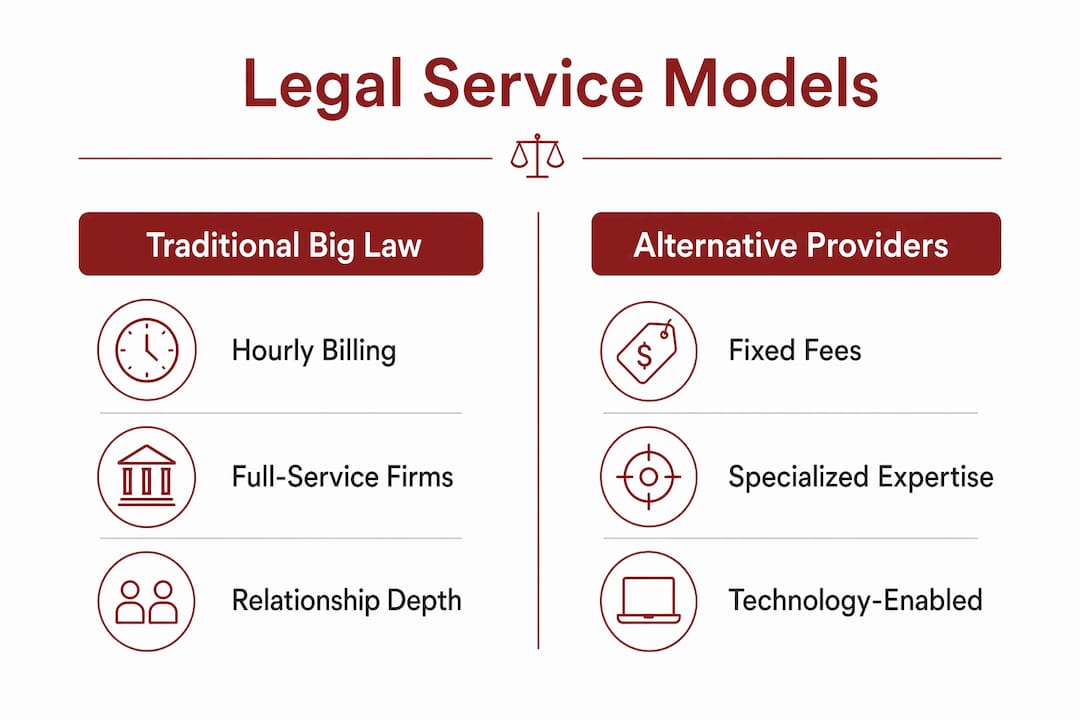
| Dimension | Traditional Big Law | Alternative Legal Service Providers |
|---|---|---|
| Cost | High; hourly billing; unpredictable | Lower; fixed-fee or transaction-based options available |
| Speed | Slower; partner availability constrains turnaround | Faster; AI and dedicated workflows enable same-day delivery |
| Specialist depth | Broad but often shallow in emerging areas | Narrow but deep in chosen practice areas |
| Regulatory relationships | Strong in established areas | Variable; stronger in technology and cross-border contexts |
| Scalability | Limited by headcount | High; technology and contract staffing enable rapid scaling |
| Pricing transparency | Low | High; fixed-fee models provide budget certainty |
| Cross-border capability | Strong for major markets | Strong for firms purpose-built for cross-border work |
The practical implication for general counsel is portfolio thinking. Route high-stakes litigation and regulatory investigations to established firms with the relationships and reputations those matters require. Route everything else to the provider that delivers the best combination of speed, cost, and specialist expertise for that specific task.
Regulatory and compliance considerations when using alternative providers
Using ALSPs introduces a set of compliance obligations that many corporate legal departments underestimate until they face a problem.
Attorney supervision requirements
Under ABA Model Rule 5.3, attorneys are responsible for supervising the work of non-attorney staff, including those employed by outside vendors. This obligation does not disappear when work is outsourced to an LPO or offshore provider. The supervising attorney must have sufficient oversight of the work product to take responsibility for it. In practice, this means establishing clear review protocols, not simply forwarding work to a vendor and accepting the output.
Unauthorized practice of law
Offshore legal service providers must operate within the scope of what is permissible under the laws of the jurisdictions involved. Work performed by non-US-licensed attorneys that constitutes the practice of law in a US jurisdiction raises unauthorized practice concerns. The safest structure routes offshore work through a US-licensed supervising attorney who reviews and takes responsibility for the final work product.
Data privacy and cross-border data transfer
US companies transferring client data to offshore providers must comply with applicable data privacy laws, including state-level frameworks like the California Consumer Privacy Act (CCPA) and sector-specific rules under HIPAA or Gramm-Leach-Bliley. Cross-border data transfers to providers in certain jurisdictions may also trigger obligations under the EU General Data Protection Regulation (GDPR) if European personal data is involved.
Conflicts of interest
ALSPs that serve multiple clients in the same industry create potential conflicts that are less visible than those at traditional firms. Unlike law firms, most ALSPs are not subject to the same formal conflict-checking requirements. General counsel should require contractual representations about conflict management and information barriers, particularly for providers handling sensitive M&A or competitive intelligence work.
Regulatory compliance in specialized sectors
For companies in financial services, healthcare, or defense, sector-specific regulations may impose additional requirements on how legal work is handled and by whom. Regulatory compliance counsel with cross-border experience is particularly valuable here, since the interaction between US sector regulations and foreign data or labor laws creates complexity that generalist providers often miss.
The bottom line on compliance is this: the regulatory framework governing ALSP use is not fully settled, and it varies by state. Before routing sensitive work to any alternative provider, a brief legal review of the applicable professional responsibility rules in your jurisdiction is a sound investment.
Beyondhorizons offers a different path for cross-border corporate legal work
For general counsel managing cross-border transactions, regulatory exposure in APAC, or emerging technology legal risk, the gap between what traditional Big Law offers and what you actually need is often widest precisely where the stakes are highest.

Beyondhorizons is a licensed law firm with lawyers trained at Magic Circle and US white shoe firms, ranked on Chambers, Legal 500, and Asia Legal Business. The firm operates as a genuine alternative to conventional corporate law firms for cross-border work: AI-enabled workflows, fixed-cost pricing on standard matters, and specialist depth in aerospace, blockchain and digital assets, robotics and automation, AI governance, and APAC regulatory compliance. Clients include US-listed companies, regional banks, and Singapore government-linked entities. For companies that need cross-border corporate counsel without the overhead of a full-service firm engagement, Beyondhorizons delivers senior-level judgment at a fraction of the cost and timeline of traditional outside counsel. Contact Beyondhorizons directly to scope your matter and receive a fixed-fee proposal.
Key Takeaways
Alternative legal service providers deliver faster, more cost-effective corporate legal outcomes than traditional Big Law across most standard transaction types, with AI-native firms now capable of automating up to 80% of routine drafting while reserving senior attorney judgment for high-value decisions.
| Point | Details |
|---|---|
| ALSPs cover five main models | Outsourcing, offshoring, temp staffing, MDPs, and AI-native firms each address different corporate legal needs. |
| Cost savings require oversight | Outsourcing can reduce legal costs by up to 30%, but only with rigorous quality control and supervision protocols. |
| AI-native firms change the pricing model | Fixed-fee and transaction-based pricing replace hourly billing, giving GCs predictable legal spend. |
| Compliance obligations follow the work | ABA Model Rule 5.3 supervision, data privacy laws, and unauthorized practice rules apply regardless of which provider handles the work. |
| Beyondhorizons for cross-border matters | Beyondhorizons combines AI-enabled workflows with Magic Circle and white shoe-trained lawyers for fixed-cost cross-border corporate legal services. |