
Ordinary cross-border activity can create a taxable presence abroad, known as a permanent establishment, even when no company was ever formally set up there. The moment that happens, corporate tax, payroll, and indirect tax obligations follow, often retroactively. This article walks through the legal tests, the biggest trigger points, the tax consequences, and a practical roadmap for containing the exposure before an auditor finds it first.
TL;DR:
- Agencies often view prolonged staff presence, especially over 50% of their working time in a country, as creating a taxable permanent establishment.
- Contract negotiation authority and decision-making location are key indicators that can turn a usual activity into a PE risk, even without physical assets.
- Digital services, revenue, and recurring physical assets like equipment or leased spaces increasingly trigger nexus rules, expanding PE risk beyond traditional physical presence.
- Retroactive tax obligations, including corporate tax, payroll, and VAT, can cascade quickly if a company is found to have a PE, leading to penalties and compliance burdens.
- Early proactive measures, including detailed documentation, contract reviews, and strategic structuring, are critical to contain and manage PE exposure before an audit occurs.
Table of Contents
- What Is a Permanent Establishment Risk in Cross-Border Tax Law?
- Common PE Triggers Every Business Should Recognize
- How Do Tax Authorities Measure Permanent Establishment Risk?
- Which Business Activities Create the Highest PE Exposure?
- What Happens if Your Business Triggers an Unintended PE?
- How Can Companies Reduce Permanent Establishment Risk?
- How Beyondhorizons Approaches Permanent Establishment Reviews
- When Should Executives Act on PE Risk, and What's the First Move?
- Get a Permanent Establishment Risk Review From Beyondhorizons
- Where to Go for Authoritative PE Guidance
- Sources
What Is a Permanent Establishment Risk in Cross-Border Tax Law?
Permanent establishment risk is the chance that a company's activity in a foreign country crosses a legal threshold and becomes a taxable presence there, exposing the business to that country's corporate tax and compliance regime. Tax authorities do not require a local entity to tax you. They only need to prove your activity meets one of a handful of established tests.
Three tests dominate international tax treaties and most domestic law modeled on them:
- Fixed place of business: A physical location, office, warehouse, or workshop, through which the enterprise carries out its business, even part time.
- Dependent agent: A person in the foreign country who habitually concludes contracts on the company's behalf, or plays the principal role leading to contracts being routinely concluded without material modification.
- Services PE: Employees or contractors providing services in-country for longer than a specified duration, commonly measured over a rolling 12-month period.
Tax treaties, largely built on the OECD Model Tax Convention, sit on top of domestic law rather than replacing it. A treaty can limit which profits get taxed and prevent double taxation, but it does not override a country's anti-avoidance rules, and it says nothing about VAT or GST. A US-based robotics firm sending an engineer to install and calibrate equipment for eight months, for instance, may trigger a services PE even if it never rents an office. Treaty relief helps with the resulting corporate tax bill; it does nothing for the payroll registration that same engineer's presence usually requires.
Common PE Triggers Every Business Should Recognize
Most permanent establishment exposure traces back to a small set of recurring scenarios, and recognizing them early is the difference between a policy fix and a tax dispute.
- A fixed physical footprint. Offices, warehouses, showrooms, and even a long-running construction or installation project (many treaties use a threshold measured in months) count as a fixed place of business. Storage-only or purely preparatory activity is usually exempt, but the exemption is narrower than most executives assume.
- A dependent agent with contracting authority. A distributor or local representative who negotiates key terms and routinely secures sign-off, even if someone back at headquarters technically signs, can look exactly like an employee for PE purposes.
- A services PE from prolonged staff presence. Consultants, engineers, or project managers working in-country past the treaty's time threshold, regardless of whether they work from a client site or a hotel room.
A mid-size software company sending implementation specialists to a client site in Vietnam for an extended period, then rotating in others, can trip a services PE even though no single employee stayed past the threshold. Authorities increasingly aggregate related engagements.
How Do Tax Authorities Measure Permanent Establishment Risk?
Assessment has moved from vague judgment calls toward measurable benchmarks, which is good news for compliance teams because measurable thresholds can be monitored.
By the numbers: The OECD Model Tax Convention's 2025 edition sets a practical marker: an employee spending more than 50% of their working time in a foreign country over a 12-month period can create PE exposure, provided the arrangement commercially benefits the enterprise.
The "commercial benefit" half of that test matters as much as the time count. A senior product architect based abroad temporarily for personal reasons, doing no work that benefits the local market, sits in a different risk category than a sales director closing deals from the same location. Authorities look at both halves together, not the clock alone.
Two other realities shape how this plays out on the ground:
- Domestic anti-avoidance rules can override a favorable treaty reading when authorities decide the structure exists mainly to avoid tax.
- Indirect taxes, VAT and GST in particular, are governed entirely by domestic law and sit outside treaty protection altogether.
- Broader reform under the OECD/G20 Inclusive Framework, including Pillar One and Pillar Two, is pushing more jurisdictions to expand what counts as taxable nexus, not narrow it.
For monitoring, that means keeping genuine time records (not estimates), activity logs tied to specific deliverables, and a running tally against the 12-month window rather than a calendar-year snapshot. Most PE disputes turn on documentation gaps, not on genuinely ambiguous facts.
Which Business Activities Create the Highest PE Exposure?
Not every cross-border activity carries equal weight. Four categories drive most of the real disputes Beyondhorizons sees. They deserve triage in that order.
Remote and hybrid staff, especially senior ones. A junior analyst working remotely from another country for a few weeks rarely moves the needle. A country manager or a vice president making pricing decisions, approving contracts, or directing strategy from that same location is a different problem entirely. Substance follows decision-making authority, not headcount.
Agents and partners with contracting power. Distribution partners, regional resellers, and even well-meaning local consultants can accidentally become dependent agents if they routinely negotiate terms that get rubber-stamped rather than genuinely renegotiated at headquarters.
Digital and economic presence. Selling into a market through a platform, app, or cloud service, with no office and no agent, used to sit outside PE frameworks entirely. That gap is closing. IMF analysis shows expanded nexus rules and digital services taxes now let countries tax remote market participation even without a traditional PE, layering new instruments on top of old ones rather than replacing them.
Local assets and repeated presence. Leased warehouses, demo equipment left on-site, or a pattern of the same employees rotating through the same location on a recurring basis all build a fact pattern that looks a lot like permanence, whether or not anyone intended it to.
- Track seniority and decision rights, not just headcount, for anyone working abroad.
- Audit every distributor and reseller contract for de facto contracting authority.
- Map digital revenue by country against local DST and nexus rules, not just corporate tax rules.
- Log any recurring or rotating physical presence, including equipment left behind.
Pro Tip: Run a "who decided this" test on every cross-border deal. If the actual commercial decision, not the signature, happened outside headquarters, treat that location as a PE risk until proven otherwise.
What Happens if Your Business Triggers an Unintended PE?
The financial exposure rarely stays contained to a single tax line, which is exactly why unintended PEs are so costly to unwind.
- Corporate tax exposure and double taxation. Profits attributable to the foreign activity become taxable there, and without careful treaty relief claims, the same income can get taxed twice.
- Payroll and social security obligations. In-country employees, or staff deemed to be working for a local PE, typically trigger local payroll registration, withholding, and social contributions retroactive to when the exposure began.
- VAT/GST registration. A taxable presence often forces indirect tax registration, with its own filing cadence and penalty regime entirely separate from corporate tax.
- Audit, penalties, and reporting fallout. Retroactive assessments come with interest and penalties, and a material PE finding can force restatement of financial results, which auditors and investors notice quickly.
None of these consequences arrive in isolation. A single misclassified engineer can cascade into a corporate tax reassessment, a payroll audit, and a VAT registration demand within the same review.
How Can Companies Reduce Permanent Establishment Risk?
Mitigation works best as a sequence, not a scattered list of fixes. Tackle these roughly in order.
- Build governance first. Put a written remote-work policy in place, define an authority matrix showing exactly who can approve contracts or pricing and from where, and start real time-tracking for any employee spending extended periods abroad.
- Fix the contract playbook. Review choice-of-law clauses, confirm which entity is actually the contracting party, and, critically, document where contracts are negotiated and signed. "Signed at headquarters" means little if every substantive term was agreed on a video call from the foreign office.
- Choose the right operating structure. An employer-of-record or PEO arrangement can let a company deploy staff abroad without creating the substance a full subsidiary implies. A local subsidiary or branch makes sense once activity is genuinely permanent; limited-scope activity (pure market research, preparatory work) can sometimes stay outside PE definitions entirely, but only if it is documented as limited and stays that way in practice.
- Consider risk transfer for quantified exposure. Tax liability insurance, the kind AIG and other specialty insurers underwrite, can shift a specific, already-identified tax exposure off the balance sheet faster than waiting months or years for an advance ruling. It is not a substitute for good structuring, but it is a legitimate tool once a risk has been sized.
- Review on a fixed schedule. A periodic PE risk review, not a one-time exercise, catches drift as headcount, contracts, and revenue mix change. Treat it the same way you treat an annual insurance renewal.
Pro Tip: Do not wait for a tax authority letter to build your audit file. The businesses that fare best in a PE dispute are the ones that can hand over a clean time log and a signed policy on day one, not the ones scrambling to reconstruct history under deadline pressure.
Treaty protection remains real but partial. It limits double taxation on income; it does nothing for VAT, payroll, or a domestic anti-avoidance challenge, so mitigation has to cover all three tracks at once, not just the corporate tax one.
How Beyondhorizons Approaches Permanent Establishment Reviews
Beyondhorizons is a Singapore-headquartered law firm built around cross-border commercial work, with lawyers trained at Magic Circle and US white-shoe firms and a team ranked across Chambers, Legal 500, and Asia Legal Business. That background matters here specifically because PE disputes rarely stay inside one jurisdiction's rules; they move between tax law, employment law, and contract drafting simultaneously.
Recurring patterns show up across engagements. Companies expanding into Southeast Asia frequently underestimate how quickly a "temporary" sales presence becomes a services PE once renewal cycles stack up. Robotics and aerospace clients installing and servicing equipment abroad often trigger PE exposure through service duration long before anyone considers opening a local entity. Once identified early, most of these situations resolve through contract redrafting and entity restructuring rather than costly disputes.
An initial PE review typically starts with a defined document set:
- Organizational chart showing decision-making authority by role and location
- Travel and time records for staff working outside their home jurisdiction
- Contracting templates and a sample of recently signed agreements
- Payroll and HR records for any in-country presence
- Revenue breakdown by country, including digital and platform-based sales
When Should Executives Act on PE Risk, and What's the First Move?
The honest answer is: before legal counsel gets involved, not after. Waiting for a formal audit notice to start documenting who does what and where is the single most common mistake we see, and it is entirely avoidable with a simple 90-day sequence.
Days 1 to 30 are for triage. Identify every person and activity that plausibly touches a foreign jurisdiction, then put stop-gap controls in place, freezing new contracting authority abroad if needed while the picture gets clearer.
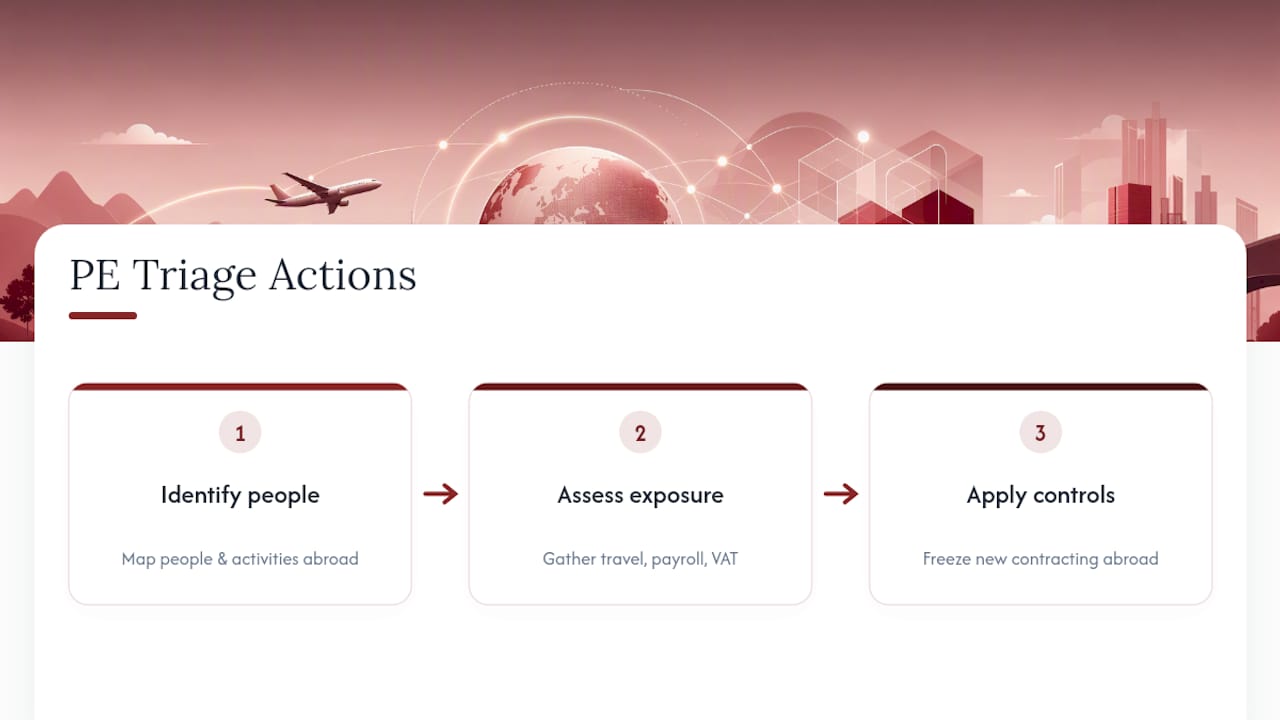
Days 30 to 60 are for documentation and correction. Gather time and travel records, amend contracts where the contracting party or signing location looks wrong, and get a preliminary read on payroll and VAT exposure.
Days 60 to 90 are for formal resolution. Commission a full PE review, decide whether an employer-of-record arrangement or a new local entity makes sense, and evaluate whether tax liability insurance fits any quantified exposure that surfaced along the way.
Ask advisers directly: which specific test are we closest to tripping, what would a local tax authority actually see in our current documentation, and what is the single fastest fix available right now?
— HL
Get a Permanent Establishment Risk Review From Beyondhorizons
Most companies discover their permanent establishment exposure the expensive way, through an audit letter, rather than the inexpensive way, through a structured review before anything goes wrong. Beyondhorizons runs PE risk reviews specifically for companies operating across Singapore, the broader APAC region, and emerging markets, combining cross-border corporate counsel, employment law expertise, and entity-structuring experience in one team rather than three separate advisers who each see only part of the picture.

The firm's cross-border corporate counsel practice handles PE reviews, contract redrafting, and entity formation decisions as a connected process rather than sequential engagements, which matters when a fix in one area (say, an employer-of-record arrangement) has direct consequences for another (payroll registration, VAT treatment). For companies with remote or hybrid staff working across borders, the firm's Singapore and cross-border employment counsel addresses the payroll and worker-classification side of the same exposure. If your business has staff, agents, or revenue crossing a border right now, request an initial PE risk review and get a documented answer on where you stand before an authority asks the question for you.
Where to Go for Authoritative PE Guidance
Executives managing cross-border exposure should keep a short list of primary sources on hand rather than relying on secondhand summaries.
- OECD Model Tax Convention (2025 edition), for the core legal tests and time thresholds
- OECD cross-border and international tax work, covering Pillar One, Pillar Two, and broader nexus reform
- IRAS guidance on tax residence and permanent establishment, for Singapore-linked exposures
- AIG's overview of tax liability insurance, for risk transfer options once exposure is quantified
Sources
- OECD — Model Tax Convention on Income and on Capital (2025 edition)
- OECD — Cross-border and international tax work
- IRAS — Tax residence status of a company and permanent establishment
- AIG — Tax Liability Insurance
- IMF working paper on nexus, DSTs and digitalization (2026)