
Launch a structured cross border tax optimization program now, and engage an integrated team of tax lawyers, transfer-pricing specialists, and financial modelers as your immediate next step. The IRS statutory withholding rate sits at 30% on most US-source passive payments to foreign persons — treaty relief via W-8BEN or W-8BEN-E forms can reduce that materially, but only if the documentation is in place before payment. Meanwhile, the OECD Pillar Two GloBE rules impose a 15% global minimum tax that fundamentally changes the calculus for any group using low-tax jurisdictions.
Start here:
- Exposure map: Identify every cross-border entity, intercompany flow, and foreign-sourced revenue stream within 2–4 weeks.
- W-8 health-check: Confirm current, correctly completed W-8BEN or W-8BEN-E forms are on file for all foreign payees and payers. Missing forms mean default 30% withholding — immediately.
- Modelling sprint: Quantify GILTI, Subpart F, and Pillar Two exposure across material jurisdictions before committing to any structural change.
- Filing gap review: Check Forms 5471, 5472, 8938, and FBAR/FinCEN 114 coverage. Gaps here draw IRS scrutiny and carry significant penalties.
Where withholding or documentation gaps already exist, the cost of inaction compounds daily.
Table of Contents
- When should you launch a cross-border tax program?
- What are the core technical pillars of US-focused tax optimization?
- How does a cross-border tax engagement actually run?
- What US-specific rules matter most in 2026?
- Are you audit-ready? A compliance checklist
- How Beyondhorizons delivers cross-border tax optimization
- Key Takeaways
- The real lesson from doing this work
- Work with Beyondhorizons on your cross-border tax program
- Primary sources and further reading
When should you launch a cross-border tax program?
Certain business events make the need concrete rather than theoretical. If any of the following apply, the program should already be underway.
- M&A or outbound investment: Acquiring or establishing a foreign subsidiary triggers CFC classification, Subpart F analysis, and transfer pricing obligations from day one. Cross-border M&A work without parallel tax structuring routinely creates avoidable exposure.
- Material foreign revenues or dividends: Once foreign-sourced income becomes significant relative to total revenue, withholding leakage and foreign tax credit utilization under IRC §§901–904 become priority issues.
- New hires or operations in foreign jurisdictions: Employee presence can create permanent establishment, triggering local corporate tax obligations and payroll reporting requirements.
- IP transfers or licensing: Moving intangibles across borders without arm's-length pricing documentation invites Section 482 challenges and potential penalties.
- Pillar Two revenue threshold proximity: Groups approaching or exceeding the consolidated revenue threshold for GloBE rules need modelling now, not after the rules bite.
- Upcoming filing deadlines: Forms 5471/5472/8938 and FBAR/FinCEN 114 have fixed annual deadlines. Missed filings carry automatic penalties regardless of tax owed.
Internal owners to involve from the start: tax, legal, treasury, FP&A, and operations. Cross-functional coordination is not optional — proactive modelling and coordinated teams are what separate groups that manage international tax well from those that discover problems at audit.
What are the core technical pillars of US-focused tax optimization?
A well-designed program addresses eight discrete workstreams. Each has its own deliverables, inputs, and metrics.
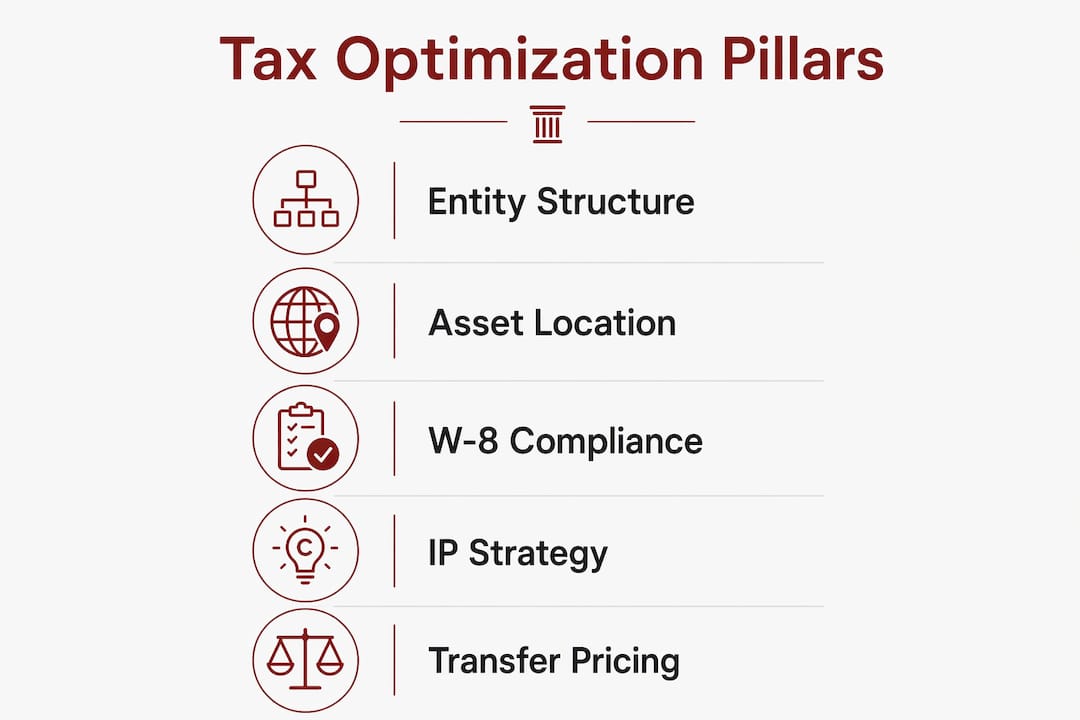
| Pillar | Primary Deliverables | Key Inputs | Success Metric |
|---|---|---|---|
| Entity & jurisdiction structure | Holding company design, substance analysis | Corporate org chart, revenue flows | Effective tax rate reduction |
| Treaty withholding (W-8BEN/W-8BEN-E) | Form collection workflows, treaty eligibility matrix | Payee details, treaty schedules | Withholding rate avoided vs. 30% baseline |
| Transfer pricing (Section 482) | Policy documentation, benchmarking studies | Intercompany agreements, financials | Audit-ready contemporaneous file |
| CFC, Subpart F & GILTI modelling | Exposure quantification, planning options | CFC ownership data, earnings & profits | Incremental ETR change |
| Cash repatriation | Repatriation route analysis, after-tax cash scenarios | Local distribution rules, FTC position | After-tax cash available to parent |
| IP & intangible location | IP holding structure, cost-sharing agreements | IP valuations, royalty flows | Royalty withholding minimized |
| State & local tax (SALT) | Nexus review, apportionment analysis | Revenue by state, payroll/property data | Avoided state tax exposure |
| Compliance & information reporting | Forms 5471/5472/8938, FBAR/FinCEN 114 | Entity list, account balances | Zero missed filings |
Asset location deserves specific attention beyond the table. Where a corporate group holds treasury assets or investment portfolios, placing tax-inefficient assets (bonds, high-yield credit) in tax-advantaged structures and tax-efficient assets in taxable accounts can generate over 45 basis points of additional annual after-tax return. That is a structural gain, not a rate-chasing exercise.

Pro Tip: Document treaty-benefit eligibility and maintain payer-ready W-8 forms proactively. Retrospective reclaim processes are administratively intensive and slow — prevention costs a fraction of what recovery does.
For IP strategy specifically, IP placement and data considerations interact directly with transfer pricing policy and can determine whether royalty flows are taxed at treaty-reduced rates or at full statutory withholding.
How does a cross-border tax engagement actually run?
Understanding the phases helps procurement and legal ops plan realistically.
- Discovery (2–6 weeks): Entity mapping, intercompany flow analysis, W-8 health-check, and preliminary filing gap review. Output: exposure map and prioritized risk register.
- Modelling and option design (4–8 weeks): Quantify GILTI/Subpart F/Pillar Two exposure, model repatriation routes, and evaluate structural alternatives. When modelling repatriation, include both statutory tax costs and operational cash-flow effects — withholding, local distribution rules, and timing of foreign tax credits — to show after-tax cash available under different routes.
- Legal structuring and documentation (overlapping with modelling): Entity formation, intercompany agreement drafting, W-8 workflow implementation, and IP holding structure design.
- Implementation (3–6 months): Entity registrations, local substance arrangements, transfer pricing studies, and local-file preparation. Timeline depends heavily on the number of jurisdictions requiring local counsel.
- Ongoing monitoring (quarterly/annual): Pillar Two compliance tracking, W-8 renewal management, transfer pricing true-ups, and filing calendar management.
Primary cost drivers are entity network complexity, transaction volume, depth of transfer pricing benchmarking, third-country substance requirements, and the number of jurisdictions needing local counsel. For a practical global business setup alongside the tax program, early coordination between legal, tax, and accounting teams avoids duplicated work.
Resourcing checklist: internal data and accounting owners; external tax and legal advisors; modelling specialists; and local counsel for every material jurisdiction.
What US-specific rules matter most in 2026?
Three areas demand immediate attention for US-parented multinationals.
Treaty withholding and W-8 forms. The statutory 30% withholding baseline applies to dividends, interest, royalties, and other fixed or determinable annual or periodical income paid to foreign persons. Treaty relief requires a valid, correctly completed W-8BEN (individuals) or W-8BEN-E (entities) on file with the payer before payment. The US-Canada treaty, for example, reduces dividend withholding to 15% for most shareholders and 5% for qualifying corporate shareholders. Foreign tax credits under IRC §§901–904 then offset residual foreign tax against US liability, but only to the extent of the applicable limitation basket.
The most common and most expensive failure in cross-border tax programs is not a structural error — it is an expired or missing W-8 form that triggers default 30% withholding on payments that should have been taxed at 5% or 15%. Fix the documentation first; structure second.
Subpart F, GILTI, and CFC rules. US shareholders of controlled foreign corporations must include certain passive and mobile income under Subpart F, and GILTI applies a minimum inclusion on excess returns of CFCs. Recent legislative developments — including changes under the One Big Beautiful Budget Act — affect credit utilization and global effective tax rates. Groups should model these changes now to assess their impact before year-end.
OECD Pillar Two GloBE. The 15% global minimum tax limits the effectiveness of low-tax jurisdiction strategies for in-scope groups. The US has not yet adopted GloBE domestically, but US-parented groups with operations in implementing jurisdictions face top-up taxes there. MNEs should evaluate organizational structure, data readiness, and country-by-country reporting eligibility for transitional safe harbors now.
California nonconformity with several federal international tax provisions adds a state-level layer: California does not conform to the federal GILTI deduction, which can produce a materially higher state ETR for California-nexus groups.
This section summarizes primary-source issues and does not replace jurisdiction-specific counsel for formal filings.
Are you audit-ready? A compliance checklist
Use this list to identify gaps that need remediation before the next filing cycle.
- Confirm current, complete W-8BEN or W-8BEN-E forms for every foreign payee and payer relationship; centralize collection and automate expiry reminders in treasury or a shared-services function.
- Verify Forms 5471, 5472, and 8938 coverage for all controlled foreign corporations and foreign financial assets above reporting thresholds.
- Confirm FBAR/FinCEN 114 filings for all foreign financial accounts exceeding $10,000 aggregate.
- Validate transfer pricing documentation: contemporaneous benchmarking studies, intercompany agreements, and local files for material jurisdictions. Enforcement risk is heightened where intercompany margins deviate without a documented commercial rationale.
- Review entity substance: local directors, employees, and operational activity must support the economic reality of the structure, particularly post-BEPS and under Pillar Two.
- Conduct source-of-income reviews to identify any activities that could constitute a permanent establishment in a foreign jurisdiction.
Red flags requiring immediate remediation: missing or expired W-8 forms; undocumented intercompany pricing; undisclosed offshore entities above filing thresholds; and structures lacking genuine commercial substance.
Remediation sequence: prioritize high-dollar withholding leakage first, then documentation gaps, then run a fast-track cost analysis comparing reclaim costs against prospective prevention spend. Simple documentation fixes are often the highest-return tasks in the entire program.
How Beyondhorizons delivers cross-border tax optimization
Beyondhorizons provides integrated legal and tax advisory for US-focused multinationals, covering everything from initial exposure mapping through implementation and audit defense. The firm's cross-border corporate counsel team brings together lawyers from Magic Circle and US white-shoe backgrounds, ranked on Chambers, Legal 500, and Asia Legal Business. Clients include US-listed companies, Singapore government-related entities, and regional banks, with sector depth in aerospace, robotics, blockchain and crypto, and transportation.
Service offerings include:
- Diagnostic: 2–4 week exposure map, W-8 health-check, and preliminary modelling.
- Treaty and withholding optimization: W-8 workflow design, treaty eligibility analysis, and payer-side process implementation.
- Transfer pricing policy and documentation: Section 482-compliant studies, local files, and benchmarking.
- Entity formation and substance solutions: holding company design, local registration, and substance arrangements.
- Ongoing compliance governance: filing calendar management, Pillar Two monitoring, and regulatory compliance oversight.
Beyondhorizons combines the technical depth of a top-tier international tax practice with the commercial focus of a firm that has actually structured transactions across APAC, the US, and emerging markets — not just advised on them from the sidelines.
Engagement options include fixed-fee diagnostics, scoped implementation bundles, and ongoing counsel-of-record arrangements. The firm's global coordination model means multi-jurisdictional programs run as a single integrated engagement rather than a patchwork of disconnected local advisors.
Key Takeaways
Effective cross border tax optimization requires acting on documentation and structure simultaneously — waiting for a perfect plan while withholding leakage accumulates is the most common and most costly mistake.
| Point | Details |
|---|---|
| Fix W-8 forms first | Missing or expired W-8BEN/W-8BEN-E triggers 30% default withholding; this is the fastest recoverable value in any program. |
| Model GILTI and Pillar Two now | Groups near or above the GloBE revenue threshold need scenario analysis before structural decisions are made. |
| Document transfer pricing contemporaneously | Benchmarking studies and intercompany agreements must exist before an audit, not in response to one. |
| Asset location adds structural value | Tax-aware placement of assets across entity types can generate over 45 basis points of annual after-tax return. |
| Beyondhorizons as your partner | Beyondhorizons delivers integrated legal, tax, and modelling support from diagnostic through implementation for US-focused multinationals. |
The real lesson from doing this work
Most cross-border tax programs underperform not because the strategy is wrong, but because the fundamentals are skipped. We regularly see groups that have invested in sophisticated holding structures yet are losing money to default withholding on routine dividend payments because a W-8BEN-E was never collected or lapsed two years ago. The second consistent finding: asset location decisions made at entity formation, and rarely revisited, account for a disproportionate share of recoverable after-tax value. Structural planning produces more durable results than rate-chasing, and the modelling to prove it is rarely as complex as teams assume. The firms that get this right treat tax optimization as an operational discipline, not a one-time project.
Work with Beyondhorizons on your cross-border tax program
Beyondhorizons offers US-focused multinationals a clear path from compliance gap to optimized structure, without the coordination overhead of managing multiple disconnected advisors across jurisdictions.

Three ways to engage:
- Fixed-fee diagnostic (2–4 weeks): Exposure map, W-8 health-check, and a preliminary model of GILTI/Pillar Two impact. Deliverable: a prioritized action plan your board can act on.
- Scoped implementation: Entity structuring, W-8 workflow design, transfer pricing studies, and local filings, coordinated as a single engagement.
- Retainer/counsel-of-record: Ongoing filing calendar management, Pillar Two monitoring, and advisory access for emerging issues.
The firm's cross-border corporate counsel team is available for an initial consultation to scope your program and identify the highest-priority remediation steps. For groups with sector-specific needs in aerospace, robotics, blockchain, or transportation, the same team covers the regulatory and commercial dimensions alongside the tax work.
Contact Beyondhorizons to request a fixed-fee diagnostic or a scoped proposal.
Primary sources and further reading
- IRS — Withholding on Specific Income and W-8 Forms — authoritative source for statutory withholding rates, W-8BEN/W-8BEN-E requirements, and treaty claim procedures.
- OECD — Global Anti-Base Erosion Model Rules (Pillar Two) — primary guidance on GloBE rules, implementation status, and transitional safe harbors.
- Goldman Sachs Asset Management — Tax-Aware Asset Allocation and Asset Location — analysis of after-tax return benefits from tax-aware strategic asset allocation.
- RSM US — International Tax Planning Guide — practical guidance on transfer pricing, CFC rules, and Pillar Two readiness for US multinationals.
- Beyondhorizons — Tax Planning Strategies for Businesses: 2026 Guide — practical 2026 resource covering entity structuring and US technical considerations.
- Price & Accountants — Global Business Setup Guide 2026 — jurisdictional setup and tax-registration workflows for international expansion.