
What is tax restructuring and why does it matter?
Tax restructuring is the deliberate reconfiguration of a company's legal, financial, or operational framework to optimize tax efficiency during major corporate events such as mergers, acquisitions, financial distress, or ownership changes. It is not a single transaction. It is a coordinated set of decisions that determines how liabilities are recognized, deferred, or eliminated across an organization's entire structure.
For U.S. corporations, one of the most powerful tools available is the tax-free corporate reorganization under IRC Section 368. These transactions allow companies to defer federal income tax, provided they satisfy specific criteria: continuity of shareholder interest, a valid business purpose, and continuity of the business enterprise. Critically, "tax-free" under Section 368 means deferral, not elimination. Assets carry over their existing tax basis, and shareholders may still incur taxable gain on any cash or property received alongside stock, known as "boot."
The scope of corporate tax restructuring extends well beyond mergers. It covers:
- Debt workouts and bankruptcy planning under IRC Section 368(a)(1)(G)
- Legal entity rationalization to reduce structural complexity
- Spin-offs and divisions qualifying under IRC Section 355
- Recapitalizations and identity-change reorganizations
- Cross-border restructuring with transfer pricing implications
Understanding these tools is the starting point. Executing them correctly, without triggering unintended tax consequences, is where advisory expertise becomes indispensable.
Key benefits your company gains from restructuring its tax position
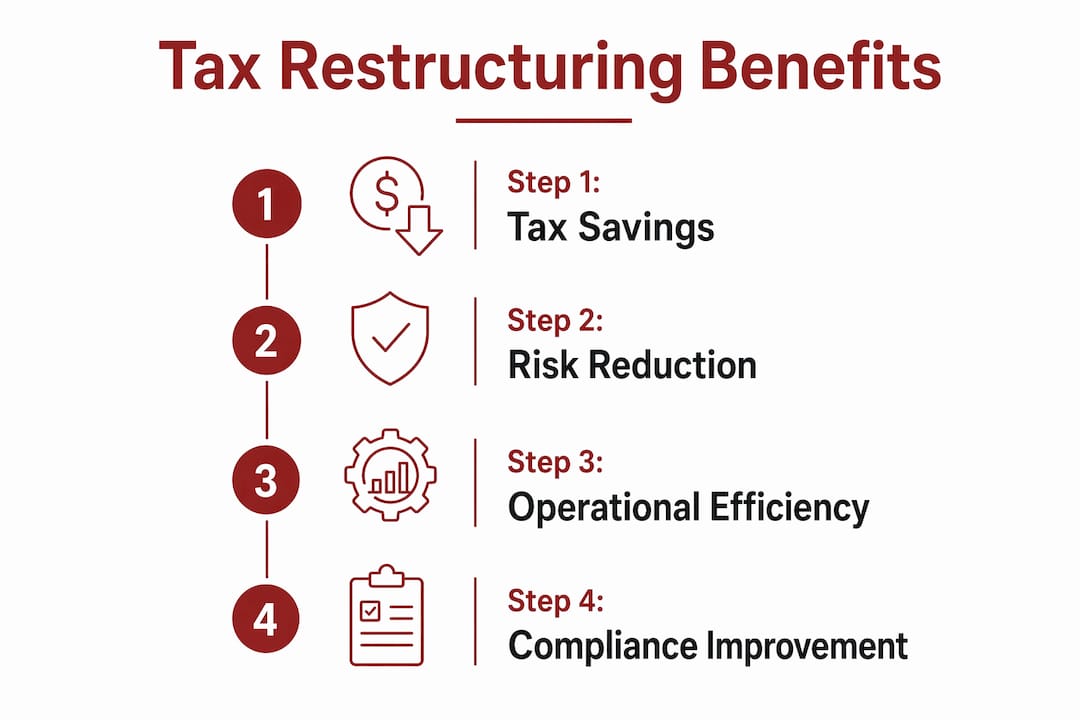
Done well, corporate tax restructuring delivers advantages that go far beyond a lower tax bill. Strategic restructuring objectives typically include centralizing functions and intangible assets, consolidating acquisitions into a cleaner holding structure, and achieving a competitive global effective tax rate.
The operational and financial benefits are concrete:
- Centralized IP and functions: Consolidating intellectual property and shared services into a single entity reduces duplication and creates a defensible transfer pricing position.
- Improved cash flow deployment: Eliminating redundant legal entities frees up trapped cash and reduces compliance costs across multiple jurisdictions.
- Tax attribute preservation: Properly structured reorganizations preserve net operating losses (NOLs), credits, and other tax attributes that would otherwise be lost in a taxable transaction.
- Regulatory alignment: Restructuring ahead of a major transaction reduces the risk of post-closing audit exposure and strengthens the company's compliance posture.
- Flexibility for future growth: A rationalized structure is easier to adapt for subsequent acquisitions, joint ventures, or market exits.
For companies operating across borders, the business tax strategies embedded in a restructuring plan also determine how future earnings are taxed in each jurisdiction, making the upfront design work genuinely consequential.
Core advisory services you need during a restructuring
The advisory work required in a tax restructuring is specialized and, in many cases, sequential. Getting the sequence wrong can permanently impair tax attributes or trigger unexpected income recognition.
Key services include:
- Debt workout and bankruptcy planning: Advisors assess cancellation of debt (COD) income exposure and model the tax outcomes of different debt resolution paths. Bankruptcy planning offers optionality but shares risks with out-of-court workouts, including attribute reductions under IRC Section 108.
- Tax attribute optimization: Identifying and preserving NOLs, credits, and basis before an ownership change is critical. Advisors model the impact of IRC Section 382 limitations on NOL utilization following a more-than-50% ownership shift.
- COD income management: When debt is discharged at a discount, the forgiven amount is generally taxable. Advisors structure transactions to qualify for exclusions under insolvency or bankruptcy exceptions.
- Transfer pricing documentation: For cross-border restructurings, arm's length documentation for intercompany transactions is not optional. It is the primary defense against disallowance by tax authorities.
- State and local tax compliance: State tax restructuring requires separate transfer pricing studies and careful attention to nexus, apportionment, and combined reporting rules that vary significantly by state.
Pro Tip: Bring your tax and accounting teams into alignment before the restructuring plan is finalized. Early cross-functional coordination prevents costly errors in asset basis calculation and intercompany debt documentation that are extremely difficult to correct after the fact.
How the tax restructuring process actually works
A well-managed restructuring follows a defined lifecycle, though the timeline varies considerably depending on transaction complexity and the number of jurisdictions involved.
Phase 1: Strategic assessment. Advisors map the existing legal entity structure, identify tax attributes at risk, and model the tax consequences of proposed changes. This phase produces the business justification documentation that regulators and courts require.
Phase 2: Structure design. The team selects the appropriate reorganization type, whether a statutory merger under Section 368(a)(1)(A), a stock acquisition under Section 368(a)(1)(B), an asset acquisition under Section 368(a)(1)(C), or a spin-off under Section 355. Each carries different requirements for shareholder continuity, asset transfers, and boot treatment.

Phase 3: Implementation. Legal agreements, board resolutions, and intercompany contracts are executed in the correct sequence. Successful restructuring requires detailed documentation including business justifications, financial forecasts, and compliance demonstrations at each step.
Phase 4: Post-restructuring maintenance. Transfer pricing policies are updated, financial statements are adjusted to reflect the new structure, and ongoing compliance obligations are tracked. This phase is often underestimated. A structure that qualifies as tax-free at closing can lose that status if subsequent transactions violate continuity requirements.
Timeline expectations are realistic: straightforward domestic reorganizations can close within a few months, while cross-border restructurings involving multiple jurisdictions can take over a year from design to full implementation.
Common tax risks and compliance challenges during restructuring
The risks in a corporate restructuring are not hypothetical. They are specific, well-documented, and often triggered by decisions made early in the process.
- COD income recognition: Debt discharged at a discount generates ordinary income unless an exclusion applies. The attribute reduction rules that follow a bankruptcy exclusion can eliminate NOLs and basis that the company was counting on.
- Section 382 ownership change limitations: A more-than-50% ownership shift triggers annual limits on NOL utilization. Advisors must model these limits before the transaction closes, not after.
- Book-versus-tax discrepancies: Restructurings that are treated differently for financial reporting and tax purposes create deferred tax assets and liabilities that affect earnings per share and balance sheet presentation.
- Transfer pricing exposure: Transfer pricing policies alone do not constitute restructuring, but any transfer of functions, assets, or risks requires arm's length documentation to withstand audit scrutiny.
- State tax traps: States do not automatically conform to federal tax-free reorganization rules. A transaction that qualifies under Section 368 at the federal level may still trigger gain recognition in certain states.
- Foreign currency impacts: Cross-border restructurings involving functional currency differences can generate phantom income under IRC Section 987, even when no cash changes hands.
Proactive risk mitigation means running these scenarios before the structure is locked in, not discovering them during an IRS examination.
Expert perspective: what is reshaping U.S. tax restructuring right now
The OECD Pillar Two global minimum tax of 15% has fundamentally altered the calculus for multinational corporations. Traditional strategies that relied on routing income through low-tax jurisdictions are delivering diminishing returns. Multinationals with consolidated revenue above EUR 750 million are now subject to a top-up tax in every jurisdiction where their effective rate falls below 15%, and the compliance burden of filing a GloBE Information Return adds another layer of operational complexity.
The practical response from leading advisory firms, including KPMG and PwC, has shifted toward comprehensive Pillar Two impact assessments and legal entity rationalization rather than aggressive rate arbitrage. Alvarez & Marsal has been particularly active in distressed restructuring contexts, where the interaction between COD income rules and Pillar Two creates new planning considerations.
A few principles that define current best practice:
- Distinguish restructuring from transfer pricing corrections. Not all function transfers constitute restructuring. A change in transfer pricing policy without an accompanying transfer of assets, functions, or risks is a pricing adjustment, not a restructuring, and treating it as one creates unnecessary regulatory exposure.
- Run Pillar Two impact assessments before designing the new structure. Companies that retrofit their structures after the fact face significantly higher costs and compliance risk than those that build Pillar Two into the original design.
- Use transitional safe harbors while they remain available. The OECD's transitional rules offer meaningful relief for companies still mapping their GloBE positions.
Pro Tip: Technology matters here. Tools like KPMG's BEPS 2.0 Automation Technology (KBAT) help multinationals model GloBE positions across jurisdictions in real time, turning a manual compliance burden into a manageable planning exercise.
Types of tax restructuring strategies: mergers, acquisitions, and spin-offs
The IRC provides a defined menu of tax-free reorganization structures, each suited to different business objectives.
Type A: Statutory mergers and consolidations. The most flexible structure. Target shareholders receive acquirer stock, and the transaction qualifies as long as continuity of interest and business purpose requirements are met. Boot is taxable to shareholders under IRC Section 354.
Type B: Stock-for-stock acquisitions. The acquirer exchanges solely its voting stock for at least 80% control of the target. No cash consideration is permitted without disqualifying the transaction.
Type C: Asset acquisitions. The acquirer purchases substantially all of the target's assets in exchange for voting stock. The target must then distribute the stock received to its own shareholders.
Type D: Asset transfers with spin-offs. A corporation transfers assets to a controlled subsidiary and distributes the subsidiary's stock to shareholders under Section 355. This is the mechanism behind most corporate spin-offs.
Type E: Recapitalizations. Used to restructure a company's debt and equity without a change in ownership. Common in distressed situations where creditors exchange debt for equity.
Type G: Bankruptcy reorganizations. Transfers of assets in a Title 11 case qualify for tax-free treatment if stock or securities are distributed pursuant to the reorganization plan.
Each structure carries specific requirements for cross-border M&A transactions, and the choice between them often determines how much flexibility the combined entity retains for future transactions.
Real-world examples of successful tax restructuring
Spin-off with Section 355 qualification. A large U.S. industrial conglomerate separated its manufacturing and services divisions into two independent public companies. By structuring the transaction to satisfy Section 355's active trade or business requirement and the device restriction, the company distributed subsidiary stock to shareholders without triggering corporate-level gain. The key to qualification was demonstrating that both businesses had been actively conducted for at least five years prior to the distribution.
Debt-for-equity exchange in a distressed restructuring. A mid-market retailer facing covenant defaults negotiated a debt-for-equity exchange with its senior lenders. Advisors structured the exchange to qualify under the insolvency exclusion of IRC Section 108, eliminating COD income recognition while preserving the company's remaining NOL balance. The attribute reduction that followed was modeled in advance, and the company's tax planning was adjusted accordingly.

Cross-border legal entity rationalization. A U.S.-headquartered technology company with subsidiaries in 14 countries collapsed its holding structure from 23 entities to 9 following a Pillar Two impact assessment. The rationalization eliminated redundant compliance costs, consolidated IP ownership into a single jurisdiction, and reduced the number of GloBE filings required. Transfer pricing documentation was updated to reflect the new structure before the first post-restructuring fiscal year closed.
These examples share a common thread: the tax outcome was determined by decisions made in the design phase, not the execution phase.
How to choose the right tax advisory professionals for your restructuring
The quality of your advisory team is the single most controllable variable in a restructuring. Here is what actually differentiates strong advisors from adequate ones.
Depth in the specific transaction type. A firm with deep experience in distressed debt restructurings may not be the right choice for a cross-border spin-off. Ask specifically about the team's experience with your transaction type, not the firm's general reputation.
Tax and accounting integration. The best advisory teams include both tax counsel and accounting professionals who work together from day one. Firms that hand off between departments mid-process create the exact documentation gaps that generate audit risk.
Cross-border capability. For any restructuring involving non-U.S. entities, the advisor must understand both U.S. tax rules and the local rules in each relevant jurisdiction. Transfer pricing documentation that satisfies the IRS may still fail OECD arm's length standards in a foreign jurisdiction.
Regulatory compliance track record. Ask whether the firm has managed IRS examinations of restructuring transactions and what the outcomes were. Advisors who have defended their work under audit scrutiny understand what documentation actually holds up.
Technology and modeling capability. For multinationals navigating Pillar Two, advisors who can model GloBE positions across jurisdictions using purpose-built tools deliver faster, more accurate analysis than those relying on manual spreadsheets.
Beyondhorizons works with business owners and corporate advisors on complex cross-border transactions, bringing together legal and commercial expertise from Magic Circle and U.S. white-shoe firm backgrounds. For companies managing restructuring across APAC and emerging markets, that combination of legal depth and regional knowledge is often the deciding factor.

If your restructuring involves cross-border elements, Beyondhorizons' global expertise and ranked legal team can help you navigate the full lifecycle from structure design through post-closing compliance.
Key Takeaways
Effective tax restructuring requires early advisory alignment, precise structure selection, and documentation that holds up under regulatory scrutiny across every jurisdiction involved.
| Point | Details |
|---|---|
| Tax-free means deferral | Under IRC Section 368, reorganizations defer tax rather than eliminate it; assets carry over their existing tax basis. |
| Pillar Two changes the calculus | The OECD 15% global minimum tax makes low-tax jurisdiction strategies less effective for multinationals above EUR 750 million in revenue. |
| Early coordination prevents costly errors | Aligning tax and accounting teams before the plan is finalized prevents asset basis and intercompany debt documentation mistakes. |
| Structure type determines flexibility | The choice between Type A, B, C, D, E, or G reorganization determines boot treatment, continuity requirements, and future transaction options. |
| Documentation is the primary defense | Detailed business justifications, financial forecasts, and arm's length transfer pricing studies are required to withstand IRS audit scrutiny. |