
Investment structuring is the legal and ownership architecture used to hold, manage, and move capital across entities and jurisdictions. Done well, it determines your tax efficiency, liability exposure, governance control, and exit optionality. Done poorly, it creates compliance traps that compound over years.
The core business case is straightforward: the right structure protects assets from litigation, reduces withholding friction on cross-border flows, and lets you sell a single holding company rather than unwinding a dozen local positions at exit. Common building blocks include holding companies, special purpose vehicles (SPVs), limited liability companies (LLCs), partnerships, and trusts. Each serves a distinct purpose, and most sophisticated platforms combine several.
Table of Contents
- What is investment structuring, and why does it matter for cross-border deals?
- Why strategic structuring goes well beyond tax
- Which legal vehicles should you use, and when?
- Cross-border tax and regulatory rules every U.S. investor must know
- How to design a resilient structure: checklist and advisor questions
- What does implementation actually cost, and how long does it take?
- Designing governance and succession into your structure
- Anonymized case studies: how structuring changed the outcome
- Clear next steps: moving from reading to action
- Key Takeaways
- The case for treating structuring as a dynamic discipline
- Beyondhorizons: cross-border structuring advisory for businesses that operate globally
- Useful sources and practitioner resources
What is investment structuring, and why does it matter for cross-border deals?
Investment structures influence liquidity, reporting obligations, investor protections, and operational transparency. Choosing the wrong wrapper can increase compliance costs and reduce investor access simultaneously. For U.S. businesses operating across borders, the stakes are higher: FATCA, CFC rules, FIRPTA, and PFIC regimes each impose distinct obligations that a poorly designed structure triggers unnecessarily.
The primary objectives are risk management, tax efficiency, governance clarity, and exit optionality. None of these operates in isolation. A structure optimized purely for a single year's tax position often lacks the flexibility to support a future acquisition, a generational transfer, or a clean exit.
Why strategic structuring goes well beyond tax
Multi-entity frameworks preserve enterprise value during lawsuits, succession gaps, and liquidity events by siloing risks and creating transaction optionality. The benefits extend across five dimensions:
- Liability protection. Segregating operating assets from investment assets means a judgment against one entity cannot reach another. An SPV holding a single real estate asset, for example, insulates the broader portfolio from that asset's litigation risk.
- Privacy and information control. Holding structures can limit public disclosure of beneficial ownership, particularly relevant for family offices and high-net-worth principals navigating competitive markets.
- Governance and succession control. Properly drafted governance terms determine who appoints directors, who holds veto rights, and how ownership transfers on death or incapacity, without triggering a forced sale.
- Operational and transactional flexibility. Multi-entity platforms allow partial sales, carve-outs, and protected royalty or real estate ownership without compromising operating assets.
- Jurisdictional and treaty access. Interposing a holding company in a treaty-favorable jurisdiction can reduce withholding taxes on dividends, interest, and royalties flowing between operating entities.
Pro Tip: Design for optionality from day one. A structure built around a single-year tax objective rarely survives the first major liquidity event intact. Build in the flexibility to add entities, shift financing, or execute a clean exit without a full rebuild.
Which legal vehicles should you use, and when?

| Structure | Primary Use Case | Governance Complexity | Typical Tax Role | Key Regulatory Concern | Cost Profile |
|---|---|---|---|---|---|
| Holding company | Treaty access, centralized ownership, exit simplification | Moderate | Participation exemptions, dividend routing | Substance requirements, BEPS | Medium–High |
| SPV | Single-asset ring-fencing, project finance | Low–Moderate | Asset isolation, debt structuring | Thin-cap rules, local registration | Low–Medium |
| LLC (U.S.) | Pass-through taxation, flexible governance | Low | Pass-through, check-the-box elections | State-level filings, PFIC risk for non-U.S. investors | Low |
| Limited partnership | Private equity, fund structures | Moderate | Pass-through, carried interest | LP/GP fiduciary duties, securities law | Medium |
| Trust (discretionary) | Succession, asset protection, privacy | High | Income distribution flexibility | Reporting obligations, CRS/FATCA | Medium–High |
Holding platforms commonly use jurisdictions such as Luxembourg, the Netherlands, Singapore, or Delaware to secure treaty benefits and participation exemptions. A single share sale of a holding vehicle can substitute multiple local share transfers, reducing transaction friction at exit considerably.
- Use an SPV for single-asset deals where liability isolation is the primary objective.
- Use a holding company when treaty access, centralized financing, or a clean exit structure is the goal.
- Use an LLC for U.S.-based pass-through treatment with flexible governance terms.
- Use a limited partnership for fund structures where GP/LP separation and carried interest mechanics are required.
- Use a trust when succession planning, asset protection, or income distribution flexibility across beneficiaries is the priority.
Pro Tip: Separate voting rights from economic rights in your governance documents. A founder can retain control through director appointment rights or reserved matters without holding a majority economic interest, which matters enormously when bringing in institutional investors.
Cross-border tax and regulatory rules every U.S. investor must know
Cross-border structures for U.S. investors carry a specific compliance stack that domestic structures do not. The key rules:
- Treaty access. Double tax treaties reduce withholding on dividends, interest, and royalties, but post-BEPS rules require genuine economic substance in the treaty jurisdiction. A paper-only holding company risks denial of treaty benefits and penalties.
- CFC rules. U.S. shareholders owning more than 10% of a controlled foreign corporation must include certain undistributed income in their U.S. taxable income under Subpart F, regardless of whether a distribution is made.
- PFIC rules. A passive foreign investment company classification triggers punitive tax treatment on gains and distributions. U.S. investors in foreign funds or holding vehicles with predominantly passive income need to assess PFIC status before investing.
- FIRPTA. The Foreign Investment in Real Property Tax Act imposes withholding on dispositions of U.S. real property interests by foreign persons. Structuring around FIRPTA requires careful analysis of the ownership chain.
- FATCA and CRS. Foreign financial institutions must report U.S. account holders under FATCA, and the Common Reporting Standard extends automatic information exchange globally. Opaque structures face increased audit risk as a result.
Common cross-border friction points to anticipate:
- Treaty abuse challenges where substance is thin or the principal purpose test is triggered
- Withholding tax mismatches between treaty and domestic rates
- FDI screening (CFIUS in the U.S.) for investments in sensitive sectors
- Inconsistent local tax treatment of hybrid instruments or entities
- Interest limitation rules restricting deductibility of cross-border financing costs
For ongoing regulatory compliance obligations, structures need a documented compliance calendar, not just a one-time setup opinion.
How to design a resilient structure: checklist and advisor questions
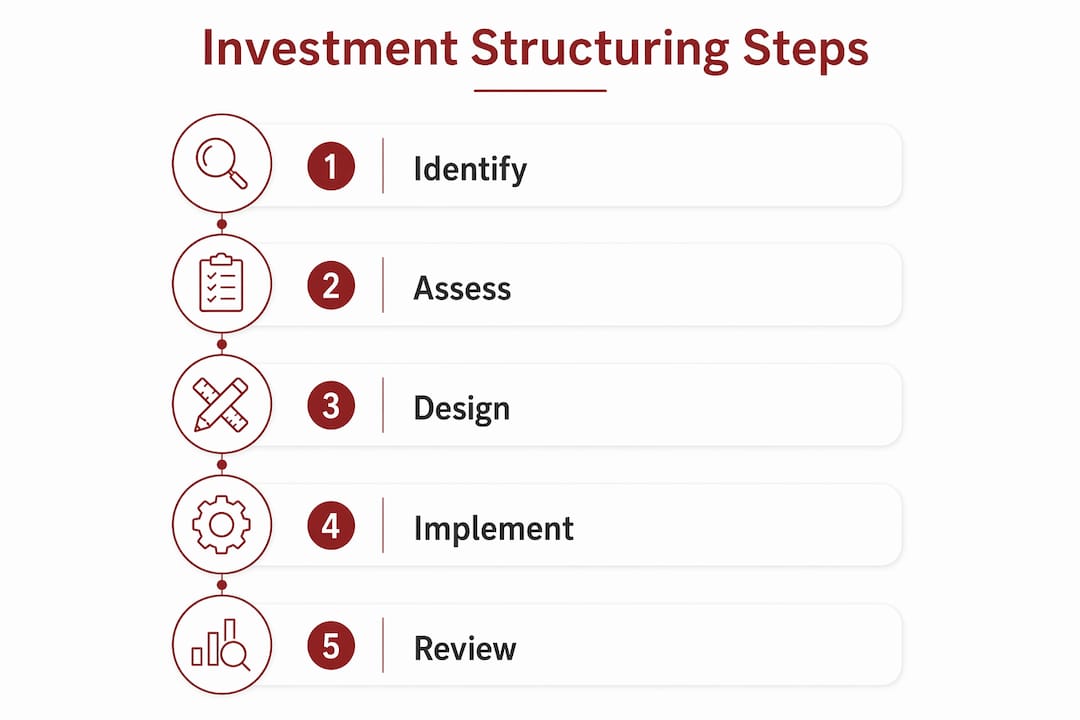
Implementation checklist:
- Define commercial objectives first: income generation, capital growth, succession, or exit
- Map the jurisdictions involved and identify treaty networks, substance requirements, and local registration rules
- Select the appropriate legal wrappers for each layer (operating, holding, financing, trust)
- Draft governance documents that separate economic and control rights
- Build substance: local boards with real responsibilities, governance calendars, documented commercial rationale
- Obtain tax opinions on treaty access, withholding positions, and anti-avoidance exposure
- Implement FATCA/CRS classification and reporting procedures
- Schedule a periodic review, at minimum every two years or on any material change
Questions to ask your advisers:
- What substance does this structure require, and who maintains it?
- How does this structure perform at exit: share sale, asset sale, or IPO?
- What are the ongoing compliance costs across all jurisdictions?
- How does the structure respond to a change in tax law in the primary operating jurisdiction?
- What happens to governance and ownership on the death or incapacity of a key principal?
Red flags: over-structuring (every new initiative does not need a new entity), ignoring substance rules, and mismatches between governance terms and tax objectives are the three most common mistakes.
Pro Tip: Schedule a structure health-check every two years. Tax law changes, business objectives shift, and a structure that was optimal at inception can become a compliance liability within a single legislative cycle.
What does implementation actually cost, and how long does it take?
| Complexity Tier | Typical Timeline | Primary Cost Drivers |
|---|---|---|
| Simple holding SPV (single jurisdiction) | 4 weeks | Jurisdiction setup fees, registered agent, basic tax opinion |
| Multi-jurisdiction holding platform | 3 months | Local counsel in each jurisdiction, substance setup, intercompany agreements |
| Trust plus holding rebuild | 4 months | Trust deed drafting, trustee fees, tax opinions, governance restructuring |
Cost drivers scale with the number of jurisdictions, substance requirements, and the complexity of governance and financing arrangements. A single-jurisdiction LLC setup costs a fraction of a multi-tier cross-border platform with substance requirements in three countries. Budget separately for ongoing compliance: annual filings, local director fees, audit requirements, and periodic tax opinions add up quickly.
Designing governance and succession into your structure
Governance is where most structures fail in practice. The legal wrappers can be perfect, but if the governance documents do not reflect the actual control and succession intentions, disputes and deadlocks follow.
Key governance levers to build in:
- Voting versus economic splits (founders retain control; investors hold economic upside)
- Director appointment rights tied to ownership thresholds
- Reserved matters requiring supermajority or unanimous consent
- Trustee protections and letter of wishes for discretionary trusts
- Transfer restrictions, tag-along and drag-along rights, and buy-sell mechanics
Pro Tip: Draft governance and succession provisions simultaneously. A tag-along right that protects minority investors can conflict with a family succession plan if the two documents are not aligned from the start. Resolve the tension in drafting, not in litigation.
Anonymized case studies: how structuring changed the outcome
Case 1: U.S. technology company expanding into Southeast Asia
A U.S.-listed technology company was acquiring operating subsidiaries across three APAC jurisdictions. Without a holding structure, each acquisition required separate local share transfers, local counsel in each market, and multiple withholding events on intercompany dividends.
Solution: A Singapore holding company was interposed above the operating subsidiaries, centralizing ownership, financing, and dividend flows. The holding company accessed Singapore's extensive treaty network, reducing withholding on dividends flowing to the U.S. parent.
Outcome: Exit was executed as a single share sale of the Singapore holding company rather than three separate local transactions, reducing friction and transaction costs materially.
Lessons: Interpose the holding layer before acquisitions, not after. Substance in the holding jurisdiction must be established early to defend treaty access.
Case 2: Family office restructuring for succession
A family office holding real estate and listed equities across the U.S. and Europe had assets held in personal names, creating estate tax exposure and no succession mechanism.
Solution: A discretionary trust was established as the apex vehicle, with a holding company beneath it for the real estate assets and direct trust ownership of the listed equities. Governance documents specified trustee succession and a letter of wishes.
Outcome: The restructure separated legal ownership from beneficial enjoyment, reduced estate tax exposure, and gave the family a clear succession mechanism without a forced sale.
Lessons: Privacy and succession planning require the trust layer. A holding company alone does not solve the generational transfer problem.
Clear next steps: moving from reading to action
- Run a structure health-check: map your current ownership chain, identify substance gaps, and flag any FATCA/CRS classification issues.
- Gather your documents: constitutional documents, intercompany agreements, existing tax opinions, and any prior structuring advice.
- Define your objectives: are you optimizing for an exit, a generational transfer, treaty access, or liability protection?
- Shortlist advisers with genuine cross-border experience, not just domestic corporate counsel.
- Request a scoping memo that covers jurisdiction selection, wrapper recommendations, governance design, and a compliance roadmap.
Go signals: you are expanding into a new jurisdiction, approaching a liquidity event, or your current structure has not been reviewed in more than two years. No-go signals: your structure is under active regulatory review or litigation, in which case stabilize first.
For cross-border corporate transactions, a scoping memo is the right first deliverable.
Key Takeaways
Investment structuring requires matching legal wrappers to commercial objectives, building genuine substance, and designing governance that survives exits, disputes, and generational transfers.
| Point | Details |
|---|---|
| Design for optionality | Build structures that support future acquisitions, exits, and succession without a full rebuild. |
| Substance is non-optional | Post-BEPS rules require real economic presence; paper-only vehicles risk treaty benefit denial. |
| Governance drives outcomes | Separate voting and economic rights, and align governance documents with succession plans from day one. |
| U.S. rules add a specific layer | CFC, PFIC, FIRPTA, and FATCA obligations must be mapped before the structure is finalized, not after. |
| Beyondhorizons | Provides cross-border investment structuring advisory drawing on Magic Circle and U.S. white-shoe backgrounds, with clients including U.S. listed companies and regional banks. |
The case for treating structuring as a dynamic discipline
Most structuring advice focuses on the setup. The harder problem is maintenance. Tax laws change, business objectives shift, and a structure that was optimal at inception can become a compliance liability within a single legislative cycle. The firms that get this right treat structuring as an iterative process, not a one-time transaction.
There is also a tendency to over-engineer. Not every new asset or jurisdiction requires a new entity. Excess entities increase administrative burden, audit risk, and governance complexity without adding proportionate protection. The discipline is knowing when to add a layer and when to hold the existing structure.
Beyondhorizons approaches structuring engagements with lawyers from Magic Circle and U.S. white-shoe backgrounds, bringing genuine cross-border depth to jurisdiction selection, governance design, and compliance architecture. The firm's clients include U.S. listed companies, Singapore government-related entities, and regional banks, which means the team has worked through the specific friction points that cross-border structures encounter in practice. A typical engagement begins with a scoping memo covering objectives, wrapper recommendations, substance requirements, and a compliance roadmap, giving clients a clear picture before committing to implementation.
Beyondhorizons: cross-border structuring advisory for businesses that operate globally
Beyondhorizons offers cross-border corporate counsel and M&A advisory for businesses that need more than a domestic law firm can deliver. The firm handles the full structuring lifecycle: jurisdiction selection, entity setup, governance drafting, tax opinion coordination, and ongoing compliance advisory across APAC, the U.S., and emerging markets.

Engagement models include a fixed-fee scoping memo, project-based implementation, and retainer advisory for clients with ongoing structuring needs. Typical deliverables include a jurisdiction analysis, wrapper recommendations, governance term sheets, and a compliance calendar. To start a conversation about your structure, contact Beyondhorizons directly through the global expertise page.
Useful sources and practitioner resources
- OECD BEPS Project — The primary reference for understanding how post-BEPS rules affect treaty access, substance requirements, and anti-avoidance measures. Start here for the principal purpose test and the multilateral instrument.
- IRS FATCA guidance — The authoritative source for FATCA classification, registration, and reporting obligations for foreign financial institutions and U.S. account holders.
- IRS FIRPTA overview — Explains withholding obligations on dispositions of U.S. real property interests by foreign persons, including the key exemptions and treaty overrides.
- IRS PFIC guidance — Instructions for Form 8621, the primary U.S. reporting form for passive foreign investment company interests; essential for U.S. investors in foreign funds or holding vehicles.
- IRS CFC and Subpart F — Covers the controlled foreign corporation rules and the income inclusions that apply to U.S. shareholders with more than 10% ownership in a foreign corporation.
- Role of a tax attorney in structuring — Practical overview of why specialist tax counsel matters for structuring decisions and dispute risk mitigation, useful for clients assembling an advisory team.
- U.S. tax treaty network (IRS) — The complete list of U.S. income tax treaties with links to treaty text; the starting point for any withholding analysis on cross-border flows.
This article is general information, not legal or tax advice. Confirm current rules with a qualified adviser for your specific situation.