
Cross-border legal services are specialized legal supports that coordinate representation, compliance, and dispute management across multiple countries and jurisdictions simultaneously. For U.S. businesses expanding into Asia, Middle Eastern companies entering American markets, or individuals managing assets across borders, these services address a core challenge: no single legal system governs international activity, yet decisions made in one jurisdiction routinely produce binding consequences in another. The scope is broad, and the stakes are high.
At their core, cross-border legal matters involve:
- Multi-jurisdictional coordination across local counsel, regulatory bodies, and courts
- Regulatory compliance covering trade, tax, data privacy, and licensing requirements
- Dispute resolution through arbitration, litigation, or negotiated settlement
- Transactional advisory on contracts, M&A, asset finance, and corporate structuring
- Enforcement management ensuring judgments and agreements hold across borders
The firms that handle this work effectively are not generalists with international contacts; they are teams with deep knowledge of how legal systems interact, where they conflict, and how to protect clients when they do.
Table of Contents
- What cross border legal services actually cover
- Key practice areas you will encounter in cross-border work
- How regional legal differences shape U.S.-centered cross-border work
- Cross border dispute resolution: what goes wrong and what works
- How to choose a cross border legal services provider
- Beyondhorizons brings integrated cross-border counsel to your work
- Key Takeaways
What cross border legal services actually cover
The breadth of cross-border legal work extends well beyond drafting international contracts. A U.S. company placing a purchase order with a supplier in Vietnam, hosting customer data on servers in Germany, or hiring a contractor in the UAE can trigger overlapping regulatory obligations in each of those jurisdictions, often without realizing it. Even minimal cross-border operations can generate sanctions screening duties, commodity classification requirements, and data privacy obligations that demand coordinated legal responses.
Operational necessities for effective cross-border counsel include:
- Licensing and professional registration in each relevant jurisdiction
- Data privacy compliance under frameworks like GDPR, CCPA, and PDPA
- Tax structuring to address double taxation exposure and transfer pricing rules
- Enforcement mechanisms for contracts and judgments across legal systems
- Technology platforms for managing document workflows, time zones, and multi-party communications
Effective cross-border corporate counsel reduces the burden of managing multiple law firms across different countries and time zones. The alternative, a patchwork of uncoordinated local advisors, creates gaps in strategy and accountability that tend to surface at the worst possible moments.
Key practice areas you will encounter in cross-border work
Cross-border legal matters rarely fit neatly into one discipline. A single international acquisition can simultaneously raise trade law, tax, employment, data privacy, and intellectual property questions. Understanding the primary practice areas helps businesses and individuals know what expertise to demand from their legal team.
- International trade law and commercial contracts: Governing the sale of goods and services across borders, including tariff classification, export controls, and cross-border commercial agreements that hold up under multiple legal systems
- International taxation: Structuring transactions to account for double taxation agreements and transfer pricing rules that affect both financial planning and regulatory exposure
- Dispute resolution: Arbitration and litigation across jurisdictions, where jurisdiction and applicable law must be negotiated carefully during contract drafting to avoid costly parallel proceedings later
- Data privacy and cybersecurity: Managing compliance across GDPR, CCPA, and sector-specific frameworks, particularly for companies handling personal data across the EU, U.S., and Asia-Pacific
- Intellectual property: Protecting patents, trademarks, and trade secrets in jurisdictions with different registration systems and enforcement standards
- Employment and labor law: Addressing cross-border employment obligations including contractor classification, secondment agreements, and termination rules that vary sharply by country
Integrating legal, tax, trade, HR, and privacy expertise under a single cross-border legal lead produces materially better compliance outcomes than managing each discipline in isolation.
How regional legal differences shape U.S.-centered cross-border work
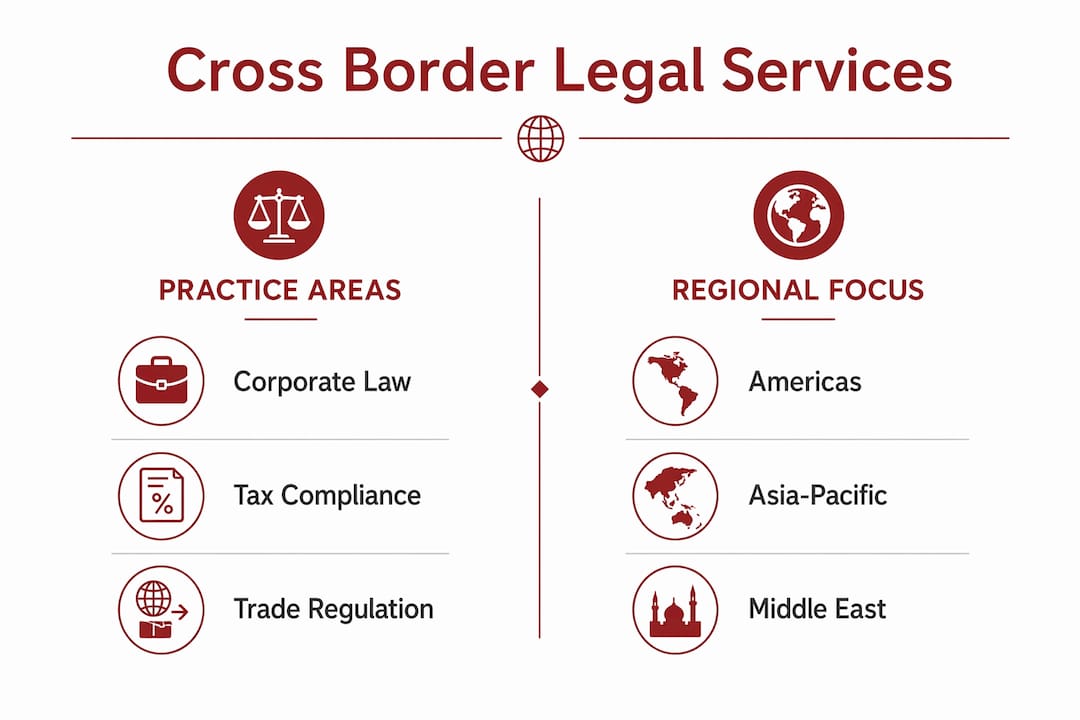
The United States operates under a common law system, but most of the world does not. Civil law jurisdictions, which govern most of continental Europe, Latin America, and large parts of Asia, interpret contracts differently, present evidence differently, and enforce judgments through different procedural mechanisms. That divide is not academic. It determines how contracts should be drafted, which dispute resolution forum to choose, and whether a judgment obtained in a U.S. court will be recognized abroad.

Americas: Canada and Mexico present the most frequent cross-border legal issues for U.S. businesses. USMCA governs trade flows, but state-level regulations, Quebec's civil law system, and Mexico's distinct corporate law framework create compliance layers that federal trade rules do not resolve.
Asia: The Asia-Pacific region presents the widest variation in legal systems, from Singapore's English common law framework to China's civil law system and India's hybrid model. Bilateral investment treaties between the U.S. and individual APAC nations affect dispute resolution rights and investment protections significantly.
Middle East: Most Gulf Cooperation Council jurisdictions operate under civil law systems influenced by Islamic law principles. Contract enforceability, arbitration recognition, and foreign ownership restrictions require specific structuring advice for U.S. companies entering these markets.
Europe: The EU's regulatory architecture, including GDPR, the EU AI Act, and the Lawyers' Services Directive requiring local registration and compliance with domestic professional rules, creates a dense compliance environment. Post-Brexit, the UK operates outside EU frameworks, adding another layer of divergence.
Practical regional compliance considerations include:
- Identifying which bilateral or multilateral treaties apply to the specific transaction or dispute
- Confirming whether local counsel registration is required for legal advice to be privileged
- Assessing foreign ownership caps and sector-specific licensing requirements
- Reviewing sanctions exposure under U.S. OFAC rules alongside local equivalents
Cross border dispute resolution: what goes wrong and what works
Cross-border disputes should be managed as enforcement and risk mitigation exercises from the outset, not as legal arguments to be won on the merits alone. A judgment that cannot be enforced where the defendant holds assets is effectively worthless, regardless of how strong the underlying claim is.
The most common failure point is misunderstanding jurisdiction and applicable law during contract drafting. When parties fail to specify which court has authority and which law governs, disputes can generate parallel proceedings in multiple countries simultaneously, each producing conflicting outcomes and compounding legal costs. Enforcing judgments across borders requires knowledge of international treaties and the location of the defendant's assets, making early legal strategy critical.
Key considerations for managing cross-border disputes effectively:
- Choose the dispute forum deliberately: International arbitration under ICC, SIAC, or LCIA rules offers enforceability advantages in most jurisdictions under the New York Convention
- Specify governing law explicitly: Ambiguity in choice-of-law clauses is one of the most expensive drafting errors in international contracts
- Map asset locations early: Enforcement strategy depends on where the counterparty holds recoverable assets
- Monitor geopolitical risk: Sanctions, export controls, and political instability can affect both the merits and the enforceability of a claim
Illustrative scenario: A U.S. technology company licenses software to a distributor in Southeast Asia. The contract specifies U.S. law but omits a dispute resolution clause. When the distributor defaults, the U.S. company obtains a judgment in a California court, only to discover that the jurisdiction where the distributor holds assets does not recognize U.S. court judgments without a bilateral treaty. An arbitration clause specifying SIAC with Singapore as the seat would have produced an enforceable award under the New York Convention in many countries. The drafting gap cost the company two years and significant legal fees.
Pro Tip: Treat dispute resolution clauses as enforcement planning, not boilerplate. The seat of arbitration, the governing law, and the arbitral rules should be chosen based on where the counterparty holds assets, not on which clause is easiest to negotiate.

How to choose a cross border legal services provider
Selecting the right provider for international legal matters is not simply a question of firm size or geographic reach. The quality of cross-border legal advice depends on how well a team integrates across disciplines and jurisdictions, not just how many offices it has on a map.
Key selection criteria:
- Jurisdictional coverage with depth: Confirm the firm has genuine expertise in the specific jurisdictions involved, not just referral relationships with local counsel
- Senior partner involvement: Specialized advisory models can deploy senior legal partners in multi-jurisdictional teams quickly for urgent matters. Insist on knowing who will actually handle your work
- Integrated teams over referral networks: A team that manages legal, tax, trade, and compliance under a single lead produces faster, more consistent advice than a loose network of independent firms
- Sector specialization: Cross-border work in aviation finance, blockchain regulation, or advanced manufacturing requires counsel who understand the commercial context, not just the legal framework
- Technology enablement: Firms using AI-assisted contract review, digital workflow platforms, and secure document management handle complex multi-party matters more efficiently
- Transparent pricing: Fixed-fee and project-based billing models reduce cost uncertainty on matters with defined scope. Hourly billing on open-ended international matters can escalate quickly
- Credentials and rankings: Chambers and Partners, Legal 500, and Asia Legal Business rankings provide independent verification of expertise and client satisfaction
Building brand authority in the legal sector is one signal of a firm's commitment to its practice area. Look for firms that publish substantive guidance on the specific cross-border issues you face, not just general marketing content.
Pro Tip: Ask prospective counsel to describe a recent matter involving your specific jurisdictions and practice area. The specificity of their answer tells you more than any directory ranking.
Beyondhorizons brings integrated cross-border counsel to your work

For businesses and individuals who need cross-border legal work done at a high commercial standard, Beyondhorizons offers a genuinely different model. Rather than routing matters through referral networks, Beyondhorizons deploys integrated teams of lawyers trained at Magic Circle and U.S. white shoe firms, ranked on Chambers, Legal 500, and Asia Legal Business, who handle transactions, regulatory compliance, and disputes as a single coordinated effort.
The firm's strengths span cross-border M&A, aviation finance, blockchain and digital assets, robotics and automation, AI governance, and emerging markets across APAC. Clients include U.S. listed companies, Singapore government-linked entities, and regional banks. Beyondhorizons also offers fractional general counsel arrangements for businesses that need senior legal oversight without the cost of a full-time hire.
If your matter involves the U.S., Asia, or the Middle East, and you need counsel who can manage the full picture rather than hand it off, reach out to Beyondhorizons to discuss your specific situation.
Key Takeaways
Cross border legal services require integrated expertise across jurisdictions, disciplines, and legal systems to protect businesses and individuals from costly enforcement failures and compliance gaps.
| Point | Details |
|---|---|
| Jurisdiction and governing law | Specify both explicitly in every international contract to prevent parallel proceedings and unenforceable judgments. |
| Regional legal system differences | Common law and civil law jurisdictions handle contracts, evidence, and enforcement differently, requiring tailored strategies. |
| Dispute resolution forum | Arbitration under recognized rules (ICC, SIAC, LCIA) produces enforceable awards under the New York Convention in many countries. |
| Provider selection criteria | Prioritize integrated teams with sector depth, senior partner involvement, and transparent pricing over large referral networks. |
| Beyondhorizons | Offers Magic Circle and white shoe-trained counsel for cross-border transactions, regulatory compliance, and disputes across APAC and beyond. |