
Choose NIST AI RMF when you need fast, operational risk mapping and no external audit is required yet. Choose ISO/IEC 42001 when a client, regulator, or procurement team demands independent certification. Most mature programs run NIST first to build the risk engine, then wrap those artifacts into an ISO 42001 management system when certification becomes commercially necessary. NIST stays voluntary; ISO 42001 is certifiable.
TL;DR:
- NIST AI RMF provides rapid, iterative risk mapping for individual AI systems, producing tangible artifacts suitable for internal use within weeks.
- ISO 42001 offers a certifiable management system aligned with existing ISO standards, requiring six to eighteen months depending on scope and documentation maturity.
- Practitioners typically adopt NIST first to build a robust risk engine, then frame artifacts within ISO 42001 for external certification and compliance needs.
- Crosswalks are available to map NIST outputs directly into ISO clauses, streamlining the integration process and avoiding duplicate work.
- Procurement and legal negotiations increasingly favor ISO 42001 certification as a credible external assurance, especially under EU AI Act considerations.
Table of Contents
- What Is ISO 42001 and What Does Certification Deliver?
- What Is NIST AI RMF and What Does It Actually Produce?
- How Do NIST AI RMF and ISO 42001 Compare?
- How Do You Map NIST AI RMF Outputs Into ISO 42001?
- Which Framework Should You Adopt First? A Decision Checklist
- Where Legal and Procurement Risk Actually Live
- A Publisher's Take on the NIST vs ISO Debate
- Getting AI Governance Right Across Borders
- Sources
- FAQ
What Is ISO 42001 and What Does Certification Deliver?
ISO/IEC 42001:2023 is the first international, certifiable standard built specifically for an AI management system, or AIMS. It follows the Annex SL structure that governs every modern ISO management standard, from clauses 4 through 10, covering context, leadership, planning, support, operation, performance evaluation, and improvement. If your organization already holds ISO 27001 or ISO 9001, this skeleton will look familiar. That overlap is deliberate and it is one of the reasons ISO 42001 adoption moves faster inside organizations that already run an ISO-based management system.
The distinctive part sits in Annex A, a set of controls addressing the AI lifecycle specifically: data governance, third-party and supplier relationships, AI impact assessments, and ongoing monitoring of deployed models. An organization does not just write a policy and call it done. Auditors expect a documented trail showing the policy was applied.
That trail typically includes:
- A defined AIMS scope statement identifying which AI systems, business units, and use cases fall under governance.
- A board-approved AI policy tied to organizational risk appetite.
- A Statement of Applicability explaining which Annex A controls apply and why others were excluded.
- Records of management review meetings where leadership actually discusses AI risk.
- Evidence from internal audits and, once certified, surveillance audits on a recurring cycle.
Certification itself runs through an accredited certification body using familiar Stage 1 and Stage 2 audit steps, the same two-phase process organizations know from ISO 27001. Stage 1 checks documentation readiness; Stage 2 tests whether the system actually operates as documented. Surveillance audits then continue annually.
Timelines vary with scope. Organizations with fewer AI use cases and existing ISO infrastructure may reach certification readiness in a shorter time frame. Larger enterprises with many models across multiple business units, no prior ISO experience, and distributed ownership of AI systems typically require a longer period for certification readiness. Cost depends similarly on the number of systems in scope, documentation maturity, and internal audit capabilities.
Certification matters most when a buyer, regulator, or investor needs proof they can point to without reading your internal risk register, as explained in this Cybersecurity guide for legal professionals: Protect client data. A procurement team evaluating vendors under a supply-chain security mandate will often accept "ISO 42001 certified" as a checkbox where "we follow a risk framework" requires a longer conversation.
What Is NIST AI RMF and What Does It Actually Produce?
The NIST AI RMF is a voluntary risk framework built around four functions: Govern, Map, Measure, and Manage. NIST designed it as outcomes-based guidance rather than a prescriptive checklist, which gives engineering and risk teams room to adapt it to their own AI stack.
Each function produces something concrete:
- Govern establishes accountability structures, policies, and risk tolerance, the organizational scaffolding everything else hangs on.
- Map identifies context: what the AI system does, who it affects, and what could go wrong for those stakeholders.
- Measure applies quantitative and qualitative methods to test whether identified risks are actually present and at what severity.
- Manage allocates resources to treat prioritized risks and tracks whether treatments work over time.
NIST published AI RMF 1.0 in January 2023, and it arrived with companion resources built for practitioners rather than executives. The Playbook translates each function into suggested actions and implementation tactics. Profiles let an organization describe a current state versus a target state for a specific use case, giving risk teams a way to track progress that isn't binary. NIST followed up with the Generative AI Profile, AI 600-1, in July 2024, addressing risks specific to large language models: hallucination, synthetic content misuse, and prompt-based manipulation.
Working through the framework generates real artifacts: risk maps tied to specific systems, measurement plans defining what "acceptable" looks like for a given metric, current and target profiles showing gap and progress, and treatment records documenting how identified risks were addressed. None of that requires external validation to be useful internally.
Pro Tip: Start your NIST work with one high-risk AI system rather than an organization-wide rollout. A single detailed Map and Measure cycle produces a template your team can replicate faster than trying to govern everything at once.
Teams often adopt RMF first precisely because it produces usable output within weeks, not months, and doesn't require budgeting for an external audit before you've even confirmed the framework fits your operations.
How Do NIST AI RMF and ISO 42001 Compare?
Both frameworks address the same underlying problem: how do you know your AI systems are actually being governed, not just discussed in a slide deck? They diverge sharply in mechanics, and understanding the following distinctions determines which one solves your immediate problem.
| Dimension | NIST AI RMF | ISO 42001 |
|---|---|---|
| Certifiable / assurance signal | No third-party certification; voluntary framework | Yes, certifiable by accredited bodies with recurring surveillance audits |
| Primary scope and structure | Four functions (Govern, Map, Measure, Manage) applied per use case | Annex SL management-system clauses (4–10) plus Annex A AI-specific controls |
| Operational depth vs management-system framing | Deep technical granularity useful to engineering and validation teams | Broader management-system alignment focused on governance and audit trails |
| Typical timeline and cost drivers | Weeks to a few months per profile; driven by number of use cases assessed | Six to eighteen months; driven by AIMS scope, control count, and existing ISO maturity |
| Regulatory alignment and procurement value | Strong fit for US federal guidance and internal risk maturity | Strong fit for EU AI Act conversations and supply-chain certification requirements |
| Best-for / sequencing | Fast operational start, engineering buy-in, iterative risk work | External proof point for regulators, clients, and procurement gatekeepers |
The practical distinction practitioners raise most often: NIST gives engineering and validation teams granular subcategories they can actually work against day to day, while ISO 42001 gives leadership and sales teams an audit-ready story to tell external parties. Neither replaces the other.
Geography plays a role too. Organizations with heavy US federal exposure often gravitate to NIST because agencies and federal contractors reference it directly. Organizations selling into the EU or responding to enterprise procurement questionnaires increasingly find ISO 42001 certification requested by name, particularly as the EU AI Act's conformity requirements push buyers toward recognized management-system evidence.
A pattern many practitioners describe: run NIST AI RMF as the operational risk method first, then frame the resulting artifacts inside an ISO 42001 AIMS when certification becomes necessary. This sequencing avoids doing the risk assessment work twice.
How Do You Map NIST AI RMF Outputs Into ISO 42001?
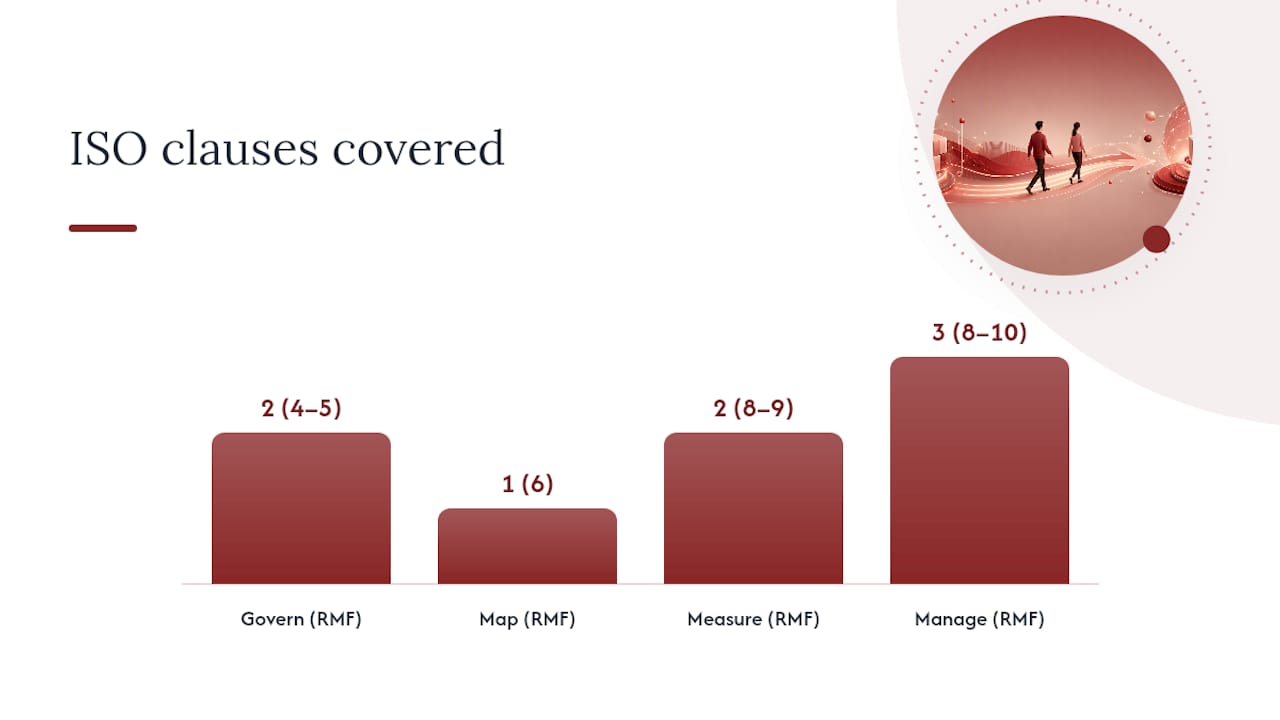
NIST maintains an official crosswalk document mapping each RMF function to specific ISO clauses, and it's the single most useful artifact for anyone trying to avoid duplicate work. Govern aligns broadly to ISO clauses 4 and 5, covering context and leadership. Map aligns to clause 6, planning and risk identification. Measure aligns to clauses 8 and 9, operational controls and performance evaluation. Manage aligns across clauses 8 through 10, covering treatment and continual improvement.
In practice, teams follow a fairly consistent sequence:
- Run RMF assessments against priority AI systems, generating current and target profiles.
- Assemble the resulting documentation: risk maps, measurement plans, treatment records.
- Perform a gap analysis against ISO 42001's Annex SL clauses and Annex A controls using the crosswalk.
- Draft the Statement of Applicability, noting which Annex A controls the RMF evidence already satisfies.
- Prepare for Stage 1 and Stage 2 certification audits, closing any gaps the mapping exposed.
A risk map built during the Map function typically satisfies both an RMF deliverable and an Annex A impact assessment control simultaneously. Measurement plans double as evidence for ISO's performance evaluation clause.
Pro Tip: Keep a single evidence register from day one, tagged against both the RMF function and the ISO clause it satisfies. Retrofitting that mapping after twelve months of ad hoc documentation is far more painful than tagging as you go.
The most common pitfall: assuming operational artifacts translate automatically without adjustment. RMF documentation is often written for engineers; ISO auditors expect governance framing, ownership, and dated review cycles. Add that layer before the audit, not during it.
Which Framework Should You Adopt First? A Decision Checklist
Before committing budget, answer five questions honestly:
- Does a client, regulator, or investor require external certification, or would an internal risk framework satisfy the current need?
- Does your organization already run an ISO management system (27001, 9001), giving you Annex SL familiarity?
- Do you have meaningful US federal government exposure where NIST is the expected reference point?
- Is speed more urgent than auditability right now, or the reverse?
- How many distinct AI systems and stakeholder groups need governance, and who owns that coordination?
Timeline bands help set stakeholder expectations early. A focused NIST profile for one or two AI use cases typically takes one to three months. Full ISO 42001 certification readiness runs six to eighteen months depending on scope and existing documentation maturity, consistent with ISO's own certification process expectations. A combined path, running NIST first and certifying against ISO 42001 afterward, generally adds certification time on top of the NIST work rather than running the two in parallel from scratch.
A note on scope: the widest cost and timeline variance in ISO 42001 projects comes from how many AI systems are in scope, not from the standard itself. Narrowing the AIMS scope to your highest-risk systems first is the single biggest lever for controlling both.
The minimum viable output under NIST is a completed current-and-target profile for your highest-risk system. Under ISO, it's a draft AIMS scope statement and gap analysis. Bring in legal counsel or a certification body once you're drafting the Statement of Applicability or negotiating contract language that references either framework.
Where Legal and Procurement Risk Actually Live
Certification and operational evidence read differently in a contract. A certificate is a binary fact a counterparty can verify. An internal risk framework requires the other side to trust your representations, which is why procurement teams increasingly write audit rights and evidence-scope clauses directly into vendor agreements rather than accepting a narrative.
Anticipate a few recurring points in negotiations:
- Audit rights: does the counterparty want the right to inspect your AIMS documentation, or will a certificate suffice?
- Evidence scope: which AI systems does the contract's governance language actually cover, and does that match your certified scope?
- Supplier certification requirements: are you now obligated to require ISO 42001 or equivalent from your own AI vendors?
- Cross-border data flow constraints tied to where models are trained, hosted, or monitored.
Jurisdictional obligations compound quickly once an AI system touches multiple markets. A model governed under one country's data protection regime may trigger separate transfer requirements the moment training data or inference logs cross a border. That's a conversation for regulatory compliance counsel, not a framework document, and it's worth raising before a contract is signed rather than after an audit finding.
A Publisher's Take on the NIST vs ISO Debate
The organizations that get this right rarely treat it as a binary choice, and the ones that struggle almost always picked one framework and tried to make it answer a question it wasn't built for. A fast-moving engineering team chasing an enterprise deal usually needs ISO 42001's certificate more than it needs another risk taxonomy. A regulated bank already buried in ISO 27001 paperwork usually gets more immediate value from NIST's granular, use-case-level profiles than from adding another management-system layer it will negotiate internally for a year.
The pattern worth trusting is sequencing, not selection. Build the risk engine with NIST, then let ISO 42001 become the certificate that proves the engine works. Skipping straight to certification without operational substance behind it produces exactly the kind of audit finding that damages credibility with the buyer you were trying to reassure.
— HL
Getting AI Governance Right Across Borders
Legal counsel advises organizations navigating exactly this decision, from mapping NIST AI RMF work into an ISO 42001 readiness plan to negotiating the audit rights and supplier clauses that show up once certification enters a contract. Where a generic compliance consultancy stops at documentation templates, experienced lawyers add the cross-border regulatory reading that turns a governance framework into something a counterparty, regulator, or procurement team will actually accept.

If your organization operates across Singapore, the wider APAC region, or is negotiating AI-related terms with counterparties in other jurisdictions, our AI governance advisory practice supports certification readiness reviews, contract negotiation on AI-specific clauses, and cross-border regulatory mapping. Contact Beyond Horizons for a tailored readiness assessment before your next AI governance milestone or vendor negotiation.
Sources
- NIST AI RMF core functions (Govern, Map, Measure, Manage)
- Artificial Intelligence Risk Management Framework (AI RMF 1.0) | NIST
- ISO/IEC 42001 — International Organization for Standardization
FAQ
Is There a NIST AI RMF Certification?
No. NIST AI RMF is a voluntary framework with no certification body or credential attached; organizations self-assess against it or use it to build toward a certifiable standard like ISO 42001.
Is NIST AI RMF a Standard?
It's a voluntary risk management framework, not a certifiable standard. NIST published it as guidance rather than a requirement organizations can be audited and certified against.
Can You Use NIST AI RMF and ISO 42001 Together?
Yes, and it's the most common practical path. Organizations run NIST's Govern, Map, Measure, and Manage functions to generate risk evidence, then map that evidence to ISO 42001 clauses using the official crosswalk to prepare for certification.
Which Framework Does the EU AI Act Reference?
The EU AI Act does not mandate either framework by name, but ISO 42001 certification is increasingly accepted as supporting evidence of conformity for procurement and regulatory conversations. Organizations with EU exposure or cross-border obligations should get tailored regulatory advice rather than assume certification alone satisfies every requirement.
How Long Does ISO 42001 Certification Take Compared to a NIST Profile?
A focused NIST profile for one or two AI systems typically takes one to three months, while full ISO 42001 certification readiness runs six to eighteen months depending on scope and existing documentation maturity.