
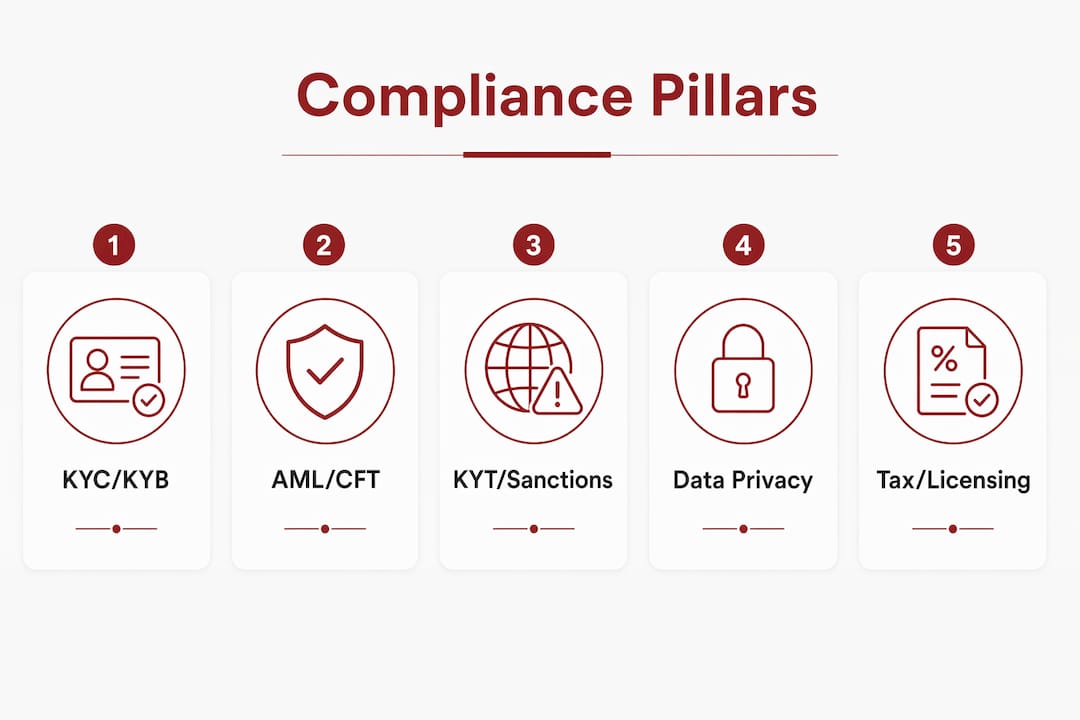
Blockchain compliance is the integrated set of legal, operational, and technical controls that allow a US-based company to run tokenized assets and cross-border digital-asset flows while satisfying FinCEN, OFAC, SEC, CFTC, IRS, and state regulators simultaneously. The five mandatory pillars every corporate program must cover are:
- KYC/KYB — identity verification for counterparties and business entities before any transaction
- AML/CFT program design — written policies, risk assessments, and suspicious-activity reporting
- KYT and sanctions screening — real-time transaction monitoring and OFAC list checks
- Data privacy protection — keeping personal data off-chain and compliant with applicable privacy law
- Tax reporting and licensing — IRS Form 1099-DA obligations, state money-transmitter licenses, and FinCEN MSB registration where required
The immediate next step for any corporate team is a cross-border gap analysis, followed by a Policy-as-Code pilot, with legal, compliance, and engineering owners assigned before the first sprint.
Pro Tip: Run the gap analysis against all five pillars simultaneously. Addressing KYC in isolation while leaving KYT unbuilt is the single most common reason programs fail their first regulatory examination.
Table of Contents
- Which US regulators govern blockchain activity?
- What are the five core pillars and who owns each control?
- How do you move from manual controls to Policy-as-Code?
- Travel Rule, DeFi, and privacy conflicts: where standard controls fail
- What does audit-ready actually look like?
- When should you hire a blockchain and crypto law firm?
- Key Takeaways
- The compliance gap most corporate teams are still ignoring
- Beyondhorizons: cross-border blockchain compliance counsel
- Useful sources for compliance teams
Which US regulators govern blockchain activity?
Six primary authorities shape the US digital asset regulation environment, and their mandates frequently overlap on a single cross-border transaction.

| Regulator | Primary mandate | Key threshold or trigger |
|---|---|---|
| FinCEN | BSA/AML, MSB registration, Travel Rule | recordkeeping thresholds, Suspicious Activity Reports, and Currency Transaction Reports |
| OFAC | Sanctions screening, blocking transactions | Any transaction touching a designated party or jurisdiction |
| SEC | Securities law for tokens that qualify as securities | Howey test analysis; broker-dealer and exchange registration |
| CFTC | Commodity derivatives and spot commodity tokens | Commodity Exchange Act jurisdiction over Bitcoin, Ether |
| IRS | Tax reporting, cost-basis tracking | 1099-DA reporting; capital gains on every disposal |
| State (e.g., NYDFS) | Money-transmitter licensing, BitLicense | State-by-state; NYDFS BitLicense for NY activity |
The FATF Travel Rule requires originator and beneficiary information to accompany virtual-asset transfers, with FinCEN's recordkeeping threshold set at a defined amount for certain transfers. Cross-border friction compounds quickly: a single payment routed through a European VASP triggers EU privacy obligations that conflict with on-chain immutability, OFAC's extraterritorial reach, and the Travel Rule's data-transmission requirements all at once.
Enforcement is not theoretical. DOJ fined OKX over $500 million for AML failures, a figure that reframes the cost-benefit calculation for every compliance budget conversation.
What are the five core pillars and who owns each control?
Effective compliance moves from periodic manual reviews to real-time, automated monitoring. Each pillar has a primary owner and a secondary stakeholder who must stay in the loop.
- KYC/KYB (Legal + Compliance own; Ops executes). Off-chain identity stores hold verified documents; only a hash or pointer goes on-chain. Business counterparties require enhanced due diligence, including UBO verification and sanctions screening at onboarding and on a periodic refresh cycle.
- AML/CFT program design (Compliance owns; Legal reviews). A written BSA/AML policy, designated compliance officer, independent audit, and employee training program are the minimum. Risk assessments must be updated when new token types or corridors are added.
- KYT and sanctions screening (Engineering builds; Compliance monitors). Blockchain analytics paired with traditional AML monitoring provide real-time visibility into high-risk wallets and complex fund flows. Chainalysis and similar platforms enrich alerts automatically, shortening investigation time and supporting SAR filings.
- Data privacy (Legal + Engineering co-own). GDPR's right to erasure conflicts with blockchain's append-only architecture. The EDPB's guidance confirms that on-chain erasure is often technically impossible; keeping personal data off-chain with only hashes on-chain is the recognized fix. US state privacy laws add parallel obligations for California and other regulated states.
- Tax reporting and licensing (Legal owns; Finance executes). IRS cost-basis tracking applies to every disposal. State licensing maps must be maintained as the business scales to new corridors.
KYC feeds KYT directly: a counterparty flagged during onboarding should trigger elevated monitoring thresholds in the transaction monitoring system, not a separate manual process.
How do you move from manual controls to Policy-as-Code?
The recommended sequence is: gap analysis → pilot Policy-as-Code → scale controls → continuous monitoring and audit. Treating compliance as infrastructure from the start avoids the costly retrofits that plague programs built on spreadsheets and email approvals.
- Define scope and owners. Map every digital-asset flow, identify the applicable regulator for each leg, and assign a named owner (Legal, Compliance, Engineering) to each control.
- Document current-state controls. Record what exists, what is manual, and where gaps sit relative to the five pillars.
- Select tooling. Integrate an identity/verification provider for KYC, a KYT analytics platform (Chainalysis is widely used), and a sanctions-list orchestration layer.
- Build the Policy-as-Code pilot. Embed allowlists in smart contracts so transfers to non-KYC'd addresses revert automatically before settlement, eliminating post-trade remediation.
- Connect off-chain data via oracles. The Chainlink Automated Compliance Engine and similar oracle patterns let smart contracts fetch sanctions lists and identity verification results without exposing personal data on-chain.
- Set test metrics and success criteria. Define alert volume, false-positive rate, SAR filing time, and sanctions-hit rate as measurable outcomes before go-live.
- Run a 30-day pilot and document results. Pilot output becomes the first entry in your audit trail.
- Scale and train staff. Certifications such as the Chainalysis Certified Compliance Analyst and ACAMS CCAS designation upskill teams managing digital-asset risk.
Pro Tip: Embed compliance logic in smart contracts for pre-trade enforcement and maintain an immutable off-chain audit trail — regulators want to see both the control and the evidence it fired.
Travel Rule, DeFi, and privacy conflicts: where standard controls fail
The top edge issues that materially change program design are the Travel Rule, DeFi counter-party ambiguity, and the conflict between privacy law and on-chain immutability. Each requires a distinct mitigation pattern rather than a generic policy update.
- Travel Rule. Pre-trade screening against VASP directories, interoperable messaging standards (such as IVMS 101), and contractual VASP onboarding requirements are the practical controls. The Travel Rule is a top operational concern for compliance officers because it forces transmission of originator and beneficiary data in ways that interact poorly with DeFi and privacy-enhancing technology.
- DeFi counter-party ambiguity. Anonymous counter-parties and composability mean standard KYC cannot be completed before a transaction executes. Mitigation patterns include permissioned rails, oracle-based provenance checks, and transaction-freeze mechanisms where contract governance permits. For DeFi-specific legal risk, the structural question is whether the protocol itself constitutes a money-services business under FinCEN guidance.
- Privacy conflicts. GDPR Article 17 is often technically incompatible with public ledgers. Leading practice is off-chain personal data storage, on-chain hashes or pointers, and cryptographic key destruction where erasure is required. A ZK-KYC approach, where a zero-knowledge proof attests that a user passed KYC without revealing the underlying data, is gaining traction for privacy-preserving compliance.
"The right to erasure may be technically impossible to implement on a public blockchain. Storing personal data off-chain and anchoring only a cryptographic hash on-chain is the approach recognized by supervisory authorities as consistent with data protection obligations." — EDPB blockchain guidance
What does audit-ready actually look like?
Audit-ready means auditable off-chain identity records, immutable transaction logs, real-time KYT alerts, and documented control tests that a regulator or counterparty can review on request.
| Milestone | What it proves | Recommended cadence |
|---|---|---|
| Initial gap analysis | Baseline control gaps vs. five pillars | Once at program launch |
| Policy-as-Code pilot results | Pre-trade controls fire correctly | 30-day pilot; document outcomes |
| Controls testing | Alert thresholds, SAR filing time, false-positive rate | Quarterly |
| Independent audit | Program-wide effectiveness | Annual minimum |
| Periodic review | New corridors, token types, regulatory changes | Semi-annual or on material change |
Indicative cost bands vary by program maturity. An initial build covering tooling, legal design, and a Policy-as-Code pilot typically runs in the range of $150,000–$400,000 for a mid-size corporate, depending on the number of jurisdictions and token types in scope. Ongoing operational costs, covering KYT licensing, staffing, and annual audit, commonly run $80,000–$200,000 per year. The OKX enforcement outcome illustrates the alternative: a nine-figure penalty dwarfs any compliance budget.
- Keep SAR filing time under 30 days from alert to submission.
- Retain transaction records for at least five years per BSA requirements.
- Test sanctions-screening coverage after every OFAC list update.
- Document every control change with a dated, signed record.
When should you hire a blockchain and crypto law firm?
Hire counsel when gaps affect registration, licensing, Travel Rule compliance, cross-border sanctions exposure, or when your team plans to embed compliance logic in smart contracts. Waiting until a regulator asks questions is the most expensive timing decision a compliance team can make.
Red flags requiring immediate counsel:
- Unclear custody arrangements or unresolved questions about whether tokens are securities
- Any DeFi integration where counter-party identity cannot be established pre-trade
- Multi-jurisdictional tax exposure with no documented cost-basis methodology
- Unresolved data residency or privacy conflicts between US and non-US regulators
- Smart contract deployment with no legal review of the embedded compliance logic
Sample RFP questions for a blockchain and crypto law firm:
- What is your experience designing Policy-as-Code programs for cross-border corporate clients?
- Can you provide examples of cross-border enforcement matters you have advised on?
- How do you structure fixed-fee pilots versus ongoing retainer engagements?
- Which KYT analytics platforms does your team work with directly?
- How do you coordinate between legal, compliance, and engineering teams on a pilot?
Avoid firms that cannot demonstrate technology integration expertise, have no cross-border enforcement experience, and offer no structured audit process. Law alone, without operationalization, is insufficient — effective programs combine legal advice with operational analytics and specialist staff training.
Also review 2026 Web3 compliance trends to benchmark what peer firms are building into their RFP requirements this year.
Key Takeaways
Blockchain compliance requires five integrated pillars, a phased Policy-as-Code implementation, and cross-border legal counsel engaged before gaps become enforcement events.
| Point | Details |
|---|---|
| Five mandatory pillars | KYC/KYB, AML/CFT, KYT/sanctions, data privacy, and tax/licensing are the non-negotiable baseline. |
| Policy-as-Code first | Embed compliance logic in smart contracts pre-trade; post-trade remediation is slower and costlier. |
| Keep PII off-chain | Store personal data off-chain with hashes on-chain; cryptographic key destruction handles erasure obligations. |
| Enforcement risk is real | The OKX $500M+ penalty shows the economics of underinvestment versus a structured compliance program. |
| Beyondhorizons for cross-border counsel | Beyondhorizons provides integrated legal and Policy-as-Code design for US cross-border blockchain engagements. |
The compliance gap most corporate teams are still ignoring
The conventional wisdom says blockchain compliance is primarily a legal problem. Get the right policies, file the right registrations, and you are covered. That framing is wrong, and it is costing companies real money.
The actual failure mode is not missing a policy document. It is building legal controls that exist entirely outside the technical system they are supposed to govern. A KYC policy that lives in a PDF while the smart contract accepts transfers from any address is not a compliance program. It is a liability with good documentation.
What changes the outcome is treating compliance as an engineering constraint from day one, not a legal wrapper applied afterward. Policy-as-Code is not a vendor pitch. It is the only architecture that closes the gap between what the policy says and what the system actually does. The firms that understand this are attracting institutional capital. The ones that do not are discovering it during enforcement.
The second underestimated issue is cross-border sequencing. US corporates often build their FinCEN program first and treat EU privacy obligations, APAC licensing, and Travel Rule interoperability as later problems. They are not later problems. They interact with the US controls at the transaction level, and retrofitting is always more expensive than designing for them upfront.
Beyondhorizons: cross-border blockchain compliance counsel
Beyondhorizons offers something most firms cannot: a team that combines Magic Circle and US white-shoe legal training with a genuinely digital-first delivery model, purpose-built for cross-border corporate engagements. For companies running digital-asset programs across multiple jurisdictions, that combination means your compliance architecture gets designed correctly the first time rather than rebuilt after a regulatory examination.

Engagement options are structured to match where your program actually is. A fixed-fee gap analysis and Policy-as-Code pilot scopes the work, identifies the gaps, and delivers a documented pilot result in 60–90 days. Ongoing retainer arrangements cover regulatory monitoring, control updates, and audit support as your program scales. Project-based billing is available for discrete matters such as licensing applications, SAR process design, or smart contract compliance review.
Beyondhorizons' lawyers are ranked on Chambers, Legal 500, and Asia Legal Business, and the firm's regulatory compliance counsel practice spans FinCEN, OFAC, SEC, and CFTC matters alongside APAC licensing and cross-border expansion. To request a scope or submit an RFP, contact the team through the cross-border corporate counsel page. A gap analysis and pilot proposal is the recommended first engagement.
Useful sources for compliance teams
- FinCEN — BSA/AML guidance, MSB registration requirements, and Travel Rule implementation: fincen.gov
- OFAC — Sanctions lists, compliance frameworks, and enforcement actions: ofac.treas.gov
- FATF — Virtual asset guidance and Travel Rule standards: fatf-gafi.org
- EDPB — Blockchain and GDPR guidance on data protection conflicts and off-chain storage patterns
- Chainalysis — KYT analytics and compliance solutions; Certified Compliance Analyst training program
- Chainlink — Policy-as-Code and oracle patterns for smart contract compliance
- Grant Thornton — Crypto compliance 2026 industry overview and enforcement trends
- Beyondhorizons — Blockchain and digital assets practice; regulatory compliance counsel; IP and data privacy counsel