
A governing law clause tells a court or tribunal which country's or state's substantive rules apply when interpreting a contract and resolving disputes over it. Courts generally respect a genuine, freely negotiated choice, but that respect has limits: certain mandatory local rules survive no matter what the parties picked. The single most important drafting habit is naming a specific jurisdiction and adding "without regard to conflict of laws" so an unwanted legal system cannot sneak in through the back door.
TL;DR:
- Using a conflict-of-laws waiver in governing law clauses prevents courts from applying unwarranted foreign laws through renvoi.
- Broad scope clauses that include contract and non-contractual claims reduce coverage gaps for torts and statutory disputes.
- Enforceability depends on matching governing law with dispute resolution methods; mismatched choices can create complications.
- Mandatory local rules, especially in employment and consumer protection, often survive a governing law clause and require explicit carve-outs.
- Proper drafting involves explicit jurisdiction selection, scope definition, and alignment with enforcement mechanisms to avoid costly disputes.
Table of Contents
- Sample Governing Law Clauses You Can Adapt
- Governing Law vs. Jurisdiction: Why the Distinction Trips People Up
- A Five-Step Checklist for Drafting an Enforceable Clause
- How Governing Law Interacts With Arbitration and Cross-Border Enforcement
- Common Mistakes That Undermine an Otherwise Solid Clause
- When Cross-Border Deals Need Specialist Drafting
- A Practitioner's View on Negotiating This Clause
- Bespoke Governing Law Drafting From Beyondhorizons
- Sources
Sample Governing Law Clauses You Can Adapt
Most disputes over this clause trace back to lazy drafting, not bad luck. A few tested patterns cover the majority of commercial situations.
- Basic single-jurisdiction clause: "This Agreement shall be governed by the laws of Singapore."
- With a conflict-of-law waiver: "This Agreement shall be governed by the laws of the State of New York, without regard to its conflict of laws principles." This phrasing appears constantly in public company filings, and its popularity isn't accidental. It blocks a court from applying another jurisdiction's law through a private international law detour.
- Narrow scope (contract claims only): "This Agreement shall be governed by and construed in accordance with the laws of England and Wales." Read narrowly, this can leave tort or statutory claims arising from the same relationship governed by a different law entirely.
- Broad scope (contract plus related claims): "This Agreement, and any dispute or claim arising out of or in connection with it, whether contractual or non-contractual, shall be governed by the laws of Singapore." Adding "non-contractual" closes the gap the narrow version leaves open, a distinction Nolo's guidance on choice-of-law drafting flags as a frequent source of unintended coverage gaps.
- Paired with arbitration: "Governed by the laws of Singapore. Any dispute shall be finally resolved by arbitration administered by SIAC, seated in Singapore." New York and Delaware law remain the default choices for many US-facing agreements, a pattern visible across the Law Insider governing law clause repository.
Governing Law vs. Jurisdiction: Why the Distinction Trips People Up
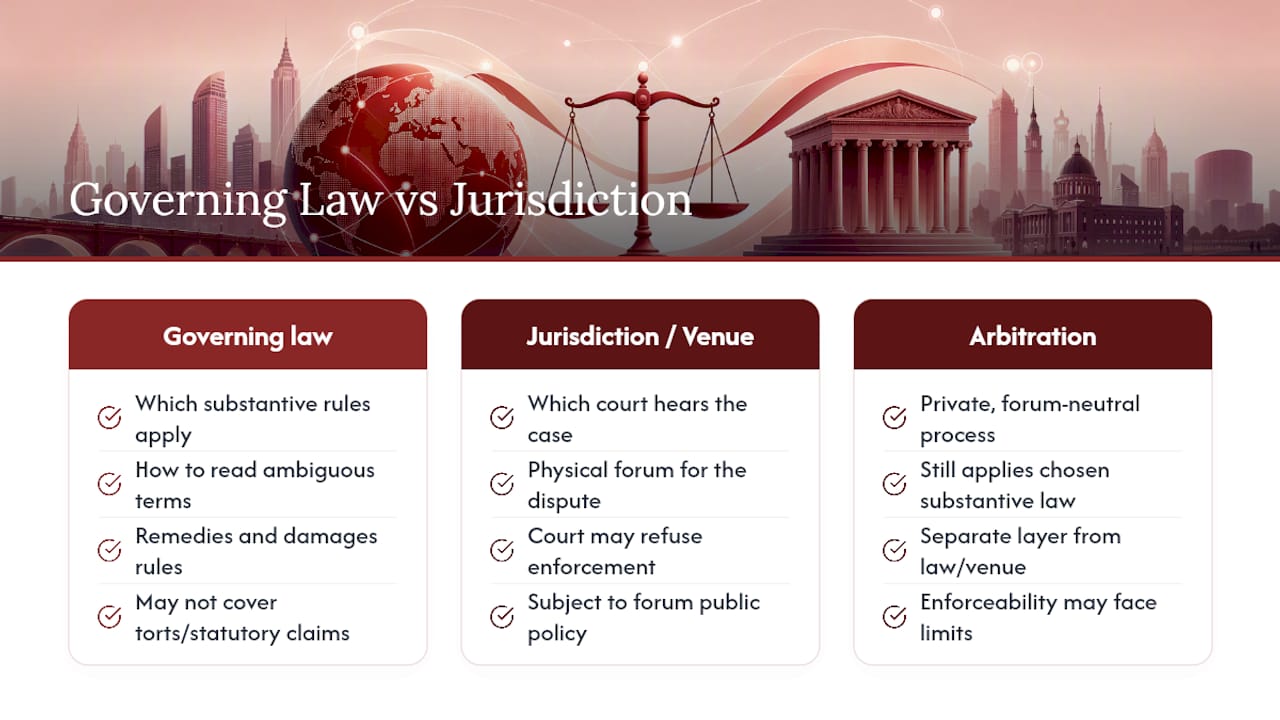
Governing law and jurisdiction answer two different questions, and conflating them is the most common drafting error counsel see. Governing law decides which substantive rules interpret the contract: how to read an ambiguous term, what remedies apply, how damages get calculated. Jurisdiction (or venue) decides which court physically hears the case. Arbitration adds a third, separate layer: a private forum-neutral process that still applies whatever substantive law the parties chose.
A clause silent on scope typically covers contractual interpretation and remedies but may not automatically extend to torts or statutory claims connected to the deal. Good drafting states this explicitly rather than leaving it to a judge's inference.
Party autonomy isn't absolute. Chambers' commercial contracts practice guide confirms that courts generally uphold bona fide choice-of-law clauses, provided they aren't contrary to public policy or used to dodge protections the parties couldn't otherwise waive. Certain subjects, notably consumer protection and employment terms, sit outside contractual choice entirely in many jurisdictions. Singapore's Unfair Contract Terms Act 1977 is one concrete example of a statute that limits how far parties can contract out of local protections, and equivalents exist across most commercial jurisdictions. Always check the mandatory rules of any jurisdiction with a real connection to the deal before assuming your chosen law fully controls.
A court can also decline to enforce the chosen law where the connection to that jurisdiction looks manufactured purely to escape local protections, or where enforcement would offend the forum's public policy.
A Five-Step Checklist for Drafting an Enforceable Clause
Negotiating this clause rewards a systematic approach more than a strong opinion about any one jurisdiction's courts.
- Choose the law deliberately, not by habit. Weigh interpretive predictability (a commercial hub with deep case law, like New York, Singapore, or England) against the practical reality of where the counterparty's assets sit.
- Add the conflict-of-laws exclusion when you want a clean result. "Without regard to conflict of laws principles" keeps a court from importing another jurisdiction's substantive rules through renvoi. The trade-off: it does nothing against mandatory local statutes that apply regardless of contractual choice.
- Define scope explicitly. State whether the clause covers contract claims only or extends to torts and statutory claims arising from the relationship. Consumer and employment contracts often carry non-waivable protections that override a broad clause regardless of wording.
- Align governing law with your dispute resolution mechanism. A governing law clause paired with a mismatched exclusive jurisdiction clause creates exactly the kind of enforcement paradox that Chambers' 2025 commercial contracts guide flags as a recurring drafting failure. Add service-of-process language if the counterparty operates in a jurisdiction with slow or unreliable methods of formal notice.
- Carve out mandatory regulatory areas. Employment terms, tax treatment, and data privacy obligations frequently have local rules that survive any governing law choice. Say so expressly rather than leaving the gap implicit. For contracts touching multiple APAC markets, our guide to commercial agreements in the region walks through how these carve-outs typically get structured.
Pro Tip: Draft the governing law and dispute resolution clauses in the same sitting, ideally the same paragraph block. Clauses drafted separately by different people at different negotiation stages are where mismatches quietly creep in.
How Governing Law Interacts With Arbitration and Cross-Border Enforcement
Choosing a governing law doesn't settle how a judgment or award actually gets enforced, and conflating the two is a costly mistake in cross-border deals. Arbitrators apply whatever substantive law the parties selected when interpreting contract terms, exactly as a court would. What changes is the enforcement path afterward.
- Arbitral awards travel under the New York Convention, giving them recognition across more than 170 signatory states with relatively limited grounds for a local court to refuse enforcement.
- Court judgments depend on bilateral treaties or a local court's own recognition doctrine, which varies far more by country and can be slower or less predictable, a distinction Sirion's contract clause explainer lays out clearly.
- Combining a well-tested commercial law (Singapore, England, New York) with an arbitration seat known for supportive courts, such as Singapore or London, tends to produce the smoothest enforcement outcomes.
- Mismatched pairings, like choosing one country's law but a court in a jurisdiction with no enforcement treaty with the counterparty's home country, routinely surface as expensive surprises after a dispute has already started.
Common Mistakes That Undermine an Otherwise Solid Clause
Most enforceability fights trace back to a handful of recurring errors rather than exotic legal issues.
- Multiple, conflicting governing law clauses buried in different sections of the same agreement, often from unreconciled templates stitched together during negotiation.
- Choosing a law with no reasonable connection to either party, inviting a court to disregard the choice entirely.
- Failing to carve out mandatory local law in employment or consumer contexts, where the clause simply won't hold on those points.
- A governing law clause paired with an exclusive jurisdiction clause pointing to a different, unrelated country.
Pro Tip: Treat a counterparty's insistence on a governing law with no enforcement track record in your jurisdiction as a negotiation red flag worth escalating, not a minor drafting preference to concede quickly.
When Cross-Border Deals Need Specialist Drafting
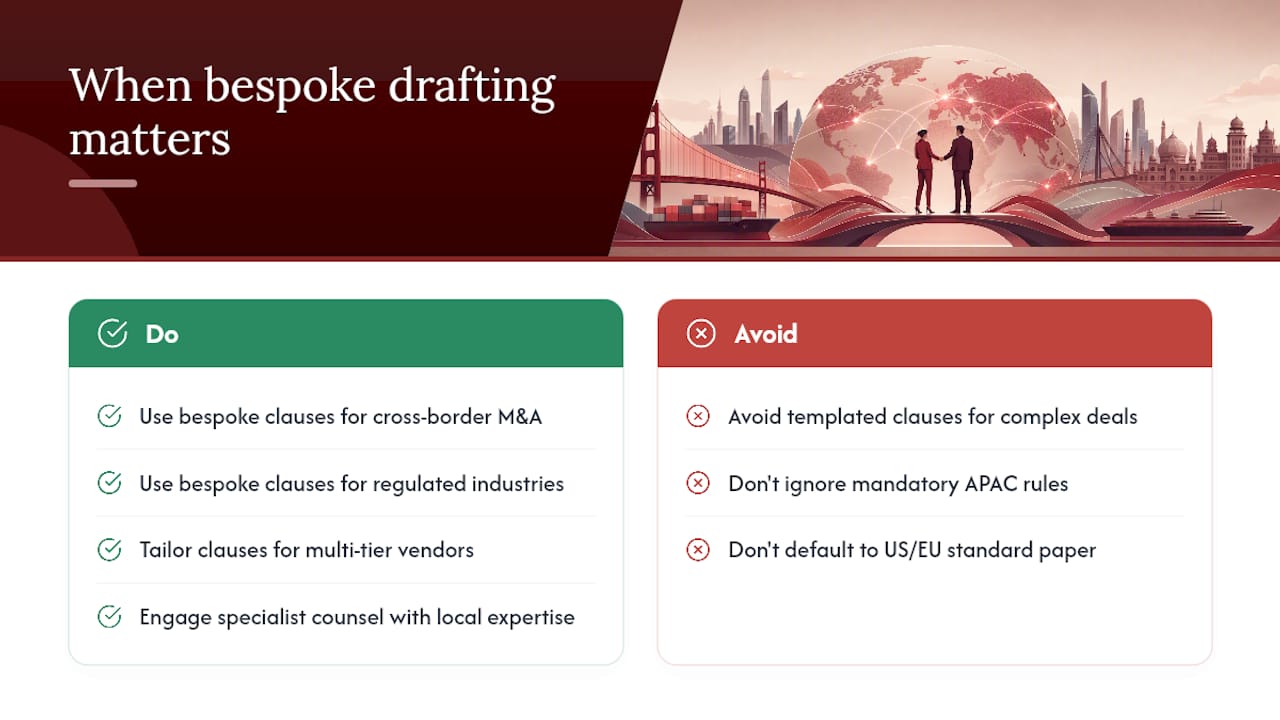
Beyondhorizons' lawyers, trained at Magic Circle and US white-shoe firms and ranked by Chambers, Legal 500, and Asia Legal Business, draft governing law clauses daily across aerospace, blockchain, robotics, and wellness deals. Cross-border M&A, regulated industries, and multi-tier vendor chains are exactly where a templated clause fails and bespoke language pays for itself, particularly when APAC jurisdictions and mandatory local rules intersect with a US or European counterparty's standard paper.
A Practitioner's View on Negotiating This Clause
Most negotiators fight hardest over governing law and hardest is rarely the right instinct. Predictability usually matters more than home-court advantage: a well-tested commercial law with deep case history beats a familiar one with thin precedent. Concede the law when the other side's jurisdiction has stronger enforcement ties to the deal; hold firm when scope or conflict-of-laws wording is vague, since that ambiguity costs more later than the law itself.
— HL
Bespoke Governing Law Drafting From Beyondhorizons
A template clause works until it doesn't, and cross-border deals are exactly where a generic "without regard to conflict of laws" line stops being enough. Beyondhorizons reviews the actual connection between your counterparty, your assets, and your chosen law, then drafts clause language built around how that specific deal would need to be enforced, not how a boilerplate library assumes it should read.

Clients get a jurisdictional risk review, tailored clause drafting for the deal's actual structure, and an enforcement analysis that flags mismatches between governing law and dispute resolution before they become expensive later. If your contract touches more than one jurisdiction, start with a conversation about cross-border corporate counsel to get the clause reviewed before signature, not after a dispute forces the question.
Sources
- Chambers Practice Guides — Commercial Contracts 2025 (Singapore) — Trends and developments
- Singapore Statutes Online — Unfair Contract Terms Act 1977
- SEC filing (example exhibiting common governing law sample clause)
Consult jurisdiction-specific counsel before finalizing clause language for a deal with real regulatory exposure.