
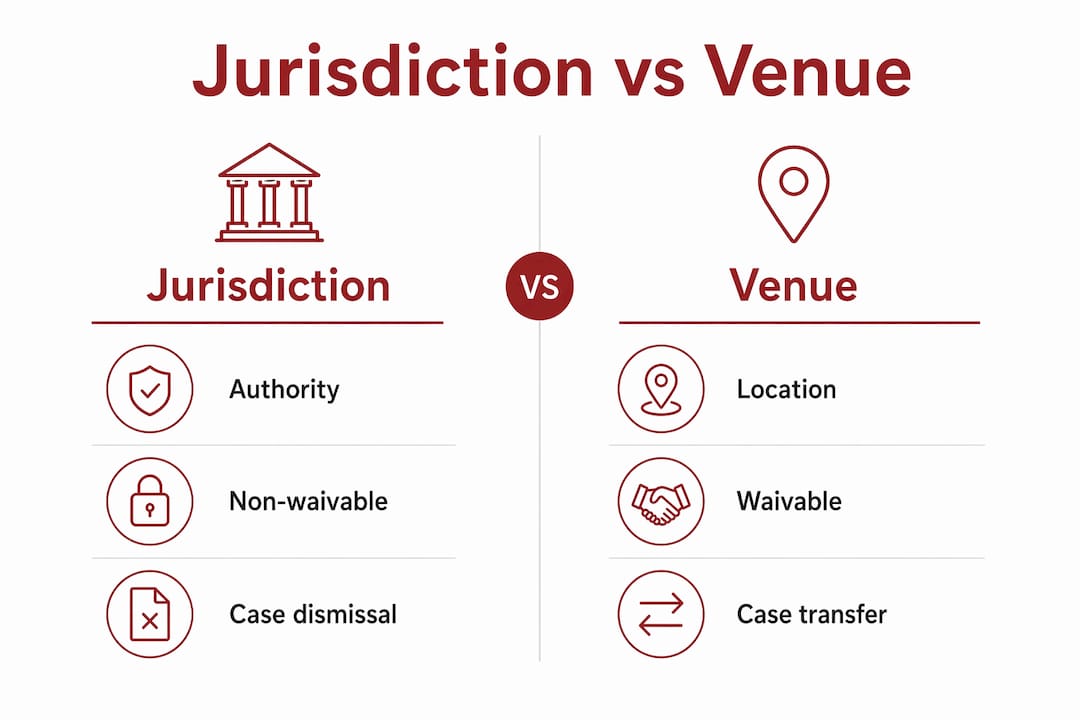
Jurisdiction is defined as a court's fundamental legal authority to hear and decide a case, while venue refers to the specific geographic location where that case is tried. The difference between venue and jurisdiction is not merely academic. For legal professionals, business owners, and entrepreneurs operating across Singapore and the APAC region, confusing the two can mean the difference between a case proceeding and a case being thrown out entirely. Jurisdiction is non-waivable and essential; venue is waivable and rooted in convenience. Getting this distinction wrong at the outset of cross-border litigation is one of the most costly procedural errors a practitioner can make.
What is the difference between venue and jurisdiction?
Jurisdiction is the court's foundational power to hear specific cases; venue is the geographic location where the case is heard. Think of jurisdiction as the court's license to act. Without it, every ruling the court issues is void. Venue, by contrast, is about where that licensed court sits and whether that location is appropriate for the parties involved.
The distinction matters most when a case is filed in the wrong place. A court without jurisdiction must dismiss the case outright. A court with improper venue, however, can simply transfer the case to a proper location. That single procedural difference has enormous consequences for litigation timelines, costs, and the viability of claims.

In the APAC context, this distinction is especially sharp. Singapore courts, for example, place significant weight on proper jurisdictional grounding before entertaining any substantive arguments. Cross-border disputes involving parties from Indonesia, Vietnam, or the Philippines often raise threshold questions about which court has authority at all, before venue even enters the conversation.
What is jurisdiction and what are its types?
Subject matter jurisdiction has two main types relevant to business disputes: federal question jurisdiction and diversity jurisdiction. Subject matter jurisdiction defines whether a court has authority over the type of claim being brought. Personal jurisdiction, by contrast, determines whether the court has authority over the specific parties in the dispute.
Subject matter jurisdiction cannot be waived by any party. A court lacking it must dismiss the case, even if both parties consent to proceed. This is the most unforgiving category of jurisdictional error in litigation.
Personal jurisdiction requires that the defendant have sufficient connections to the forum. In commercial disputes, this often turns on where a company is incorporated, where it conducts business, or where the contract was signed. For a Singapore-incorporated company with operations across Southeast Asia, personal jurisdiction questions can become genuinely complex.
Key jurisdiction categories relevant to cross-border practitioners include:
- Subject matter jurisdiction: The court's authority over the type of claim (contract, tort, regulatory).
- Personal jurisdiction: The court's authority over the specific defendant based on their connections to the forum.
- Appellate jurisdiction: The authority of a higher court to review decisions from lower courts.
- Concurrent jurisdiction: When more than one court has authority to hear the same matter.
Pro Tip: Always confirm subject matter jurisdiction before filing. A case dismissed for lack of subject matter jurisdiction cannot be cured by transfer, and if the statute of limitations has run, the claim may be lost permanently.
What is venue and how is it determined?
Venue is determined by where the cause of action arose) or where the defendant resides. In U.S. federal courts, venue rules for diversity cases follow 28 U.S.C. § 1391 guidelines. In Singapore and across APAC, venue under applicable legal frameworks aligns broadly with established international principles, though regional nuances apply.
Unlike jurisdiction, venue is a procedural privilege. Venue can be waived by failure to object at the appropriate stage of proceedings. A defendant who fails to raise a venue objection early forfeits the right to challenge it later. This makes timely procedural action critical for defense counsel.
Venue determination typically turns on several factors:
- Where the defendant resides or is domiciled.
- Where the events giving rise to the claim occurred.
- Where a substantial part of the property at issue is located.
- For corporations, where they are subject to personal jurisdiction.
Venue selection also carries tactical weight. Plaintiffs routinely choose venues based on factors like jury composition, local precedent, and the speed of the local docket. Defense counsel often respond by filing motions contesting venue selection at the earliest opportunity.
Pro Tip: In cross-border contracts, include a governing law and jurisdiction clause that specifies both the applicable law and the agreed forum. This eliminates most venue and jurisdiction disputes before they arise.
How do jurisdiction and venue differ in legal consequences?
The core procedural difference is this: jurisdiction errors are fatal; venue errors can be cured. Improper venue can often be cured by transferring the case, while lack of subject matter jurisdiction mandates dismissal with no path to transfer. Courts have discretion to transfer venue but have no discretion when subject matter jurisdiction is absent.
Waiver rules sharpen this contrast further. Subject matter jurisdiction can never be waived and can result in dismissal even years into litigation. Venue and personal jurisdiction, however, are waivable if not challenged promptly. In U.S. federal courts, Rule 12(b)(1) governs subject matter jurisdiction challenges, Rule 12(b)(2) covers personal jurisdiction, and Rule 12(b)(3) addresses venue. Singapore courts apply analogous procedural rules under the Rules of Court 2021.
| Factor | Jurisdiction | Venue |
|---|---|---|
| Definition | Court's legal authority to hear the case | Geographic location where the case is tried |
| Waivable? | No. Never waivable by any party | Yes. Waived if not timely challenged |
| Cure for error | Dismissal required. No transfer option | Transfer to proper venue is available |
| Raised by | Either party or court, at any time | Defendant must raise it early or lose it |
| Impact on claims | Dismissal may bar refiling if limitations expire | Transfer preserves the claim |
Dismissal for lack of subject matter jurisdiction cannot be cured by transfer and risks permanent claim loss if the statute of limitations has expired. This is why early jurisdictional vetting is critical for any cross-border commercial dispute.
What practical considerations affect cross-border venue and jurisdiction?
Cross-border disputes in APAC raise venue and jurisdiction questions that domestic litigation rarely encounters. A Singapore company suing a Vietnamese counterparty over a contract signed in Hong Kong may face threshold disputes about which court has authority before any substantive argument begins. Venue rules in APAC vary but generally follow locality principles, with Singapore courts emphasizing proper jurisdiction and timely challenges.
The forum non conveniens doctrine adds another layer of complexity. Forum non conveniens allows dismissal when a far more appropriate foreign forum exists, and the standard for defendants to meet is high. Courts give strong deference to the plaintiff's choice of forum. Defendants seeking to relocate a case must show that the chosen forum is genuinely oppressive or that another forum is clearly more appropriate.
Practical considerations for cross-border practitioners include:
- Early jurisdictional vetting: Confirm subject matter and personal jurisdiction before filing, not after.
- Governing law clauses: Draft contracts with explicit jurisdiction and venue clauses to reduce threshold disputes.
- Forum non conveniens strategy: Defendants should assess whether a more appropriate forum exists and act quickly if so.
- Multi-jurisdictional exposure: Corporations operating across APAC may be subject to personal jurisdiction in multiple countries simultaneously.
International arbitration offers an alternative for parties who want to sidestep domestic venue and jurisdiction disputes entirely. Arbitration clauses allow parties to agree on a neutral forum in advance, which is particularly useful for contracts involving parties from different APAC jurisdictions. Understanding cross-border legal frameworks at the contract drafting stage is far less expensive than litigating venue and jurisdiction after a dispute arises.
Plaintiff tactics in venue selection often reflect a calculated assessment of where the case is most likely to succeed. Defendants who understand this dynamic can respond more effectively, whether by challenging venue, invoking forum non conveniens, or negotiating a settlement before the forum question is resolved.
Key Takeaways
Jurisdiction determines whether a court has the legal authority to hear a case at all, while venue determines only where that case is physically tried.
| Point | Details |
|---|---|
| Jurisdiction is non-waivable | A court without subject matter jurisdiction must dismiss, even years into litigation. |
| Venue errors can be cured | Improper venue allows transfer; lack of jurisdiction does not. |
| Timely objections matter | Venue and personal jurisdiction are waived if not challenged at the earliest procedural stage. |
| Cross-border contracts need forum clauses | Governing law and jurisdiction clauses prevent threshold disputes before they arise. |
| Forum non conveniens is a high bar | Defendants must show a clearly more appropriate forum exists, not merely a more convenient one. |
Why practitioners underestimate the jurisdiction question
The most common mistake I see in cross-border disputes is treating jurisdiction as a formality. Practitioners file in a convenient forum, assume the other side will not object, and move straight to the merits. That assumption is expensive when it is wrong.
Subject matter jurisdiction is not a technicality. It is the threshold question that determines whether the court has any authority to act. I have seen cases where jurisdictional defects were raised for the first time on appeal, years after trial, because subject matter jurisdiction can be raised at any point. The entire litigation investment was at risk.
The venue question is more forgiving, but it still rewards early action. A defendant who misses the window to challenge venue loses that tool entirely. In APAC cross-border matters, where the choice of forum can affect everything from applicable law to enforcement of judgments, that lost opportunity carries real strategic cost.
My recommendation for business owners and counsel alike: treat jurisdiction and venue as the first two questions in any dispute, not an afterthought. Vet them before filing, address them in every contract, and raise objections at the first available opportunity. The procedural investment at the outset is a fraction of the cost of litigating these questions mid-case.
— HL
How Beyondhorizons helps clients manage cross-border disputes
Cross-border disputes involving venue and jurisdiction questions require counsel who understands both the procedural rules and the commercial stakes. Beyondhorizons is a Singapore-headquartered law firm with lawyers from Magic Circle and US white shoe firms, ranked on Chambers, Legal 500, and Asia Legal Business.

The firm's cross-border corporate counsel practice handles jurisdiction and venue questions across APAC, from contract drafting with governing law clauses to representing clients in threshold jurisdictional disputes. Beyondhorizons also draws on its global cross-border expertise to advise clients on forum selection, arbitration strategy, and multi-jurisdictional exposure. For legal professionals and business owners who need clear, commercial guidance on where and how to pursue or defend a claim, Beyondhorizons offers the depth of experience that these questions demand.
FAQ
What is the main difference between venue and jurisdiction?
Jurisdiction is the court's legal authority to hear a case; venue is the geographic location where the case is tried. Jurisdiction is non-waivable, while venue can be waived if not challenged promptly.
Can a case be dismissed for improper venue?
Improper venue rarely results in permanent dismissal. Courts typically transfer the case to a proper venue rather than dismiss it, preserving the plaintiff's claim.
What happens if a court lacks subject matter jurisdiction?
The court must dismiss the case outright. Dismissal for lack of subject matter jurisdiction cannot be cured by transfer, and if the statute of limitations has expired, the claim may be permanently lost.
What is forum non conveniens?
Forum non conveniens is a doctrine that allows a court to dismiss or stay a case when a far more appropriate foreign forum exists. The standard is high, and courts give strong deference to the plaintiff's chosen forum.
How do venue and jurisdiction apply in Singapore cross-border disputes?
Singapore courts emphasize proper jurisdictional grounding and timely procedural challenges. Venue rules in Singapore align broadly with international principles, but cross-border disputes often require early vetting of both jurisdiction and forum to avoid costly threshold litigation.