
Automation risk assessment is the process of systematically identifying, scoring, and mitigating risks introduced by automation technologies across their full operational lifecycle. Business leaders and compliance officers deploying AI, robotics, or process automation need this discipline to meet standards like ISO 42001, the EU AI Act, and the NIST AI Risk Management Framework. Without a structured approach, organizations expose themselves to regulatory penalties, operational failures, and reputational damage. The good news is that comprehensive frameworks now cover more than 65 assessment items across nine lifecycle phases, giving teams a clear map from planning through retirement.
What frameworks guide automation risk assessment?
Three international frameworks define the current standard for automated risk evaluation. ISO 42001 governs AI management systems. The EU AI Act establishes binding obligations for high-risk AI systems. The NIST AI RMF provides a voluntary but widely adopted structure for governing AI risk across four core functions: Govern, Map, Measure, and Manage.
These frameworks share a common principle: risk assessment must span the entire lifecycle, not just the deployment phase. Comprehensive AI risk frameworks cover over 65 assessment items across nine lifecycle phases, from context establishment and data governance through model development, deployment, monitoring, and retirement. That breadth matters because risks evolve at each stage. A data privacy risk at ingestion looks very different from a bias risk at inference.
ISO/IEC 27005 adds a critical layer for information security within automation systems. ISO/IEC 27005 scores highest among international standards for automation readiness, with a score of 4.60 out of 5.00. Its process-oriented design integrates naturally with AI-driven risk management architectures that use natural language processing and machine learning to flag emerging threats.
The practical implication for compliance officers is this: no single framework is sufficient on its own. Aligning your program with ISO 42001 for AI governance, ISO/IEC 27005 for information security, and the EU AI Act for regulatory compliance creates a layered defense that satisfies auditors and boards alike.
- ISO 42001: AI management system requirements and continuous improvement obligations
- EU AI Act: Risk classification by use case, with binding obligations for high-risk categories
- NIST AI RMF: Voluntary but globally recognized; maps risk functions to organizational roles
- ISO/IEC 27005: Information security risk management; highest automation readiness among peer standards
Pro Tip: Build your automation risk assessment template by mapping each of the nine lifecycle phases to the relevant control from ISO 42001 or NIST AI RMF. This prevents gaps and makes regulatory audits significantly faster.
What tools and methods support reliable risk assessments?
The 5x5 risk scoring matrix is the most widely used tool for quantifying automation risks. It multiplies likelihood (1–5) by impact (1–5) to produce a score between 1 and 25. Risk scores of 16–25 fall into the Critical band and require executive approval before deployment proceeds. That threshold forces senior accountability into the process at exactly the right moment.

Automated risk assessment software accelerates analysis by ingesting data from multiple sources and generating risk scores in near real time. Platforms designed for third-party risk management, for example, reduce vendor due diligence from weeks to days. That speed matters when an automation project depends on a chain of vendors, each carrying their own compliance and security exposure.
For hazard analysis, the most effective approach combines two methodologies rather than relying on one.
| Method | Focus | Best used for |
|---|---|---|
| HAZOP (Hazard and Operability Study) | Process deviations and flow disruptions | Complex automated workflows and production lines |
| FMEA (Failure Mode and Effects Analysis) | Component-level failure modes | Robotic systems, sensors, and mechanical automation |
| Combined HAZOP + FMEA | Both process and component risk | High-stakes AI and industrial automation deployments |
Dual-lens hazard analysis using HAZOP and FMEA together provides broader risk identification than either method alone. HAZOP challenges what happens when a process deviates from design intent. FMEA asks what happens when a specific component fails. Together, they cover both the system and its parts.
Cognitive automation introduces a third dimension that neither HAZOP nor FMEA fully addresses. Task-Technology Fit and Cognitive Load Theory must be incorporated when evaluating whether a knowledge-intensive task is suitable for AI automation. The three-stage framework covers suitability assessment, cognitive load quantification, and human oversight prescriptions. Skipping this step is how organizations end up automating tasks that still require human judgment, creating over-automation risk.
Pro Tip: When selecting automated risk assessment software, prioritize platforms that generate audit trails tied to specific AI components. Regulators under the EU AI Act will ask for evidence, not just scores.
How to conduct step-by-step automation risk assessments
A credible risk assessment starts with the right team, not the right template. Form a cross-functional group that includes business operations, IT and security, legal counsel, and representatives from the departments most affected by the automation. Each function sees different risks. Legal spots regulatory exposure. IT spots integration vulnerabilities. Operations spots workflow breakdowns.
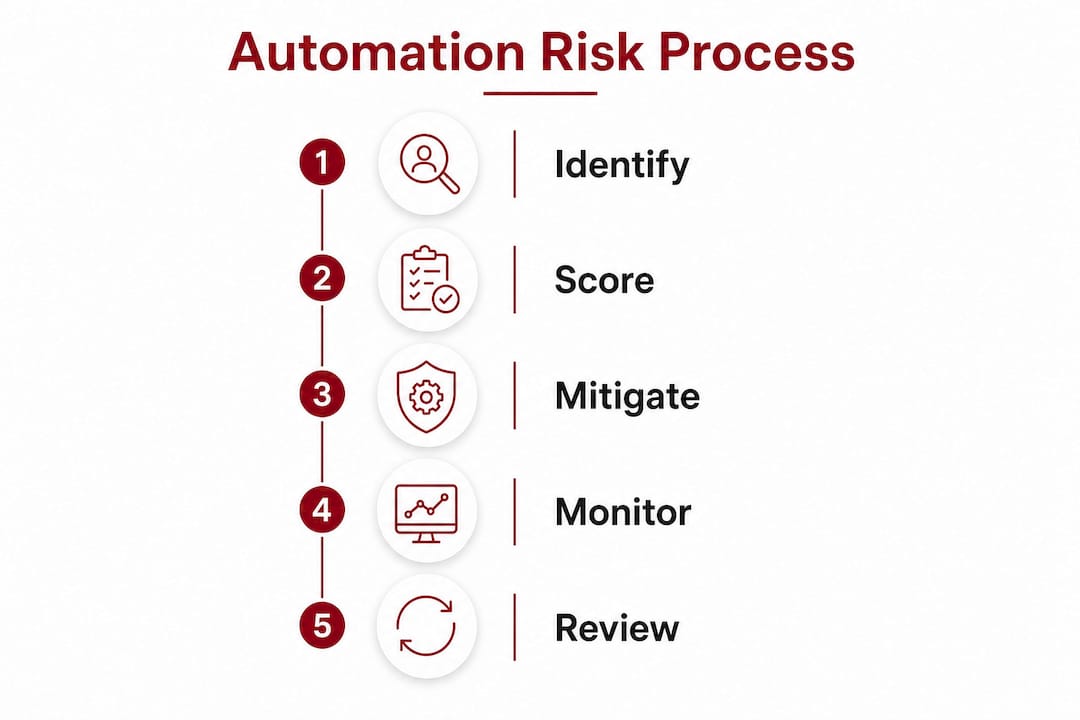
The step-by-step process follows the lifecycle structure:
- Establish context. Define the automation's purpose, scope, and regulatory classification. Identify applicable standards (ISO 42001, EU AI Act, NIST AI RMF) and document the business case assumptions you are testing.
- Identify risks by phase. Work through each lifecycle phase, from data collection and model training through deployment and monitoring. Document risks in categories including data privacy, algorithmic bias, cybersecurity, and regulatory compliance.
- Score each risk. Apply the 5x5 matrix. Record likelihood, impact, and the resulting score. Flag Critical scores (16–25) for executive review before proceeding.
- Define mitigations. Assign a specific mitigation action to each risk. Assign an owner and a deadline to every treatment item. Unowned mitigations do not get implemented.
- Re-score residual risk. After applying mitigations, score the remaining risk. This residual score is what the organization actually carries. Skipping this step creates a false picture of your risk posture.
- Monitor and update continuously. Treat the risk register as a living governance document, not a quarterly export.
The categories your risk register should cover at minimum:
- Data privacy: Consent, data minimization, cross-border transfer obligations
- Algorithmic bias: Training data quality, fairness metrics, demographic impact testing
- Cybersecurity: Access controls, adversarial attack vectors, model poisoning
- Regulatory compliance: EU AI Act classification, MAS guidelines, sector-specific obligations
- Operational continuity: Fallback procedures, human override protocols, incident response
Live risk registers embedded in AI governance systems avoid gaps between risk management and compliance controls. That integration enables timely, auditable oversight. A register that lives in a spreadsheet outside your governance platform is a liability, not an asset.
| Risk category | Example risk | Scoring input | Mitigation owner |
|---|---|---|---|
| Data privacy | Unauthorized cross-border data transfer | Likelihood 4, Impact 5 = 20 (Critical) | Chief Privacy Officer |
| Algorithmic bias | Biased model outputs in hiring automation | Likelihood 3, Impact 5 = 15 (High) | Head of AI Ethics |
| Cybersecurity | Model poisoning via training data | Likelihood 3, Impact 4 = 12 (High) | CISO |
| Regulatory compliance | EU AI Act misclassification | Likelihood 2, Impact 5 = 10 (High) | General Counsel |
What are common mistakes in automation risk assessments?
The most damaging mistake is treating the risk register as a compliance checkbox rather than a strategic tool. Most automation project failures trace back to this attitude. Teams complete the assessment, file the document, and move on. The register never gets updated. Risks that were rated Medium at launch become Critical after deployment, with no one watching.
Automation risk assessment done right validates your business case. It forces you to test the assumptions behind your automation investment before you commit capital and organizational change. A risk register that only satisfies auditors is a missed opportunity.
Three other mistakes appear consistently across automation programs:
- Single-method hazard analysis. Using only FMEA or only HAZOP leaves blind spots. FMEA misses process-level deviations. HAZOP misses component failures. Use both.
- Skipping residual risk re-scoring. Applying a mitigation does not eliminate a risk. Re-scoring after treatment is the only way to know what risk you actually carry.
- Ignoring cognitive and operational risks in AI automation. Technical capability is not the same as task suitability. A model that can perform a task is not automatically the right tool for it. Cognitive Load Theory and Task-Technology Fit frameworks exist precisely to catch this gap.
Avoiding these mistakes requires executive engagement, not just compliance team effort. When boards and C-suites treat automation risk analysis as a governance priority, teams allocate the time and resources to do it properly. When they treat it as a legal formality, they get formality in return.
Pro Tip: Schedule a mandatory residual risk review 90 days after any major automation goes live. Operational reality almost always differs from pre-deployment assumptions, and your risk register should reflect that.
Staying current with legislative intelligence pitfalls also helps compliance officers avoid regulatory blind spots as AI laws evolve rapidly across jurisdictions.
Key takeaways
Effective automation risk assessment requires lifecycle-based scoring, cross-functional ownership, and continuous register updates aligned with ISO 42001, the EU AI Act, and NIST AI RMF.
| Point | Details |
|---|---|
| Use lifecycle frameworks | Cover all nine phases from context establishment to retirement using ISO 42001 or NIST AI RMF. |
| Apply the 5x5 scoring matrix | Scores of 16–25 require executive approval before any deployment proceeds. |
| Combine HAZOP and FMEA | Dual-lens hazard analysis catches both process deviations and component failures that single methods miss. |
| Assign owners to every mitigation | Unowned treatment items do not get implemented; ownership and deadlines are non-negotiable. |
| Treat risk registers as living documents | Continuous updates aligned with EU AI Act requirements prevent gaps between governance and compliance. |
The shift from compliance to governance is the real challenge
The technical side of automation risk assessment is solvable. Frameworks exist. Scoring matrices are well-defined. The harder problem is cultural. Most organizations I have worked with know what a good risk register looks like. Far fewer have the internal discipline to keep it current and connected to real decision-making.
What I have seen work is tying the risk register directly to capital allocation. When an automation project cannot proceed past a certain gate without a current, signed-off risk assessment, the register stops being a document and starts being a governance instrument. That shift changes how teams engage with it.
The EU AI Act and ISO 42001 are pushing organizations in this direction by design. They require continuous documentation, not point-in-time snapshots. That is a meaningful change for companies used to annual compliance reviews. The organizations that adapt fastest are the ones that build AI governance structures before regulators force them to, not after.
I also think the role of a robotics law specialist is underutilized in most automation risk programs. Legal counsel with deep expertise in autonomous systems and AI liability can identify regulatory exposure that technical teams simply do not see. That cross-disciplinary input is not a luxury for high-risk deployments. It is a requirement.
— HL
Beyondhorizons' approach to automation risk and AI governance
Automation risk programs succeed when legal expertise and technical governance work together from the start. Beyondhorizons brings both to the table.

Beyondhorizons is a Singapore-headquartered law firm with lawyers from Magic Circle and US white shoe firms, ranked on Chambers, Legal 500, and Asia Legal Business. The firm's AI governance advisory covers EU AI Act compliance, MAS regulatory alignment, and cross-border risk management for companies deploying automation across APAC and beyond. For organizations that need digital-first legal services built around AI tools and emerging technology, Beyondhorizons offers counsel that is commercial, practical, and current. Contact the team to discuss your automation risk governance needs.
FAQ
What is an automation risk assessment?
Automation risk assessment is the structured process of identifying, scoring, and mitigating risks introduced by automation technologies across their full lifecycle. It aligns with standards including ISO 42001, the EU AI Act, and the NIST AI RMF.
What does a 5x5 risk scoring matrix do?
The 5x5 matrix multiplies likelihood by impact to produce scores from 1 to 25. Scores of 16–25 fall into the Critical band and require executive approval before deployment.
How often should a risk register be updated?
Risk registers must be updated continuously as a living governance document, not on a fixed quarterly cycle. The EU AI Act specifically requires ongoing documentation tied to specific AI components and operational changes.
What is the difference between HAZOP and FMEA?
HAZOP identifies risks from process deviations, while FMEA focuses on component-level failure modes. Using both together provides broader risk identification than either method alone.
Why should legal counsel be involved in automation risk assessments?
Legal counsel identifies regulatory exposure, liability gaps, and cross-border compliance obligations that technical teams typically miss. A robotics law specialist or AI governance lawyer adds a layer of analysis that protects the organization from regulatory and contractual risk.
Recommended
- AI Code Counsel Singapore — AI Governance, Risk & Compliance Legal Advisory | Beyond Horizons Legal
- AI Governance Lawyer — Singapore, EU AI Act, MAS | Beyond Horizons
- Anti Sandbagging Provision: APAC Contract Guide
- Cybersecurity & Emerging Technology Law Singapore — Data Protection, AI & Cyber Risk | Beyond Horizons Legal