
An effective arbitration clause names arbitration as the exclusive forum, picks institutional rules (or UNCITRAL for ad hoc proceedings), fixes a seat, sets the number and method of appointing arbitrators, and states the language and governing law. A starter clause you can adapt: "Any dispute arising out of or in connection with this Agreement shall be referred to and finally resolved by arbitration administered by [Institution] under its rules, seated in [City, Country], before [one/three] arbitrator(s), in the [language] language, with this Agreement governed by the laws of [Jurisdiction]."
TL;DR:
- Choosing a seat with a reliable arbitration statute and strong court support is crucial for enforceability and intervention options.
- Institutional rules provide administrative support and a clear appointing authority, whereas ad hoc arbitration offers flexibility and cost savings if the appointment process is specified.
- Broad scope wording like "arising out of or in connection with" covers most disputes, while narrow language can lead to jurisdictional disputes.
- Matching the arbitrator number to the deal's value, such as a sole arbitrator for smaller contracts and three for high-value disputes, optimizes speed and legitimacy.
- Simpler, well-defined clauses with a named seat, institution, and arbitrator number generally outperform overly complex or vague language that creates enforcement or procedural risks.
Table of Contents
- Model Arbitration Clause Templates You Can Adapt Now
- Which Drafting Choices Actually Change the Outcome?
- Optional Clauses Worth Adding (And When to Skip Them)
- Five Drafting Mistakes That Cause Arbitration Clauses to Fail
- A Clause Bank for Common Commercial Deals
- Practical Notes From Cross-Border Practice
- Why Simpler Clauses Usually Win
- Get a Bespoke Arbitration Clause Drafted for Your Deal
- Sources
Model Arbitration Clause Templates You Can Adapt Now
Every institutional provider publishes a baseline template for a reason: consistent structure prevents the jurisdictional fights that make arbitration clauses fail. The AAA's clause drafting resource offers standard language plus variations for mediation-first and expedited procedures, while HKIAC's model clauses cover both institutional and ad hoc scenarios.
Institutional template: "Any dispute, controversy, or claim arising out of or in connection with this Agreement, including its existence, validity, or termination, shall be referred to and finally resolved by arbitration under the [HKIAC/AAA/JAMS] Rules, seated in [City, Country], before [number] arbitrator(s) appointed in accordance with those Rules, conducted in [language]."
Ad hoc (UNCITRAL) template: "Any dispute arising out of or in connection with this Agreement shall be settled by arbitration under the UNCITRAL Arbitration Rules, with [Institution] designated as the appointing authority, seated in [City, Country]."
Mediation-then-arbitration variant: "The parties shall first attempt to resolve any dispute through mediation for a fixed period, after which either party may refer the dispute to arbitration under [Rules]."
Three variables need editing every time: seat, arbitrator number, and appointing authority. Everything else can usually stay as boilerplate. AAA's ClauseBuilder AI tool can speed up this customization, though the core jurisdictional decisions still deserve a manual second look.
Which Drafting Choices Actually Change the Outcome?
Most arbitration clause disputes trace back to five decisions drafters rush through. Get these right and the rest of the clause is largely mechanical.
Seat of arbitration. The seat sets the curial law, meaning which national courts can support or intervene in the proceeding, grant interim relief, or hear a challenge to the award. Choosing a seat with a modern arbitration statute and reliable court assistance (Singapore, Hong Kong, London, and similar hubs) usually beats picking a "neutral" location with no track record. If enforcement in a specific country is the priority, check that country's New York Convention status before finalizing the seat; for real estate contexts, see what is real estate arbitration with our comprehensive guide for investors.
Institutional versus ad hoc. Institutional rules give you administrative support and a built-in appointing authority when parties disagree. Ad hoc arbitration under UNCITRAL rules is more flexible and often cheaper, but only works smoothly if you name an appointing authority in the clause itself. The IBA Arbitration Clause Guidelines treat this as the first fork in the road for any drafter.
Scope wording. Broad language ("arising out of or in connection with") captures contractual, tort, and pre-contractual disputes tied to the agreement. Narrow language ("arising under this Agreement") invites arguments about what actually falls within the clause, and those arguments often end up in court rather than arbitration.
Governing law versus seat. These are separate choices doing different jobs. The seat governs procedure; the governing law clause governs substance. A governing law clause for cross-border contracts that doesn't align cleanly with the arbitration seat is one of the more common sources of confusion in multi-jurisdiction deals.
Arbitrator number and appointment. A sole arbitrator is faster and cheaper; a three-member tribunal often feels more legitimate for high-value disputes, particularly with multiple nationalities involved.
- Always include a replacement mechanism if an appointed arbitrator becomes unavailable.
- Avoid listing narrow qualification requirements (a specific bar admission plus a specific technical degree) unless you're confident the pool of eligible candidates is large enough.
Pro Tip: Match arbitrator count to deal value, not ego. A $2 million supply contract rarely needs a three-arbitrator panel; a $200 million joint venture usually does.
Optional Clauses Worth Adding (And When to Skip Them)
Not every clause needs every bell and whistle. A few additions earn their place depending on the deal.
- Mediation step: Useful for ongoing commercial relationships, but only if you set a firm deadline. Guidance from JAMS's clause workbook recommends stating that mediation "shall not be a condition precedent" beyond a fixed window (commonly 30 days), so a reluctant party can't use it to stall.
- Emergency arbitrator opt-in: Worth including whenever urgent interim relief (an injunction, asset freeze) is plausible before a tribunal is constituted. Tie the language directly to the institution's rules rather than drafting bespoke procedure.
- Confidentiality: Arbitration is private by default in most institutional rules, but not automatically confidential. A short clause stating that "the existence, content, and outcome of the arbitration shall remain confidential except as required by law or to enforce the award" closes that gap.
- Fee allocation: Include a fee-shifting provision only if cost discipline matters more than flexibility, since it removes a tribunal's usual discretion to allocate costs based on conduct.
Five Drafting Mistakes That Cause Arbitration Clauses to Fail
- Vague seat or rules language. "Arbitration in Asia under applicable rules" isn't a seat. Name a city and an institution.
- Overly narrow scope wording that excludes tort claims or pre-contractual disputes connected to the deal.
- Unworkable arbitrator qualifications, such as requiring a niche technical certification that few practicing arbitrators hold.
- Mediation steps with no deadline, which a party can exploit to delay arbitration indefinitely.
- No clear enforcement language, leaving ambiguity about how the award gets entered as a judgment in the relevant jurisdiction.
The IBA Guidelines flag broad scope wording and named appointing authorities as the two fixes that prevent the largest share of these problems.
A Clause Bank for Common Commercial Deals
Keep these snippets on hand and swap the bracketed terms for the deal at hand.
- Standard institutional: "…arbitration administered by [HKIAC/AAA/JAMS] under its rules then in effect, seat: [City, Country], number of arbitrators: [one/three], language: [English]."
- Ad hoc/UNCITRAL: "…arbitration under the UNCITRAL Arbitration Rules, appointing authority: [Institution], seat: [City, Country]."
- Mediation first: "…mediation for [30] days, not a condition precedent beyond that period, followed by arbitration under [Rules]."
- Expedited procedure: "…arbitration under the Expedited Procedures of [AAA/JAMS/HKIAC] Rules for claims not exceeding [$USD amount]."
- Emergency arbitrator opt-in: "…either party may apply for emergency interim relief under the Emergency Arbitrator provisions of [Rules] prior to constitution of the tribunal."
Cross-border deals usually need the seat, rules, and language fields adjusted for every counterparty jurisdiction. Domestic deals often only need the seat and arbitrator count touched.
Practical Notes From Cross-Border Practice
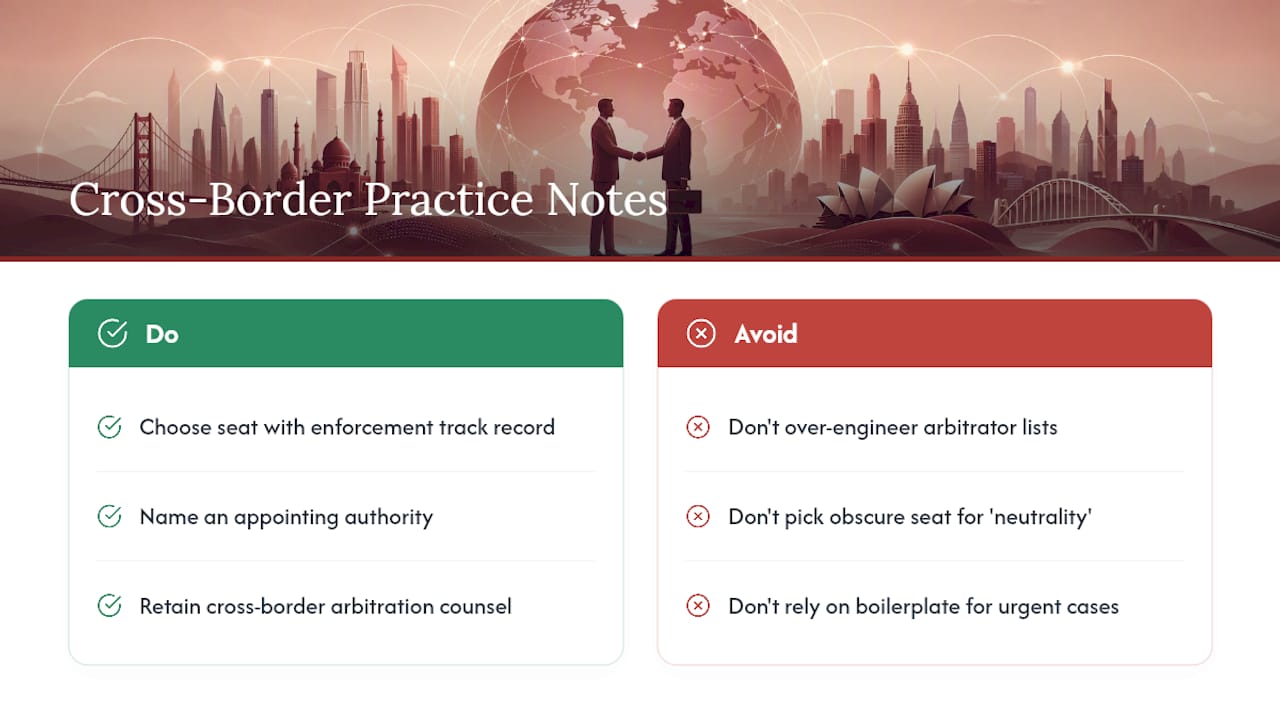
Drafters who over-engineer arbitrator qualification lists or lock in an obscure seat "for neutrality" usually create more enforcement headaches than they solve. Prioritize a seat with a solid enforcement track record and a named appointing authority over cosmetic neutrality. For multiparty structures, multi-contract deals, or anything requiring urgent interim relief across jurisdictions, a template stops being enough. That's when it's worth involving counsel experienced in cross-border arbitration and enforcement rather than adapting boilerplate alone.
Why Simpler Clauses Usually Win
The biggest mistake I see in arbitration clause drafting isn't a missing provision. It's over-engineering: piling on qualification requirements, multi-step escalation ladders, and bespoke procedural carve-outs that sound thorough but create ambiguity later. A clean clause with a named seat, institution, and arbitrator count beats a "comprehensive" one every time. Whatever you negotiate away from the template, write it down in a side letter or negotiation memo. Memory fades faster than disputes arise.
— HL
Get a Bespoke Arbitration Clause Drafted for Your Deal
Templates get you 80% of the way there, but the last 20% (multiparty structures, enforcement across two or three jurisdictions, industry-specific carve-outs) is where generic language breaks down. Legal professionals draft and review arbitration clauses for cross-border commercial agreements, M&A deals, and joint ventures, advising on seat selection, institutional rule choice, and enforcement strategy across APAC and beyond.
The firm's lawyers, trained at Magic Circle and US white shoe firms, handle this alongside broader cross-border corporate transaction work, so the arbitration clause gets drafted with the rest of the deal in mind, not as an afterthought bolted on at signing. If you're negotiating a contract that needs a seat, rules, and enforcement strategy tailored to your counterparties rather than copied from a template, start a conversation about your arbitration clause with the team directly.