
Oil and gas finance is the discipline of raising, allocating, and managing capital across one of the most capital-intensive industries on earth. Upstream exploration and production (E&P) companies, midstream pipeline operators, and downstream refiners each face distinct funding requirements, risk profiles, and regulatory constraints that make generic corporate finance frameworks inadequate. The U.S. market, governed by the Office of the Comptroller of the Currency (OCC), the Securities and Exchange Commission (SEC), and the Federal Energy Regulatory Commission (FERC), adds another layer of complexity that shapes every financing decision.
The core elements professionals need to understand include:
- Capital raising: Equity issuances, reserve-based lending (RBL), high-yield bonds, mezzanine debt, and sustainability-linked instruments
- Treasury management: Cash flow forecasting, working capital optimization, and hedging against commodity price swings
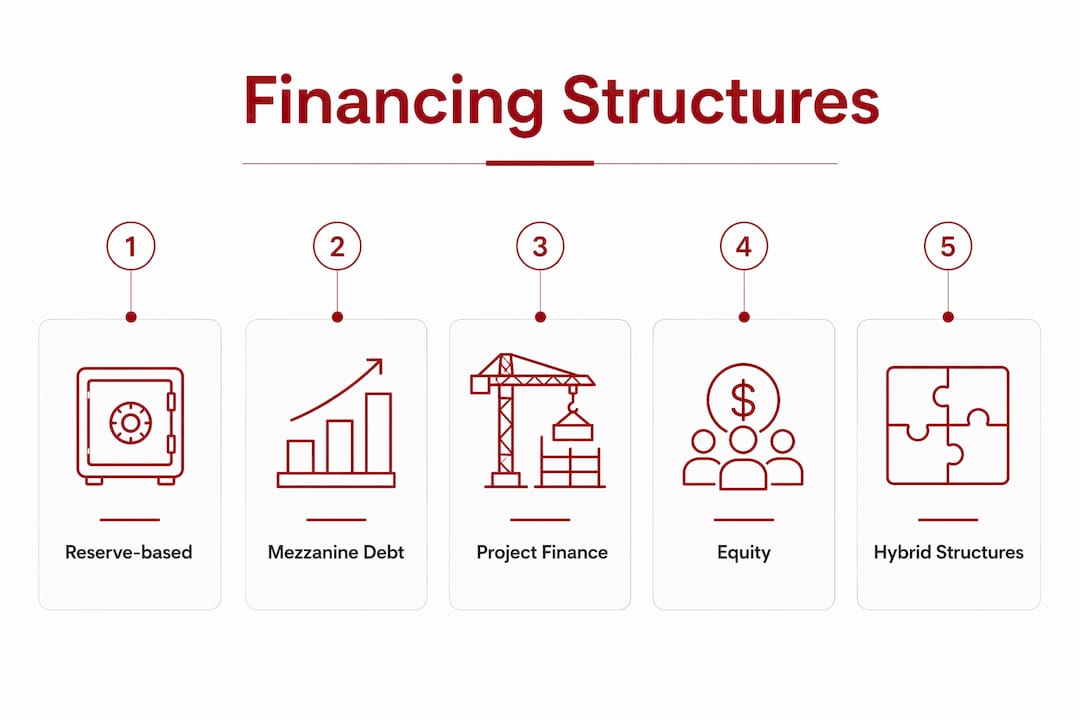
- Financing structures: Project finance, structured finance, asset-backed securitizations, and hybrid capital solutions
- Risk frameworks: Commodity price volatility, jurisdictional risk, ESG-related credit constraints, and insurance coverage
- ESG and sustainability: Sustainability-linked loans, green bonds, and investor reporting requirements that now directly affect capital access
- Tax and incentives: Intangible drilling cost deductions, depletion allowances, and investment tax credits specific to U.S. oil and gas operations
The IEF Investment Report projects that industry investment must rise by 25% annually above 2020 levels to prevent supply shortfalls and escalating price volatility. That figure alone frames why getting oil and gas finance strategies right is not an academic exercise. It is a matter of energy security.
How oil and gas firms raise capital and manage treasury functions
Capital raising in the oil and gas sector is not a one-size-fits-all exercise. The right instrument depends on where a company sits in the value chain, its reserve base, its credit rating, and increasingly, its ESG positioning.

Capital raising methods
The most common approaches include:
- Equity raises: Public offerings and private placements give companies access to long-term capital without mandatory debt service, though they dilute existing shareholders.
- Corporate loans and revolving credit facilities: General-purpose facilities tied to the company's overall creditworthiness, distinct from reserve-backed structures.
- Acquisition financing: Term loans or bridge facilities used to fund asset purchases, often structured around the cash flows of the acquired asset.
- Sustainability-linked loans and hybrid bonds: Instruments whose pricing adjusts based on the borrower's ESG performance metrics. Companies issuing sustainability-linked instruments do so proactively to maintain capital market access, not merely to satisfy compliance requirements.
- High-yield bonds: Longer-term, interest-only instruments with 10-year maturities that have historically provided affordable access to capital markets for E&P companies.
Treasury management in practice
Treasury functions in oil and gas go well beyond cash pooling. The core challenge is managing liquidity across a business where revenues are denominated in U.S. dollars but operating costs span multiple currencies and jurisdictions.
Key treasury techniques include:
- Commodity hedging: Using futures, swaps, and options to lock in revenue floors and protect debt service capacity when oil prices fall
- Working capital optimization: Accelerating receivables from offtake agreements and managing payables to service providers and contractors
- Cash flow forecasting: Modeling production decline curves against forward commodity prices to project borrowing base headroom
- Currency risk management: Hedging foreign exchange exposure on international operations, particularly relevant for U.S. companies with assets in the Middle East, West Africa, or Latin America
The relationship between market volatility and treasury risk is direct. Upstream companies face cash flow volatility from commodity prices and must continuously invest capital expenditure to offset reserve depletion, which compresses the cash available for debt service. A treasury function that does not model this depletion curve against forward strip prices is flying blind.
Corporate governance also shapes capital management. U.S.-listed E&P companies face SEC disclosure requirements on reserves, material contracts, and related-party transactions that directly affect how capital is structured and reported. Compliance with OCC guidelines on oil and gas lending further constrains how banks structure credit facilities.

Pro Tip: When structuring a new credit facility, model your borrowing base at both the current strip price and a stress case 30% below it. Lenders increasingly apply their own ESG overlays to reserve valuations, which can reduce your available borrowing base independent of commodity prices.
What financing structures does the oil and gas industry actually use?
The range of financing structures in oil and gas is wider than in most industries, reflecting the sector's unique asset base, long project timelines, and the need to match capital to specific risk profiles.
Reserve-based lending
RBL is the workhorse of E&P finance. A reserve-based lending facility is a revolving credit secured by proved reserves, with a borrowing base re-evaluated periodically, typically every six months, based on an independent reserve engineer's assessment. Most RBLs carry a 3–5 year term. The borrowing base is sensitive to commodity prices and, increasingly, to lender ESG policies that can impose unanticipated constraints on available credit.
Mezzanine debt and second-lien loans
When an RBL falls short, companies turn to subordinated capital. Mezzanine debt sits below senior loans in the capital structure and is typically unsecured, based on cash flow ratios rather than a borrowing base. Second-lien loans rank behind the RBL but ahead of unsecured creditors, carry higher interest rates to compensate for the additional risk, and commonly carry 5-year maturities with interest-only payment structures.
Project finance and structured finance
Project finance isolates the financial risk of a specific asset, such as a pipeline, LNG terminal, or offshore platform, within a special purpose vehicle. Lenders look to the project's cash flows for repayment rather than the sponsor's balance sheet. This structure suits large midstream and downstream assets where cash flows are predictable and contractually supported by long-term offtake agreements.
Asset-backed securitizations (ABS) take this further by pooling producing assets and issuing securities against their cash flows, providing access to capital markets investors who would not otherwise participate in oil and gas lending.
Financing options at a glance
| Instrument | Typical term | Security | Best suited for |
|---|---|---|---|
| Reserve-based lending (RBL) | 3–5 years | Proved reserves | E&P companies with producing assets |
| Second-lien term loan | 5 years | Junior lien on reserves | Growth capital beyond RBL capacity |
| Mezzanine debt | 3–5 years | Unsecured / cash flow | Acquisitions with limited reserve base |
| High-yield bonds | 10 years | Unsecured | Large E&P companies with capital markets access |
| Project finance | 10 years | Project assets and cash flows | Midstream and downstream infrastructure |
| Sustainability-linked loan | 3–5 years | Corporate or asset | Companies with measurable ESG targets |
| Equity | Permanent | N/A | Long-term capital without debt service obligation |
The shift from bank-led RBL toward private credit and asset-backed securitizations is accelerating, driven partly by ESG-related capital constraints that have caused some traditional lenders to reduce their oil and gas exposure. Private equity, meanwhile, is moving toward stable midstream and downstream infrastructure assets that generate reliable cash flows attractive to pension funds and infrastructure investors.
Key financing considerations by sector:
- Upstream: RBL is the primary tool; mezzanine and second-lien fill gaps; high-yield bonds suit larger operators
- Midstream: Project finance dominates; infrastructure funds and pension capital are active buyers
- Downstream: Corporate finance structures prevail; asset-backed facilities used for refinery upgrades
How should you assess risk in oil and gas financing?
Risk assessment in oil and gas financing covers a wider spectrum than most industries. Commodity price volatility, jurisdictional instability, environmental liability, and shifting ESG standards all feed into credit decisions, insurance underwriting, and investor appetite.
Commodity price risk
Oil price volatility directly affects borrowing bases, loan covenants, and a company's ability to service debt. When prices fall sharply, a semi-annual borrowing base redetermination can reduce available credit precisely when a company needs it most. Upstream companies that have not hedged their production are particularly exposed. The OCC's Comptroller's Handbook identifies this price sensitivity as a primary driver of credit risk in E&P lending.
Jurisdictional and political risk
Cross-border oil and gas deals require a thorough analysis of political stability, contract enforceability, and regulatory consistency. The 2026 ConocoPhillips/BP Iraq redevelopment agreement illustrates this directly: the deal's viability hinged on cost of supply thresholds and the ability to leverage existing infrastructure to minimize capital intensity in a complex jurisdiction. Political risk insurance, stabilization clauses in host government agreements, and international arbitration provisions are standard tools for managing this exposure.
ESG and environmental risk
Environmental, social, and governance criteria now significantly influence financing availability, insurance underwriting, and lender participation in oil and gas projects. A company with poor environmental compliance history may find its borrowing base constrained not by reserve values but by lender ESG policies. Investor expectations for ESG transparency are driving companies to adopt sustainability-linked financing proactively rather than reactively.
Key risk factors and mitigation strategies:
- Commodity price volatility: Hedge production using futures and swaps; model borrowing base at stress-case prices
- Reservoir and production risk: Commission independent reserve engineering reports; structure RBL drawdowns against proved developed producing (PDP) reserves only
- Jurisdictional risk: Use political risk insurance, stabilization clauses, and international arbitration provisions
- ESG-related credit constraints: Adopt sustainability-linked loan structures with measurable KPIs; publish annual ESG reports aligned with GRI or SASB standards
- Counterparty risk: Require credit support from offtake counterparties; use letters of credit or parent guarantees
- Liquidity risk: Maintain undrawn RBL capacity as a liquidity buffer; avoid over-reliance on a single lender
Pro Tip: When entering a new jurisdiction, conduct a legal and regulatory due diligence review that covers not just the host country's petroleum law but also its investment treaty network, arbitration framework, and ESG reporting requirements. The cost of this upfront work is a fraction of the cost of a financing dispute later.
What investment trends are reshaping oil and gas finance?
The capital structure of the oil and gas industry is shifting faster than at any point since the shale revolution. Several forces are converging to change where money comes from, what it costs, and what conditions it carries.
The underinvestment problem
The IEF, in partnership with BCG, has warned of an ongoing investment crisis where upstream underinvestment risks supply shocks, price volatility, and energy security threats. Oil and gas companies cut their combined capital expenditure by 34% in 2020. The recovery has been uneven, and the structural consequence is a tighter supply-demand balance that amplifies price volatility.
Statistic: Industry investment must rise by 25% annually above 2020 levels to stave off a supply crisis, according to an IEF and BCG analysis. Without that increase, intra-annual price ranges could widen significantly, deepening economic instability.
Private credit and the retreat of traditional banks
Traditional bank lending, particularly RBL, is facing structural headwinds. ESG policies at major financial institutions have reduced their appetite for new oil and gas credit, pushing borrowers toward private credit funds, family offices, and alternative asset managers. These lenders often move faster and impose fewer ESG conditions, but they price the additional risk accordingly.
Infrastructure deals and cross-border capital flows
Large-scale infrastructure deals signal where capital is flowing. In July 2026, U.S. firms signed over $60 billion in agreements at the U.S.-Iraq Business Summit, including the rehabilitation of the Iraq-Syria crude oil pipeline with an initial capacity of 2 million barrels per day. Deals of this scale require layered financing structures combining government-backed facilities, export credit agency support, and private capital.
The midstream shift
Private equity is shifting focus toward midstream and downstream infrastructure assets that generate stable, contracted cash flows. Pension funds and infrastructure investors, who need long-duration assets with predictable yields, find these assets attractive in a way that upstream E&P never was. This capital rotation is reshaping how midstream projects are financed and who holds the equity.
ESG as a capital allocation filter
Investor pressure for ESG alignment is no longer a soft preference. It is a hard constraint on capital availability. Companies that cannot demonstrate credible ESG reporting frameworks, measurable emissions reduction targets, and sustainability-linked financing structures are finding their cost of capital rising and their lender pool shrinking. The energy transition legal and compliance framework is evolving rapidly alongside these financing shifts.
Expert insights on the evolving oil and gas finance landscape
The financing environment for oil and gas has grown materially more complex over the past five years. ESG demands, regulatory tightening, and the retreat of traditional bank capital have forced companies to rethink their entire approach to capital structure.
That framing captures the central tension in oil and gas finance today. Companies need capital to maintain production, but the capital markets are applying conditions, particularly ESG conditions, that were not part of the equation a decade ago.
Managing borrowing base sensitivities
Borrowing base redeterminations are a recurring pressure point. When commodity prices fall, lenders reduce the borrowing base, cutting available credit at the worst possible moment. Companies that have diversified their capital stack, combining an RBL with a sustainability-linked revolving facility and a high-yield bond, are better positioned to absorb a borrowing base reduction without a liquidity crisis.
Sustainability-linked financing as a strategic tool
Sustainability-linked loans and hybrid bonds are not just compliance instruments. Companies that structure these instruments well can access a broader investor base, reduce their cost of capital, and signal to regulators and counterparties that they are managing the energy transition seriously. The key is setting KPIs that are genuinely stretching rather than cosmetic. Lenders and investors are increasingly sophisticated at distinguishing between the two.
Cross-border legal considerations
Cross-border oil and gas financing involves multiple legal systems, currency regimes, and regulatory frameworks simultaneously. A U.S. E&P company financing an asset in Iraq, for example, must navigate U.S. sanctions law, Iraqi petroleum law, international arbitration provisions, and the ESG disclosure requirements of its U.S. lenders, all at once. Beyondhorizons brings cross-border corporate counsel expertise to exactly these situations, advising on transaction structuring, regulatory compliance, and contract frameworks across jurisdictions.
Pro Tip: Structure sustainability-linked loan KPIs around metrics you can independently verify and publicly report, such as methane intensity, flaring reduction rates, or water recycling volumes. Vague ESG commitments attract lender scrutiny and can trigger margin ratchets that increase your borrowing cost.
Tax implications and incentives relevant to oil and gas finance
The U.S. tax code contains several provisions that directly affect the economics of oil and gas investment, and understanding them is part of any serious financial analysis of the sector.
Intangible drilling costs (IDCs)
Intangible drilling costs, which cover labor, fuel, and other non-salvageable expenses incurred during drilling, are generally deductible in the year they are incurred for independent producers. This accelerated deduction significantly improves the after-tax return on new drilling programs and is a key factor in capital allocation decisions for U.S. E&P companies.
Depletion allowances
The percentage depletion allowance permits independent producers and royalty owners to deduct a fixed percentage of gross income from oil and gas wells, subject to taxable income limits. This deduction is separate from cost depletion, which recovers the actual capitalized cost of the reserve. For smaller independent producers, percentage depletion can be more valuable than cost depletion, particularly in the early years of production.
Investment tax credits and energy transition incentives
The Inflation Reduction Act introduced and expanded a range of tax credits relevant to oil and gas companies managing the energy transition, including credits for carbon capture and storage (Section 45Q), hydrogen production, and methane emissions reduction. Companies that integrate these credits into their financial modeling can materially improve project economics and access sustainability-linked financing on better terms.
Tax structuring for joint ventures and partnerships
Many large oil and gas projects in the U.S. are structured as partnerships or limited liability companies (LLCs) for tax purposes, allowing income, deductions, and credits to flow through to investors without entity-level taxation. This pass-through structure is a central feature of master limited partnerships (MLPs), which have historically been a major source of midstream capital. The tax efficiency of the MLP structure directly affects the cost of capital for midstream infrastructure.
Cross-border tax considerations
U.S. companies operating internationally must manage foreign tax credits, transfer pricing rules, and the application of U.S. tax treaties to their overseas operations. The interaction between U.S. corporate tax rules and host country petroleum fiscal regimes, including production sharing contracts and royalty-tax systems, requires careful modeling to avoid double taxation and to optimize the after-tax return on cross-border investments.
How do joint ventures and partnerships finance large oil and gas projects?
Joint ventures (JVs) are the dominant structure for financing large-scale oil and gas projects, from deepwater exploration to LNG terminals to cross-border pipeline systems. The logic is straightforward: the capital requirements are too large for any single company to bear alone, and the risk profile benefits from being spread across multiple parties.
How JV financing works
In a typical upstream JV, each partner contributes capital in proportion to its working interest. The JV agreement specifies each party's share of costs, revenues, and decision-making authority. Financing can be structured at the JV level, with lenders taking security over the project assets and cash flows, or at the partner level, with each party financing its share independently.
Project finance structures are common in large JVs because they ring-fence the project's debt from the sponsors' balance sheets. Lenders conduct detailed due diligence on the project's reserves, production profile, offtake agreements, and operating costs before committing capital. The non-recourse or limited-recourse nature of project finance means that lenders bear more project risk, which they price into the interest rate and covenant package.
Risk sharing and capital discipline
JVs serve a risk management function as well as a financing one. By sharing the capital burden, partners can participate in projects that would be too large or too risky on a solo basis. The 2026 ConocoPhillips/BP Iraq redevelopment agreement is a recent example: the deal's structure leveraged existing infrastructure to reduce capital intensity, a deliberate choice that reflects the capital discipline investors now demand.
Governance and dispute resolution
JV governance is a frequent source of friction. Disagreements over capital calls, development plans, and exit mechanisms can stall projects and trigger financing defaults. Well-drafted JV agreements include clear decision-making thresholds, deadlock resolution mechanisms, and pre-agreed exit rights. Beyondhorizons advises on commercial contract structures for cross-border energy JVs, including the dispute resolution provisions that protect financing arrangements when partner relationships become strained.
Debt vs. equity financing: which structure fits oil and gas?
The choice between debt and equity is not binary in oil and gas. Most companies use both, and the optimal mix shifts with commodity prices, reserve life, project stage, and investor sentiment.
The case for debt
Debt preserves ownership and, when structured correctly, is cheaper than equity on an after-tax basis because interest payments are tax-deductible. For a producing E&P company with a stable reserve base and predictable cash flows, an RBL or term loan is the most efficient way to fund capital expenditure. The discipline imposed by debt covenants, particularly borrowing base constraints, also forces management to prioritize capital allocation.
The downside is that debt amplifies risk. When commodity prices fall and cash flows compress, debt service obligations remain fixed. Companies that entered the 2014 price downturn with high leverage faced covenant breaches, borrowing base reductions, and in some cases, bankruptcy. The same dynamic played out in 2020 when oil demand collapsed.
The case for equity
Equity carries no mandatory repayment obligation, which makes it the right instrument for early-stage exploration, development projects with uncertain production timelines, or companies operating in high-risk jurisdictions. The cost is dilution and the higher return expectations of equity investors, who typically require a risk premium above the cost of debt.
Large integrated oil companies, including ExxonMobil, Shell, and BP, historically carry low debt levels relative to their asset base. This is a deliberate choice: their scale and diversification allow them to self-fund capital expenditure from operating cash flows, avoiding the refinancing risk that comes with high leverage.
Hybrid structures
The space between pure debt and pure equity is occupied by mezzanine debt, convertible bonds, preferred equity, and volumetric production payments (VPPs). A VPP, for example, monetizes future production by granting a lender a royalty interest in specified reserves in exchange for upfront capital. The lender receives hydrocarbons rather than cash, and typically hedges the commodity price risk using forward sales or swaps. This structure suits companies that need capital but want to avoid diluting their equity or breaching RBL covenants.
The right capital structure for any given company depends on its reserve life, cash flow stability, tax position, and the current cost of each instrument. Financial modeling that stress-tests the capital structure against a range of commodity price scenarios is the starting point for any serious financing decision.
Key Takeaways
Oil and gas finance requires matching capital instruments to specific risk profiles across upstream, midstream, and downstream sectors, with ESG criteria and commodity price volatility now shaping every major financing decision.
| Point | Details |
|---|---|
| RBL is the E&P backbone | Reserve-based lending with 3–5 year terms and semi-annual borrowing base reviews remains the primary E&P financing tool. |
| Investment gap is real | Industry investment must rise 25% annually above 2020 levels to prevent supply shortfalls and price volatility. |
| ESG reshapes capital access | Sustainability-linked loans and ESG reporting requirements now directly affect borrowing costs and lender participation. |
| JVs spread risk and capital | Joint ventures allow companies to finance large projects by sharing capital calls, risk, and governance across multiple partners. |
| Debt discipline matters | High leverage amplifies commodity price risk; stress-testing capital structures against price downturns is a standard practice for sound financial management. |
How Beyondhorizons supports oil and gas finance decisions
Oil and gas financing transactions rarely stay within a single jurisdiction or a single legal framework. A U.S. E&P company closing an acquisition in the Middle East, a midstream operator structuring a cross-border pipeline JV, or an energy company issuing a sustainability-linked bond in the Singapore capital markets all face the same challenge: the legal, regulatory, and commercial frameworks governing their financing are layered, fast-moving, and unforgiving of gaps.

Beyondhorizons brings together lawyers from Magic Circle and U.S. white-shoe firms with deep experience in cross-border corporate transactions, energy transition law, and regulatory compliance. The firm's team advises on transaction structuring, JV governance, sustainability-linked financing frameworks, and the cross-border legal considerations that determine whether a financing closes on schedule or stalls in due diligence. Ranked on Chambers, Legal 500, and Asia Legal Business, Beyondhorizons serves U.S.-listed companies, regional banks, and government-related entities across APAC and emerging markets. For oil and gas professionals navigating the intersection of capital markets, ESG mandates, and cross-border regulation, the firm offers the regulatory compliance counsel and commercial judgment that complex energy finance demands.