
Distressed asset investors are specialized market participants who acquire securities or properties trading deeply below intrinsic value due to financial or operational distress, targeting outsized returns through recovery and restructuring. The global distressed opportunity exceeds $1.2 trillion as of early 2026, a figure that signals both the scale of market dislocation and the potential for disciplined investors to generate significant alpha. Historical returns for distressed debt average 15% to 20%, placing this asset class well above most traditional fixed-income strategies. For investors focused on high-yield recovery projects across the APAC region, understanding the mechanics, strategies, and legal frameworks of distressed investing is not optional. It is the foundation of every successful trade.
What strategies do distressed asset investors use to generate returns?
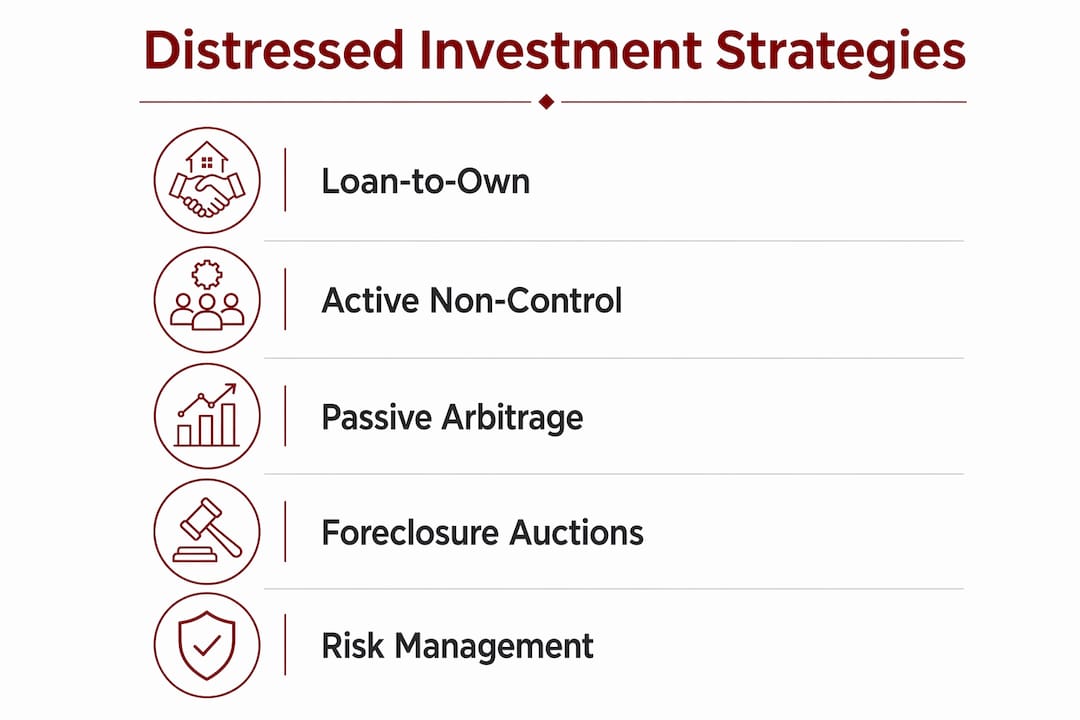
Three core approaches define how professionals profit from distressed investing. Each carries a distinct risk profile, time horizon, and operational requirement.
Loan-to-own (active control)
The loan-to-own strategy targets the fulcrum security, which is the specific debt tranche most likely to convert into equity during a restructuring. Investors acquire a blocking position in this tranche, then use that leverage to convert debt into controlling equity in the reorganized company. Targeted returns in active control strategies range 20%–25% over 2–4 years. This approach demands deep legal and operational expertise because the investor effectively becomes the company’s new owner. Mistakes in identifying the true fulcrum security can result in total capital loss.

Active non-control
Active non-control investors take meaningful positions and push for favorable restructuring outcomes without seeking outright ownership. They negotiate for equity kickers, improved covenants, or cash payouts. This strategy suits investors who want influence over the restructuring process but prefer to exit before taking on operational responsibility. Returns are typically lower than loan-to-own but the execution risk is also reduced.
Passive discount arbitrage
Passive investors buy deeply discounted debt and wait for market-driven price recovery, without engaging in the restructuring process. This approach relies on discount capture, coupon income, and equity conversion upside over multi-year horizons. It also offers a meaningful diversification benefit: distressed debt has historically shown low correlation with public equity markets, making it countercyclical. The tradeoff is limited control over outcomes.
| Strategy | Typical return target | Time horizon | Control level |
|---|---|---|---|
| Loan-to-own (active control) | 20%–25% | 2–4 years | Full operational control |
| Active non-control | 15%–20% | 1–3 years | Influence without ownership |
| Passive discount arbitrage | 12%–18% | 1–3 years | None |
Pro Tip: Before committing capital to any active strategy, map the full capital structure and confirm which tranche sits at the fulcrum. Misidentifying it is the single most common error among first-time distressed investors.
How do foreclosures and auctions fit into distressed property investing?
Buying distressed properties through foreclosure is a distinct sub-strategy within the broader distressed investing universe. It requires a different skill set from debt investing but follows the same core logic: acquire at a discount, recover value through repositioning or resale.
The foreclosure process moves through three stages, each with different risk and discount profiles.
-
Pre-foreclosure. The seller is behind on payments but the property has not yet been seized. Investors can negotiate directly, typically securing discounts of 5%–15% off retail value. Title is cleaner at this stage and financing is more accessible.
-
Auction. Properties sell at courthouse steps or online platforms. Discounts reach 10%–25%, but buyers often cannot inspect the property beforehand. Auctions require cash or hard money financing, and closing can happen within hours of the winning bid. Weeks of pre-research are non-negotiable.
-
Bank-owned REO (real estate owned). After a failed auction, the lender takes title. REO properties are often easier to finance with conventional loans and allow full inspections, but discounts narrow as banks price for a clean sale.
The most dangerous hidden cost at auction is a surviving lien. Tax liens and HOA super-liens do not get extinguished by foreclosure sales in many jurisdictions. An investor who wins a bid without verifying lien status can inherit obligations that exceed the discount gained. Title searches, lien verification, and condition assessments are not optional steps. They are the work that separates profitable trades from expensive mistakes.
Foreclosure sourcing works best as a supplemental strategy within a broader portfolio. Relying on it exclusively limits deal flow and concentrates geographic and regulatory risk.
Pro Tip: Layer motivation signals when sourcing distressed properties. Tax delinquency alone is a weak signal. Tax delinquency combined with absentee ownership and deferred maintenance points to a seller far more likely to transact at a real discount.
What are the key risks distressed asset investors must navigate?
Distressed investing rewards expertise and punishes shortcuts. The risks are structural, legal, and operational, and they compound quickly when investors underestimate any one of them.
-
Capital erosion from legal proceedings. Contentious Chapter 11 reorganizations can last months or years. Legal fees and long bankruptcy timelines erode recovery percentages significantly, particularly for investors holding junior tranches.
-
Cramdown risk. Bankruptcy courts can impose a cramdown, forcing a restructuring plan on dissenting creditors. This can wipe out expected recoveries for entire debt tiers, even when the investor believed their position was protected.
-
Illiquidity and price volatility. Secondary markets for distressed debt are thin. Exiting a position before restructuring completes often means accepting a large price haircut. Investors who need liquidity at the wrong moment absorb the worst outcomes.
-
Hidden property costs. In real estate, surviving tax liens and HOA super-liens represent a category of risk that financial models rarely capture. Verification beyond distress signals is the only reliable defense.
-
Operational blind spots. Relying solely on financial models in restructuring plans fails to capture operational risks. Cross-disciplinary expertise including C-suite operational insight is critical to assessing whether a distressed business can actually be turned around.
The investors who consistently protect capital treat legal, operational, and financial analysis as equally weighted inputs, not sequential steps.
How can APAC investors access distressed asset opportunities?
Access to institutional-grade distressed strategies has expanded meaningfully for accredited investors in the APAC region. The structures and frameworks available today make it possible to participate without the minimum commitments that once restricted this asset class to the largest funds.
-
Interval funds. Accredited investors can access distressed strategies through interval funds. Management fees average around 1.25%, which is materially lower than traditional hedge fund structures. The tradeoff is that capital should be treated as illiquid for a 3–5 year investment horizon, even with quarterly windows available.
-
Cross-border regulatory navigation. APAC markets span vastly different insolvency regimes, from Singapore’s well-regarded restructuring framework to less predictable jurisdictions across Southeast Asia. Investors pursuing cross-border distressed deals need counsel who understands both the local legal environment and the international capital structure implications.
-
Singapore as a restructuring hub. Singapore’s insolvency framework, updated through the Insolvency, Restructuring and Dissolution Act, positions the city-state as the preferred venue for regional restructurings. Investors with exposure to APAC distressed situations benefit from advisors with direct experience in Singapore restructuring proceedings.
-
The current opportunity window. The private credit downturn represents the greatest distressed investment opportunity since 2008, driven more by sentiment and liquidity needs than by fundamental deterioration. That distinction matters. When distress is sentiment-driven rather than structural, recovery timelines compress and return profiles improve.
The APAC distressed market rewards investors who combine local regulatory knowledge with the financial discipline to hold through volatility. Partnering with advisors who bring both legal and operational depth is not a luxury. It is a structural advantage.
Key Takeaways
Distressed asset investing requires combining financial discipline, legal expertise, and operational insight to generate superior returns across debt and property markets.
| Point | Details |
|---|---|
| Three core strategies | Loan-to-own, active non-control, and passive arbitrage each offer distinct return and risk profiles. |
| Fulcrum security is central | Correctly identifying the fulcrum tranche determines whether active control strategies succeed or fail. |
| Foreclosure stages matter | Pre-foreclosure, auction, and REO each carry different discount ranges, financing needs, and hidden risks. |
| APAC access has expanded | Interval funds with minimums as low as $2,500 now give accredited investors institutional-grade distressed exposure. |
| Legal expertise is non-negotiable | Cross-border insolvency navigation and lien verification protect capital in ways financial models alone cannot. |
The APAC distressed market rewards conviction, not caution
The most common mistake I see among investors entering the distressed space is treating it as a financial exercise. They build detailed models, identify the discount, and assume the math will protect them. It rarely does on its own.
What actually separates the investors who generate 20%+ returns from those who break even is operational conviction. The best distressed investors I have observed do not just buy the debt. They understand the business, the management team, the regulatory environment, and the legal capital structure before they commit a dollar. In APAC, that operational depth is even more critical because the legal frameworks vary so dramatically across markets.
The current private credit dislocation is genuinely the most attractive entry point in over a decade. But sentiment-driven distress can reverse quickly. Investors who move without thorough due diligence will find that the window closes before their thesis plays out. The discipline to source carefully, verify exhaustively, and hold with conviction through volatility is what this market actually rewards.
One observation I keep returning to: the investors who outperform consistently are the ones who treat legal counsel as a strategic partner from day one, not as a compliance cost at the end. In a cross-border APAC restructuring, the difference between a well-structured position and a wiped-out one often comes down to which jurisdiction’s insolvency law governs the outcome.
— HL
Beyondhorizons: cross-border counsel for distressed asset recovery
Distressed investing in APAC demands more than financial acumen. It demands legal precision across multiple jurisdictions, insolvency frameworks, and regulatory environments that shift with each market.

Beyondhorizons is a Singapore-headquartered law firm with lawyers from Magic Circle and US white shoe firms, ranked on Chambers, Legal 500, and Asia Legal Business. The firm’s corporate transactions practice supports distressed asset investors through cross-border restructurings, capital structure analysis, and insolvency proceedings across APAC. Whether you are acquiring fulcrum securities in a regional restructuring or navigating a foreclosure portfolio across multiple jurisdictions, Beyondhorizons brings the legal depth and commercial judgment that complex distressed situations require.
FAQ
What is a distressed asset investor?
A distressed asset investor acquires securities or properties trading at significant discounts due to financial or operational distress, targeting returns through recovery, restructuring, or resale. Historical returns for this asset class average 15% to 20%.
What is the fulcrum security in distressed debt investing?
The fulcrum security is the debt tranche most likely to convert into equity during a restructuring. Loan-to-own investors target it specifically to gain controlling ownership of the reorganized company.
What discounts are available when buying distressed properties?
Pre-foreclosure deals typically offer 5%–15% discounts off retail value, while foreclosure auctions can yield 10%–25% discounts. Auction purchases carry higher risk due to limited inspection access and potential surviving liens.
How can APAC investors access distressed debt funds?
Accredited investors can access institutional-grade distressed strategies through interval funds with minimums as low as $2,500 and quarterly redemption windows. Capital should be treated as illiquid for a 3–5 year horizon regardless of the redemption structure.
Why is legal expertise critical for distressed asset investing?
Distressed capital structures involve complex insolvency laws, cramdown risk, and hidden liabilities like tax liens that financial models do not capture. Cross-disciplinary legal and operational expertise is the primary defense against catastrophic capital loss.