
ESG compliance is defined as mandatory adherence to environmental, social, and governance laws, regulations, and enforceable standards that carry legal penalties for non-compliance. This is distinct from voluntary ESG reporting, which companies choose to publish for reputational purposes. For corporate compliance officers across APAC, understanding this distinction is the starting point for every serious compliance program. Frameworks like the EU Corporate Sustainability Reporting Directive (CSRD), the International Sustainability Standards Board (ISSB) standards IFRS S1 and S2, and the Global Reporting Initiative (GRI) now define what mandatory ESG disclosure looks like in practice. The concept of double materiality, which requires companies to report both how ESG issues affect their finances and how their operations affect society and the environment, sits at the center of the most demanding frameworks.
What are the key components and requirements of ESG compliance?
ESG compliance covers three distinct operational domains, each with its own legal and reporting obligations. Getting one wrong creates liability across the others.
Environmental requirements
The environmental pillar covers greenhouse gas emissions tracking, environmental permits, waste management, and climate risk disclosure. Compliance demands documented environmental permits, supply chain diligence, and labor law adherence integrated into ESG disclosures. This means your environmental data must be audit-ready, not just published in an annual report.
Social requirements
The social pillar addresses labor law adherence, workplace safety, human rights in supply chains, and diversity reporting. Supply chain sustainability and labor law adherence are critical and often overlooked pillars of ESG compliance requiring legal and operational due diligence. Many APAC businesses underestimate how far down the supply chain this obligation reaches.

Governance requirements
Governance compliance involves board oversight on sustainability, anti-bribery policies aligned with UK Bribery Act and US Foreign Corrupt Practices Act standards, whistleblower protection mechanisms, and linking executive pay to ESG targets. Strong governance ensures ESG commitments are more than marketing and is increasingly required as part of mandatory compliance. Boards that treat ESG as a finance committee matter rather than a full board responsibility create structural gaps that regulators notice.
The major reporting frameworks each company must understand include:
- CSRD/ESRS: EU-mandated, applies to large companies and non-EU companies with significant EU revenue; requires double materiality assessment
- GRI: Stakeholder-focused; widely used globally including across APAC; not legally mandatory but frequently required by investors
- ISSB IFRS S1/S2: Financially material sustainability and climate disclosures; increasingly adopted by APAC regulators
- SASB: Industry-specific metrics; often used alongside GRI or ISSB
- TCFD: Climate-related financial disclosures; now embedded in ISSB S2
Pro Tip: Start your compliance program by mapping which frameworks your investors, lenders, and key trading partners require. Regulatory mandates matter, but contractual ESG requirements from counterparties often arrive first.
How do regulatory frameworks and standards differ across jurisdictions?
ESG frameworks differ in focus: GRI centers on stakeholder impact, ISSB on financial materiality, and CSRD on mandatory EU-wide sustainability disclosure. Understanding these differences prevents companies from over-investing in one framework while missing obligations under another.
| Framework | Scope | Legal enforceability | Materiality approach |
|---|---|---|---|
| EU CSRD/ESRS | EU companies and large non-EU companies with EU operations | Mandatory; government penalties apply | Double materiality |
| ISSB IFRS S1/S2 | Global; adopted by individual regulators | Varies by jurisdiction | Financial materiality |
| GRI | Global; voluntary baseline | Not legally mandatory | Stakeholder impact |
| SASB | Industry-specific; US origin | Voluntary; investor-driven | Financial materiality |
| TCFD | Climate focus; now embedded in ISSB S2 | Mandatory in some jurisdictions | Financial materiality |
For APAC-based businesses, the picture is more complex than this table suggests. Singapore's SGX-listed companies face mandatory climate reporting aligned with ISSB standards. Australia's Treasury has legislated mandatory climate disclosures phased in from 2025. Hong Kong's SFC and HKEX have issued TCFD-aligned requirements for listed issuers. Japan's Financial Services Agency has moved toward ISSB adoption. These are not voluntary exercises. They carry disclosure obligations with legal consequences.
The challenge for regional companies is that a single business operating across Singapore, Australia, and with EU customers may face three overlapping mandatory regimes simultaneously. Board reporting best practices in 2026 require companies to map each jurisdiction's requirements separately before attempting a unified compliance approach.
Beyond regulatory mandates, investor-driven ESG compliance is growing faster than regulation. Institutional investors, including sovereign wealth funds active across APAC, now embed ESG compliance requirements directly into investment agreements and loan covenants. A company that meets no mandatory regulatory threshold may still face contractual ESG obligations from its capital providers.
Pro Tip: Build a jurisdiction matrix that lists every country where you operate, the applicable ESG regulation, the reporting deadline, and the enforcement body. Review it quarterly. Regulatory timelines in APAC are moving faster than most compliance calendars anticipate.
What practical steps do businesses take to achieve ESG compliance?
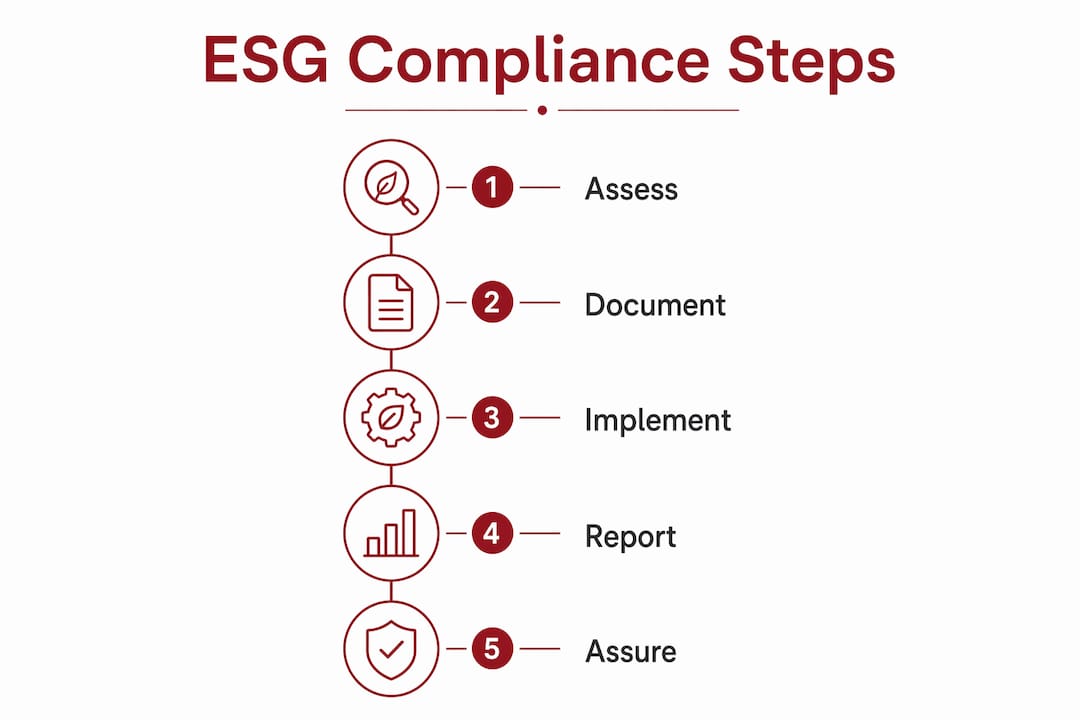
ESG compliance success depends on early investment in institutional knowledge and comprehensive systems rather than last-minute filings. Companies that treat compliance as a year-end exercise consistently fail audits and face restatement risk.
-
Conduct a double materiality assessment. Identify which ESG topics are financially material to your business and which of your operations materially affect external stakeholders. This assessment drives every subsequent disclosure decision.
-
Centralize data ownership. Assign clear ownership of ESG data across HR, finance, procurement, and facilities. ESG data scattered between departments hampers audit readiness and credibility under evolving standards. A single data owner per pillar, reporting to the Chief Compliance Officer or equivalent, is the minimum viable structure.
-
Integrate ESG into board governance. Boards must formally oversee ESG strategy, not delegate it entirely to management. This means board-level ESG reporting at least quarterly, with clear accountability for targets linked to executive compensation.
-
Prepare for third-party assurance. Compliance demands documented environmental permits, supply chain diligence, and labor law adherence integrated into ESG disclosures. Assurance providers will test your data trails, not just your published numbers. Treat your first assurance engagement as a dry run for a financial audit.
-
Conduct supply chain due diligence. Map your Tier 1 and Tier 2 suppliers against environmental and labor standards. Document your verification methodology. Regulators increasingly require documentation of methodologies and assumptions behind ESG data, demanding audit trails to avoid greenwashing risks.
-
Engage legal counsel for cross-border obligations. Companies operating across APAC jurisdictions need legal advice on how overlapping frameworks interact. Regulatory compliance counsel helps businesses identify gaps before regulators do.
-
Build internal ESG expertise. External consultants accelerate setup, but institutional knowledge must live inside the business. Train compliance, finance, and legal teams on the frameworks that apply to your operations.
Pro Tip: Treat your ESG compliance calendar like your financial reporting calendar. Set hard internal deadlines for data collection, internal review, and external assurance that are at least six weeks ahead of regulatory submission dates.
What are common challenges and misconceptions around ESG compliance?
The most damaging misconception is that ESG compliance is a marketing or CSR activity. Companies not integrating ESG as a strategic advantage risk missing benefits like better access to capital and operational resilience. Treating ESG as a communications function rather than a compliance function creates legal exposure.
The most common operational challenges include:
- Data silos. ESG data lives in HR systems, ERP platforms, and facilities management tools that were never designed to talk to each other. Without centralized data governance, companies produce inconsistent numbers across different disclosures.
- Underestimating the recurring nature of compliance. ESG compliance is an ongoing cyclical process requiring continuous reporting, audit preparation, and improvement rather than a one-time project. Executives should anticipate recurring assurance efforts with rigor comparable to financial audits.
- Greenwashing risk. Publishing ESG claims without the data and methodology to support them creates legal liability under securities law, consumer protection law, and emerging anti-greenwashing regulations in the EU and Australia.
- Scope creep in supply chains. Companies often comply at the entity level but fail to extend due diligence to suppliers. Regulators and investors are closing this gap through mandatory supply chain disclosure requirements.
- Resistance from non-compliance functions. Finance, operations, and procurement teams often view ESG data requests as administrative burden. Framing ESG compliance as a risk management and capital access issue, not a reporting exercise, changes that conversation.
How is the role of ESG consultants evolving in 2026?
Modern ESG consultants bridge complex regulatory frameworks with operational strategy, facilitating double materiality assessments and credible ESG communication. The role has shifted from report writing to systems architecture and legal readiness.
The functions a qualified ESG consultant performs today include:
- Translating CSRD, ISSB, and GRI requirements into specific data collection protocols
- Designing double materiality assessment processes and facilitating stakeholder engagement
- Preparing companies for third-party assurance by stress-testing data and documentation
- Supporting board-level ESG governance design and executive training
- Advising on legislative agenda alignment as new regulations emerge across APAC
ESG consultant day rates range from £500–800 for independent specialists to £1,200–2,000 for large firms, reflecting the complexity and scope of engagements. That cost range signals that ESG consulting has moved firmly into the professional services tier occupied by legal and financial advisors.
ESG reporting now impacts risk management, investor confidence, and finance access, requiring consultants to hold broader skills bridging data, strategy, and compliance. The best consultants function as translators and credibility builders, helping companies avoid greenwashing and preparing them for regulatory scrutiny. For APAC businesses, finding consultants with specific knowledge of regional regulatory timelines, not just EU or US frameworks, is the critical differentiator.
Key Takeaways
ESG compliance is a legally enforceable obligation requiring documented data, third-party assurance, and board-level governance, not a voluntary reporting exercise companies can approach casually.
| Point | Details |
|---|---|
| ESG compliance is mandatory | Legal penalties apply under frameworks like EU CSRD; voluntary reporting is a separate, lower-stakes activity. |
| Double materiality drives disclosure | Companies must report both financial impact of ESG risks and their own impact on society and the environment. |
| Data centralization is non-negotiable | ESG data scattered across HR, finance, and facilities creates audit failures and greenwashing liability. |
| APAC faces overlapping regimes | Singapore, Australia, Hong Kong, and Japan each have distinct ESG mandates that may apply simultaneously. |
| Compliance is cyclical, not one-time | Treat ESG assurance with the same recurring rigor as financial audits, not as an annual report exercise. |
Why getting ESG compliance meaning right changes everything
Most compliance officers I work with arrive at ESG with the same instinct: find the framework, fill in the template, publish the report. That instinct is understandable. It is also the fastest route to a greenwashing investigation.
The shift that changes outcomes is recognizing that ESG compliance is a data and governance problem before it is a reporting problem. The companies that sail through assurance are the ones that built data ownership structures eighteen months before their first mandatory filing. They assigned a named owner to every data point. They ran internal audits before external ones. They treated the double materiality assessment as a board-level strategy exercise, not a consultant deliverable to file and forget.
For APAC compliance officers specifically, the jurisdictional complexity is real and growing. The temptation is to wait for local regulators to finalize requirements before acting. That approach consistently puts companies behind. Investor-driven ESG requirements arrive before regulatory mandates, and the companies that built compliance infrastructure early are the ones that access capital on better terms.
The greenwashing risk in APAC markets deserves a direct warning. Regulators in Australia and Singapore are actively investigating ESG claims that lack documented methodological support. Publishing sustainability commitments without the data architecture to back them is not a communications risk. It is a legal risk.
My advice to compliance officers: start with your data, not your disclosure. Map what you have, identify what you are missing, and build the governance structure that makes your numbers defensible. The report is the last step, not the first.
— HL
How Beyondhorizons supports your ESG compliance program
Beyondhorizons is a Singapore-headquartered law firm with lawyers ranked on Chambers, Legal 500, and Asia Legal Business, advising clients across APAC on cross-border corporate compliance and regulatory matters. The firm's team brings direct experience in supply chain due diligence, ESG audit readiness, and the overlapping regulatory obligations that affect companies operating across multiple APAC jurisdictions.

For businesses navigating mandatory ESG disclosure under ISSB, SGX, or CSRD requirements, Beyondhorizons provides legal counsel on governance structures, contractual ESG obligations, and employment law compliance. The firm's global employment counsel practice supports the social pillar of ESG compliance, including labor law adherence and supply chain due diligence. Contact Beyondhorizons to discuss how your compliance program maps to the regulatory requirements that apply to your operations.
FAQ
What is ESG compliance in simple terms?
ESG compliance is the mandatory process of meeting environmental, social, and governance laws and regulations, with legal penalties for non-compliance. It differs from voluntary ESG reporting, which carries no direct legal consequences.
What does ESG compliant mean for a business?
An ESG compliant business has documented policies, data systems, and governance structures that satisfy the specific ESG regulations and standards applicable to its operations, and can demonstrate this through third-party assurance.
What is the ESG compliance definition under CSRD?
Under the EU CSRD, ESG compliance requires large companies to conduct a double materiality assessment and disclose sustainability information under the European Sustainability Reporting Standards (ESRS), enforceable by government penalties.
What does an ESG consultant do for compliance?
An ESG consultant designs data collection systems, facilitates double materiality assessments, prepares companies for third-party assurance, and translates frameworks like CSRD and ISSB into specific operational requirements.
Why does ESG compliance matter for APAC businesses?
APAC businesses face mandatory ESG requirements from Singapore's SGX, Australia's Treasury, Hong Kong's HKEX, and Japan's FSA, alongside investor-driven contractual obligations that often arrive before regulatory mandates.