
Before your first meeting, map your counterpart's decision-making structure, verify who holds actual authority, and set objective anchors — the Program on Negotiation at Harvard Law School and Harvard Business Review both identify these as the highest-leverage preparation steps US corporate clients consistently skip. Beyondhorizons recommends engaging specialist cross-border counsel before term sheets are exchanged, not after.
Immediate actions for the next 24–72 hours:
- Confirm the decision-maker. Ask directly: "Who else must approve this?" A surrogate negotiator gathering information for a committee is common in consensus-driven cultures.
- Run a seven-dimension cultural scan covering communication style, decision-making, time orientation, relationship expectations, power distance, risk tolerance, and emotional display (detailed in the next section).
- Identify shared standards. Find one industry benchmark, valuation method, or technical specification both sides already accept.
- Set a written follow-up protocol. Agree on language, format, and turnaround time for post-meeting summaries before the first session ends.
- Brief internal stakeholders on timeline realism — relationship-first cultures rarely sign on the first visit.
- Engage Beyondhorizons for clause drafting, compliance screening, and cultural advisory before the term sheet stage.
Table of Contents
- What should you check before a cross-border negotiation meeting?
- How do dignity, honor, and face cultures negotiate differently?
- Is the disagreement stylistic or strategic? Here is how to tell
- How do objective anchors accelerate deals when trust is thin?
- What legal safeguards should US firms demand in cross-border deals?
- What does a cross-border negotiation timeline look like, and what does it cost?
- Red flags US negotiators should catch before they become problems
- How Beyondhorizons supports US companies in cross-border negotiations
- Key Takeaways
- A practitioner's perspective on what actually changes deals
- Authoritative sources and further reading
What should you check before a cross-border negotiation meeting?
A seven-dimension checklist is the practitioner standard for cross-cultural preparation. Work through each dimension before the first meeting.
| Dimension | Due-diligence action |
|---|---|
| Communication style | Review counterpart's prior contracts and correspondence for directness signals; ask a local advisor whether "yes" means agreement or acknowledgment |
| Decision-making process | Request an org chart; ask "What is your typical approval timeline?" |
| Attitude toward time | Confirm whether the counterpart's culture treats deadlines as firm or aspirational; build schedule buffers accordingly |
| Relationship expectations | Allocate time for social interaction before agenda items; do not open with term sheets |
| Power distance | Identify seniority levels on both sides; match rank in the room |
| Risk tolerance | Ask "What conditions would make this deal difficult for your organization?" to surface unstated constraints |
| Emotional display | Research whether open disagreement is acceptable or face-threatening in the counterpart's context |
Pro Tip: Checklists describe tendencies, not individuals. Treat each dimension as a hypothesis to test, not a verdict to apply. Stereotyping a Japanese counterpart as consensus-driven or a German one as purely transactional will cost you more than ignorance would.
How do dignity, honor, and face cultures negotiate differently?
Researchers at the Program on Negotiation classify negotiation-relevant cultures into three archetypes. Each predicts distinct communication and conflict behaviors.
Dignity cultures (Northern Europe, North America)
Individuals derive self-worth internally. Direct disagreement is acceptable and expected.
- Do: State positions clearly, use data-led arguments, propose written term sheets early.
- Don't: Interpret bluntness as hostility; it is efficiency.
- Common misread: A US team reads a Dutch counterpart's flat "no" as a negotiating tactic and keeps pushing. The Dutch counterpart meant no. Corrective tactic: accept the rejection, reframe the underlying interest, and return with a restructured proposal.
Honor cultures (Middle East, Latin America, Southern Europe)
Reputation and respect within the group drive behavior. Public challenge is deeply threatening.
- Do: Criticize proposals privately, never in front of the counterpart's team; invest in hospitality and relationship time.
- Don't: Issue ultimatums or create situations where the counterpart must back down publicly.
- Common misread: A US negotiator presses for a concession in a group session. The counterpart agrees to avoid public embarrassment, then reverses the position after the meeting. Corrective tactic: move sensitive issues to a bilateral side conversation.
Face cultures (East Asia, Southeast Asia)
Social harmony and group standing take precedence. Silence is deliberate, not confused. Mastering silence is essential — filling it prematurely signals weakness and can trigger unnecessary concessions.
- Do: Allow pauses; interpret silence as deliberation, not rejection.
- Don't: Force a public "yes" or "no"; offer off-ramps that let the counterpart reposition without losing standing.
- Common misread: A US team reads extended silence after a proposal as confusion and volunteers a lower price. The counterpart was consulting internally. Corrective tactic: state your position, then wait.
Is the disagreement stylistic or strategic? Here is how to tell
Misreading cultural behavior as deliberate resistance is the most common error US negotiators make. A simple diagnostic flow prevents costly misinterpretation.

If the counterpart is evasive on timelines → ask "What is your typical approval process for a deal of this size?" A vague answer signals authority limits, not bad faith.
If the counterpart reverses a position after a group session → the reversal is almost always face-saving or internal-approval driven, not deception. Pause and request a bilateral call.
If the counterpart goes silent after a proposal → wait at least 30 seconds before speaking. Silence in many East Asian contexts signals deliberation.
If the counterpart introduces a new issue late in negotiations → this may be a tactical anchor or a genuine governance requirement surfaced by internal review. Ask: "Is this a condition for signing, or a preference you'd like us to address?"
- Signals of authority limits: surrogate negotiator, requests to "consult internally," inability to confirm timelines.
- Signals of face-saving behavior: reversals after group sessions, indirect language, third-party intermediaries.
- Signals of genuine strategic resistance: consistent position across multiple sessions, written objections, escalation to senior principals.
Pro Tip: When you cannot tell whether a "no" is cultural or strategic, introduce a neutral third-party standard — an industry benchmark, an independent valuation, or a model clause from a recognized body. If the counterpart engages with the standard, the issue is negotiable. If they deflect it entirely, you have found a genuine constraint.
How do objective anchors accelerate deals when trust is thin?
When personal trust is not yet established, anchor early discussions in mutually accepted standards. This removes cultural friction from the price of admission.
- Industry KPIs and benchmarks. In aerospace and aviation finance deals, reference published lease rate factors or maintenance reserve norms from recognized industry bodies rather than proprietary internal models.
- Independent valuations. Commission a third-party valuation from a mutually agreed firm before price discussions begin. Both sides negotiate against the same number.
- Escrow and milestone-linked payment. Propose escrow for a defined portion of consideration, released against verified milestones. This replaces trust with a verifiable mechanism.
- International standards references. In technology and data deals, cite ISO standards, GDPR adequacy decisions, or UNCITRAL model clauses as neutral drafting references. Counterparts who accept international standards as a baseline are signaling good faith.
- Model clause libraries. The ICC, LCIA, and UNCITRAL each publish model arbitration and force majeure clauses. Proposing one of these early signals that you are not trying to impose US-centric terms.
What legal safeguards should US firms demand in cross-border deals?
The contract is where cultural goodwill meets legal reality. Mapping decision-making and governance before drafting prevents provisions that look enforceable on paper but fail in practice.
Must-have clauses for US corporate clients:
- Choice of law and jurisdiction. Specify governing law explicitly. For APAC deals, Singapore law and SIAC arbitration are widely accepted neutral choices. For deals with US-listed counterparties, Delaware or New York law is standard.
- Dispute resolution. Prefer international arbitration over local courts in jurisdictions with limited enforcement track records. Specify seat, rules, and number of arbitrators. Beyondhorizons' arbitration practice handles clause drafting and enforcement strategy.
- Escrow and trust arrangements. Require escrow for a defined tranche of consideration where counterpart creditworthiness or regulatory approval timelines are uncertain.
- Warranties and indemnities (W&I). Negotiate representations covering financial condition, regulatory compliance, and absence of undisclosed liabilities. W&I insurance is available and increasingly common in APAC cross-border M&A.
- Termination and suspension rights. Include MAC (material adverse change) triggers, regulatory-approval conditions, and unilateral suspension rights tied to compliance failures.
- Compliance warranties. Require representations on export controls, sanctions screening, anti-corruption (FCPA, UK Bribery Act), and data transfer compliance. Make these conditions to closing, not post-closing obligations.
For commercial contract drafting and clause negotiation across APAC and emerging markets, Beyondhorizons provides fixed-fee drafting packages and retainer-based advisory.
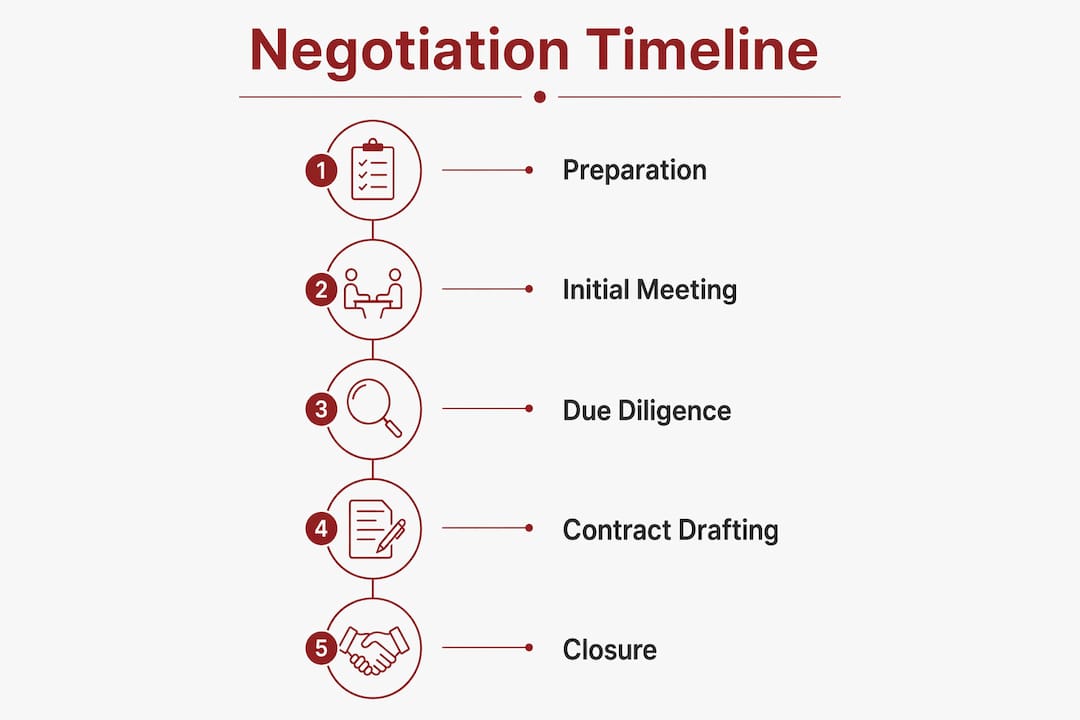
What does a cross-border negotiation timeline look like, and what does it cost?
Relationship-heavy cultures require slower timelines. Pressing for early signature frequently produces fragile post-closing performance. Budget accordingly.
| Phase | Typical duration | Resource allocation |
|---|---|---|
| Preparation and cultural mapping | 1–3 weeks | Internal deal team + external counsel |
| Initial meetings and relationship building | 2–6 weeks | Senior principals + cultural advisor |
| Term sheet / LOI negotiation | 2–4 weeks | Deal team + legal counsel |
| Detailed negotiation and contract drafting | 4–12 weeks | External counsel-led, internal review |
| Closing and conditions satisfaction | 2–6 weeks | Legal, compliance, finance |
| Post-signing relationship management | Ongoing | Relationship lead + counsel on call |
Fee models:
- Hourly billing: Standard for complex, evolving negotiations where scope is uncertain.
- Fixed-fee packages: Available for discrete phases (term sheet review, clause drafting, compliance checklist).
- Retainer agreements: Suited to ongoing cross-border programs or multi-deal mandates.
- Success fees: Applicable in limited advisory contexts; confirm regulatory permissibility by jurisdiction.
Pro Tip: Agree on a budget ceiling for each phase before engaging external counsel, and require a written scope-of-work memo before work begins. Scope creep in cross-border matters is common because new issues surface as governance mapping deepens.
Red flags US negotiators should catch before they become problems
- Surrogate negotiator with no authority: Verify decision-making power before sharing material terms. Ask: "Are you authorized to agree to commercial terms today?"
- Evasive answers on approval timelines: A counterpart who cannot describe their internal approval process may not have authority, or the deal may face internal opposition not yet disclosed.
- Inconsistent document trail: Discrepancies between term sheets, emails, and draft contracts signal either poor process or deliberate ambiguity. Require a single consolidated redline at each stage.
- Rushed closing pressure: Artificial urgency is a classic tactic. Verify whether the deadline is real (regulatory, fiscal year, third-party expiry) or manufactured.
- Language used loosely: In cross-cultural contexts, "agreement in principle" can mean anything from a binding heads of terms to a polite acknowledgment. Always confirm in writing what was agreed and what remains open.
Response templates:
- On authority: "Before we proceed to commercial terms, can you confirm who on your side has authority to execute?"
- On timelines: "What internal steps need to happen between today and signing? We want to build a realistic schedule."
- On document inconsistency: "We noticed a discrepancy between the draft and the term sheet on [clause]. Can we align on a single working document?"
A common post-closing problem: a US technology firm closed an APAC licensing deal without confirming that the counterpart's signatory had board authority. The agreement was later challenged internally by the counterpart's parent company. Counsel's intervention at the term sheet stage, requiring a board resolution as a condition to signing, would have prevented the dispute entirely.
How Beyondhorizons supports US companies in cross-border negotiations
Beyondhorizons delivers practical legal and negotiation support for US corporate clients across APAC and emerging markets, combining sector depth in aerospace, blockchain, robotics, and advanced air mobility with Magic Circle and US white shoe firm pedigree.

Engagement models are designed for deal-stage flexibility: fixed-fee packages for term sheet review and compliance checklists, phased retainers for multi-stage negotiations, and full advisory-plus-drafting mandates for complex cross-border transactions. Clients include US-listed companies, regional banks, and fintech firms navigating APAC regulatory environments. The team is ranked on Chambers, Legal 500, and Asia Legal Business.
For US firms entering APAC markets, Beyondhorizons' cross-border corporate counsel practice covers the full negotiation lifecycle: cultural preparation, governance mapping, clause drafting, compliance screening, and post-signing relationship management. The firm's global expertise spans Singapore, Southeast Asia, and key emerging markets, with regulatory compliance counsel embedded in every cross-border mandate.
Contact Beyondhorizons to schedule a scoped consultation with a named counsel before your next cross-border negotiation.
Key Takeaways
Effective cross-border negotiations require mapping counterpart authority, applying a seven-dimension cultural checklist, anchoring terms in objective standards, and securing must-have legal safeguards before the term sheet stage.
| Point | Details |
|---|---|
| Map authority first | Verify whether your counterpart can actually agree to terms before sharing commercial positions. |
| Use the seven-dimension checklist | Cover communication style, decision-making, time, relationships, power distance, risk, and emotional display before the first meeting. |
| Anchor in objective standards | Propose industry benchmarks, independent valuations, or model clauses when personal trust is not yet established. |
| Demand key contract protections | Choice of law, arbitration, escrow, W&I, compliance warranties, and termination rights are non-negotiable in cross-border deals. |
| Engage Beyondhorizons early | Fixed-fee and retainer models are available for US firms at any stage of a cross-border transaction. |
A practitioner's perspective on what actually changes deals
The conventional wisdom says cross-border negotiations fail because of cultural misunderstanding. That is partly true, but it misses the deeper problem: most US deal teams treat cultural preparation as a courtesy exercise rather than a governance-mapping exercise. They learn to bow or avoid the left hand at dinner, then walk into a meeting without knowing whether the person across the table can actually say yes.
The most consequential shift in cross-border negotiation practice over the past decade is the recognition that cultural intelligence — the ability to observe, interpret, and adapt in real time — predicts outcomes better than technical bargaining skill alone. A lawyer who can read a room in Tokyo or Riyadh and adjust without losing position is worth more than one who can draft a perfect MAC clause but cannot tell when silence means deliberation.
At Beyondhorizons, the deals that close cleanly share one feature: the legal and commercial teams prepared together, not sequentially. Sector experience in aerospace, blockchain, and robotics means the firm's counsel can speak to a counterpart's technical concerns, not just their contractual ones. That changes the dynamic at the table.
If you are preparing for a cross-border transaction and want a scoped conversation with a named counsel, reach out to Beyondhorizons directly. The APAC Cross-Border Guide 2026 is also available as a starting reference.
Authoritative sources and further reading
- Program on Negotiation at Harvard Law School — Primary authority on cross-cultural communication, cultural archetypes, and negotiation strategy. The PON's practitioner guides and research summaries are the most cited resources in US executive negotiation training.
- Harvard Business Review — Cross-Border Negotiations — Foundational HBR analysis of hidden cultural challenges in international dealmaking; useful for framing the business case for cultural preparation.
- IMD — Conducting Cross-Cultural Negotiations — Case-study-based framework for the seven-dimension checklist; recommended for deal teams preparing for first meetings.
- IESE — Cross-Cultural Negotiation Keys — Practitioner notes on relationship-first cultures and timeline management; useful for Latin American and Southern European deal contexts.
- Negotiation Journal, MIT Press — Peer-reviewed research on cultural intelligence as a predictor of negotiation success; the strongest academic backing for CQ investment.
- Beyondhorizons — APAC Cross-Border Guide 2026 — Firm resource covering APAC-specific cross-border issues, conflict checks, and deal structuring considerations for US clients.
- Dual tax residency considerations — Practical primer on dual tax residency issues relevant to cross-border deal structuring and entity planning.
For complex cases, consult the original PON guidance directly and engage qualified cross-border counsel before relying on any published framework for a specific transaction.