
Transportation public-private partnerships, commonly called P3s, are contractual agreements between a public agency and a private entity that allow greater private participation in delivering transportation projects. As defined by the U.S. Department of Transportation, these P3 agreements give private partners a role in design, construction, financing, operation, and maintenance of infrastructure that the public sector owns. The federal government shapes P3s through funding programs and regulatory oversight but is rarely a direct party to agreements themselves.
P3s span a wide spectrum of arrangements:
- Design-Build (DB): Private partner designs and constructs; the public agency operates and maintains.
- Design-Build-Finance (DBF): Private partner adds upfront financing to the design-build scope.
- Design-Build-Operate-Maintain (DBOM): Private partner handles construction and long-term operations but does not finance.
- Design-Build-Finance-Operate-Maintain (DBFOM): The most comprehensive form; private partner manages nearly all phases under a concession agreement.
- Long-term lease: Public agency leases an existing facility to a private operator for a defined period.
Key stakeholders include state and local governments (asset owners), private consortia (developers, contractors, operators), federal agencies such as the Federal Highway Administration and Federal Transit Administration, and financing institutions ranging from pension funds to private equity. The TIFIA credit program provides low-interest federal loans covering up to 49% of eligible project costs, making it one of the most consequential federal tools in P3 financing. The American Public Transportation Association (APTA) and agencies like LA Metro have shaped how transit-specific P3s are structured and evaluated across the country.
How transportation public-private partnerships are developed and financed
The financial architecture of a P3 project determines who bears risk, who gets paid, and when. Most U.S. transportation P3s combine private equity, private debt, and public funding sources into a project finance structure where the special purpose vehicle (SPV) created by the private consortium is the borrower and operator.
- TIFIA loans cover up to 49% of project costs for highways, transit, intercity rail, and intermodal facilities.
- Private Activity Bonds (PABs) allow tax-exempt financing for qualifying transportation projects; Congress has capped aggregate use at a specified limit, with most of that amount already allocated by late 2020.
- Availability payments from the public agency to the private partner are tied to facility performance, not ridership, giving the private partner revenue certainty without depending on traffic demand.
- Toll and fare revenues serve as the primary repayment mechanism in concession-based P3s.
As of 2021, 33 states plus the District of Columbia have used P3 processes to help finance, procure, and construct transportation projects. Texas has been particularly active, pioneering Comprehensive Development Agreements (CDAs) that allow both tolled and non-tolled lane improvements under a single private contract. States also use build-operate-transfer (BOT) models, design-build-maintain arrangements, and long-term operating contracts with risk-sharing provisions.
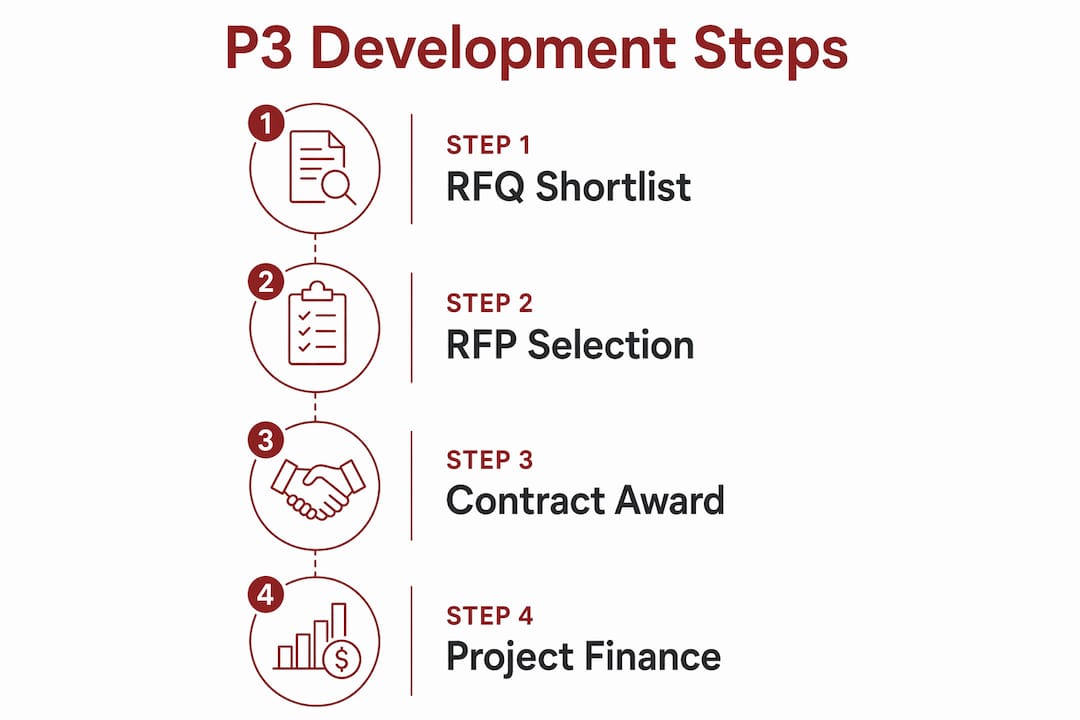
Procurement follows a two-step process. A Request for Qualifications (RFQ) shortlists experienced consortia, and a subsequent Request for Proposals (RFP) selects the team offering the best overall value. This approach, used by agencies including LA Metro, filters for financial capacity, technical depth, and operational track record before detailed proposals are evaluated.

| Financing Mechanism | Project Phase | Primary Risk Owner |
|---|---|---|
| TIFIA loan (up to 49% of eligible project costs) | Development and construction | Public agency (credit backstop) |
| Private equity | All phases | Private consortium |
| Private Activity Bonds | Construction and long-term | Private consortium / bondholders |
| Availability payments | Operations | Public agency (demand risk retained) |
| Toll/fare revenue | Operations | Private concessionaire |
Pro Tip: Availability payment structures suit projects where ridership is hard to forecast. They shift demand risk back to the public agency while still transferring construction and maintenance risk to the private partner.
What modal applications look like in practice
P3s operate differently depending on the transportation mode, and the distinctions matter for how risk is allocated and how the private partner earns its return.
In highway and toll road P3s, the private concessionaire typically finances, builds, and operates the facility, collecting tolls directly from users. The $2 billion Capital Beltway (I-495) High Occupancy Toll Lanes project in Northern Virginia is a textbook DBFOM example, with the private joint venture repaid through toll revenues over the life of the concession.
Urban transit P3s follow a different model. Municipalities retain infrastructure ownership while private operators manage vehicles, staffing, and service delivery under long-term contracts. Payment is often tied to service quality or availability rather than ridership, which protects the private operator from demand volatility. The Denver FasTrack Eagle P3 is a clear illustration: the Regional Transportation District retained all assets while Denver Transit Partners designed, built, financed, operated, and maintained the commuter rail lines under a DBFOM concession, backed by a $1.03 billion Full Funding Grant Agreement from the Federal Transit Administration.
Bus Rapid Transit (BRT) systems often split responsibilities cleanly: cities build and maintain the infrastructure and fare collection systems, while private operators own and manage the buses and hire staff under long-term contracts. LA Metro's P3 consortia bring together construction firms, infrastructure developers, pension funds, and private equity in multidisciplinary teams that combine financing depth with operational expertise.
Transit electrification is an emerging P3 frontier. The Anaheim Transportation Network partnered with bp pulse under a combined Charging-as-a-Service and Power Purchase Agreement structure, shifting capital expenses to operational expenses and transferring equipment ownership to the private partner. LA Metro used a similar P3 model for the solar component of the East San Fernando Valley Light Rail Transit Line maintenance facility.
- Highway concessions: private partner collects tolls, bears demand risk.
- Urban rail: public agency retains assets, private partner manages operations.
- BRT: split model with public infrastructure and private fleet management.
- Electrification P3s: private partner owns and operates charging or energy assets.
Benefits and challenges every decision maker should weigh
P3s offer three core advantages that make them attractive when public budgets are constrained. First, they attract private capital to projects that might otherwise wait years for public funding. Second, they can accelerate delivery by combining design, construction, and financing under one contract, removing the sequential delays of traditional design-bid-build procurement. Third, they transfer construction, operational, and revenue risks to the private partner, providing greater cost certainty for the public sector, though the private partner requires compensation for assuming those risks.
The APTA Task Force on Public-Private Partnerships is direct on this point: P3s are one tool in the transit funding toolbox, not a stand-alone solution. They work best when combined with traditional funding sources, not as a replacement for them.
Challenges are real and should not be minimized:
- Loss of public control: If contracts are not carefully structured, agencies can cede flexibility on pricing, service levels, and future network changes.
- Higher long-term costs: Private financing typically costs more than public borrowing; the risk transfer must justify that premium.
- Demand forecasting risk: Toll-based P3s depend on traffic projections that can prove wildly optimistic, as several high-profile highway concession bankruptcies have demonstrated.
- Contract complexity: Legal documentation for a major P3 often runs several hundred pages, and renegotiation is common over the life of a multi-decade agreement.
- Equity concerns: Private investors favor high-traffic, high-revenue corridors. Rural and low-income communities are less likely to attract P3 investment without availability payment structures.
Legal and contractual framework in U.S. transportation P3s
The legal foundation of any P3 project is its contract, and in transportation, those contracts are among the most complex in commercial law. DBFOM agreements and concession contracts routinely span decades and must anticipate operational, financial, and regulatory changes that no party can fully predict at signing.
Procurement law is the first hurdle. Some states still have procurement statutes designed for traditional design-bid-build projects that do not accommodate P3 procurement flexibility. Agencies in those states must either seek legislative reform or navigate workarounds, both of which add time and cost. Effective P3 laws incorporate a Value for Money assessment, designate a centralized state agency for guidance, and allow both solicited and unsolicited proposals.
Key contractual provisions to get right include:
- Risk allocation matrices that clearly assign schedule, budget, demand, and maintenance risks.
- Performance standards defining availability thresholds and service quality metrics that trigger or reduce payments.
- Step-in rights allowing the public agency to assume operations if the private partner defaults.
- Renegotiation triggers addressing material changes in law, force majeure events, or significant demand deviations.
- Termination provisions specifying compensation to the private partner and asset handback conditions.
The federal government does not typically sign P3 agreements directly, but federal funding through TIFIA, PABs, and grant programs brings federal oversight requirements into the contract. Agencies working on transportation infrastructure compliance need counsel familiar with both federal program requirements and state enabling legislation. For cross-border projects or those involving international private partners, understanding how federal procurement guidelines interact with state law is equally critical.
Who does what: stakeholder roles in P3 projects
A P3 project involves a web of parties, each with distinct responsibilities and incentives. Getting clarity on those roles before contract execution prevents the disputes that derail projects mid-delivery.
The public agency (state DOT, transit authority, or municipality) retains asset ownership, sets service standards, manages the public interest, and monitors contract compliance. It is the counterparty to the concession agreement and the entity accountable to taxpayers and elected officials.
The private consortium is typically a special purpose vehicle formed specifically for the project. It brings together a construction contractor, an operations and maintenance firm, equity investors (often infrastructure funds or pension funds), and debt providers. LA Metro's P3 teams illustrate this structure well, combining development expertise, financial institutions, and construction capacity under one contractual umbrella.
Federal agencies such as FHWA and FTA do not sign P3 agreements but shape them through funding conditions, environmental review requirements, and program rules attached to TIFIA loans or federal grants.
Lenders and investors include commercial banks, infrastructure debt funds, pension funds, and private equity. Their due diligence requirements drive much of the contract's financial structure, particularly around revenue certainty and step-in rights.
Legal and advisory teams on both sides play a structuring role that goes well beyond drafting. They negotiate risk allocation, advise on regulatory compliance, and prepare for the possibility of dispute resolution if the partnership runs into trouble.
How performance is monitored and enforced in P3 agreements
Performance monitoring is built into the payment mechanism. In availability payment P3s, the public agency withholds or reduces payments when the private partner fails to meet defined service standards, such as lane availability percentages, response times for incident management, or cleanliness benchmarks. This structure gives the private partner a direct financial incentive to maintain performance throughout the contract term.
Typical monitoring tools include independent technical reviewers, real-time data feeds from tolling and traffic systems, and periodic audits against the contract's key performance indicators. The public agency retains the right to inspect, audit, and in serious cases, invoke step-in rights. Annual performance reports are standard, and many contracts require third-party verification of the private partner's self-reported data.
The challenge is maintaining monitoring capacity over a 30-year or 50-year contract. Agency staff turn over, institutional knowledge fades, and the original contract negotiators are long gone by the time a major renegotiation arises. Building a dedicated P3 contract management unit, as Pennsylvania's PennDOT has done, is one of the more effective responses to this problem.
Lessons from real P3 projects: what worked and what did not
The Denver FasTrack Eagle P3 is widely cited as a successful model. The Regional Transportation District used a DBFOM concession to deliver 122 miles of new commuter and light rail under a single contract, with private equity from Denver Transit Partners supplementing federal grants and RTD sales tax bonds. The project delivered on schedule and transferred significant construction and operational risk away from the public agency.
Less successful have been several toll road concessions where demand projections proved too optimistic. When traffic volumes fell short of forecasts, private concessionaires faced financial distress, and public agencies were drawn into costly renegotiations or bailouts. The lesson is consistent: toll-based P3s require conservative, independently verified traffic studies, and contracts should include demand risk sharing mechanisms rather than placing all revenue risk on the private partner.
Pennsylvania's Rapid Bridge Replacement Project took a different approach, bundling 558 poor-condition bridges into a single P3 contract. The bundling strategy spread fixed transaction costs across a large portfolio and attracted private partners who could achieve economies of scale in design and construction. That model has since influenced how other states think about asset bundling for P3 procurement.
The emerging lesson from transit electrification P3s is that regulatory frameworks matter as much as financial structures. Most state P3 laws were written for toll roads and do not easily accommodate charging infrastructure or energy service agreements. Agencies that secured ordinance exemptions or used alternative procurement pathways moved faster and at lower cost than those that tried to force new project types into old statutory frameworks.
Best practices for selecting P3 partners and structuring agreements
Selecting the right private partner is as consequential as the contract itself. A consortium with strong financial backing but thin operational experience will struggle when the project moves from construction into a 30-year operations phase.
The most effective selection processes use the two-step RFQ/RFP model to evaluate technical capability, financial strength, and relevant experience before comparing detailed proposals. Shortlisting three to five qualified teams creates genuine competition without overwhelming agency evaluation capacity. Price alone should never be the deciding criterion; best-value assessments that weight technical approach, risk management plans, and long-term operational capacity produce better outcomes.
Contract structuring best practices include:
- Conduct a Value for Money analysis before committing to P3 delivery, comparing the P3 option against a public sector comparator.
- Allocate each risk to the party best positioned to manage it, not simply to the private partner by default.
- Build in contract flexibility mechanisms for material changes in law, technology, or demand without requiring full renegotiation.
- Require the private partner to maintain a reserve fund for major maintenance events.
- Retain independent technical and financial advisors throughout the procurement phase, not just at contract execution.
For agencies considering P3s in emerging sectors like transit electrification or advanced air mobility infrastructure, early engagement with transportation legal counsel familiar with both traditional P3 frameworks and new regulatory environments is the most reliable way to avoid the procurement delays that have slowed projects in other states.
How Beyondhorizons supports transportation P3 transactions
Transportation P3s sit at the intersection of infrastructure law, project finance, regulatory compliance, and commercial contract negotiation. Beyondhorizons brings cross-border legal expertise to each of those dimensions, with lawyers drawn from Magic Circle and U.S. white shoe firms who have advised on complex infrastructure transactions across APAC and beyond.

Whether you are structuring a DBFOM concession, navigating federal program requirements, or managing a contract renegotiation, Beyondhorizons offers the depth of corporate transaction counsel that transportation P3s demand. The firm's ranked legal team works with U.S.-listed companies, government-related entities, and regional banks on transactions where getting the contractual framework right from the start is the difference between a project that delivers and one that ends in arbitration.
Key Takeaways
Transportation P3s work best as one component of a broader funding strategy, not as a replacement for public investment, with federal tools like TIFIA and careful risk allocation determining whether a project succeeds.
| Point | Details |
|---|---|
| TIFIA covers up to 49% of eligible project costs | Federal low-interest loans are available for highways, transit, intercity rail, and intermodal facilities. |
| 33 states plus D.C. use P3s | Adoption is widespread, but enabling legislation varies significantly in flexibility across states. |
| Availability payments reduce demand risk | Public agency pays based on facility performance, not ridership, protecting the private partner from traffic shortfalls. |
| Contract complexity requires active management | Legal documentation often runs several hundred pages; renegotiation is common over multi-decade agreements. |
| Partner selection drives long-term outcomes | Two-step RFQ/RFP procurement and best-value assessment outperform price-only selection for P3 projects. |