
An electronic bill of lading (eBL) is a digital original document that legally replaces the traditional paper bill of lading, enabling secure, fast, and paperless cargo management in international shipping. Unlike a scanned PDF emailed between parties, a true eBL enforces exclusive control over a single digital token, giving it the same legal weight as a paper original. Key frameworks like the UNCITRAL MLETR and national legislation in the UK, Singapore, Germany, France, and the UAE have established this legal equivalence. Industry bodies including DCSA, ICC, and BIMCO are driving adoption standards that make e bills of lading a practical reality for logistics professionals today.
What are e bills of lading and how do they work?
An eBL is created and controlled on a secure platform that enforces exclusive control. Only one party can hold the original digital token at a time, directly mimicking the legal singularity of a paper original. That singularity is the core legal requirement that makes an eBL valid as a document of title.
The most common misconception in shipping is that a scanned PDF qualifies as an electronic bill of lading. It does not. A scanned PDF can be copied infinitely, which means multiple parties could attempt to claim the same cargo. True eBLs prevent duplicate financing or fraud by enforcing that only one holder exists at any moment on the platform.

eBL platforms operate in two broad categories: proprietary closed networks and interoperable open networks. Proprietary platforms require all parties to use the same system. Interoperable platforms, now enabled by the DCSA Standard Annex for eBL Platform Interoperability, allow parties on different systems to exchange documents securely. The DCSA interoperability standard also received approval from IGP&I clubs, which is the insurance validation that commercial shipping requires before adopting any new document format.
Key features that define a compliant eBL platform include:
- Exclusive control enforcement: Only one holder of the digital token at any time
- Transfer mechanism: Secure, auditable transfer of the token between shipper, consignee, and bank
- Legal framework alignment: Compliance with UNCITRAL MLETR or equivalent national law
- API connectivity: Integration with trade finance systems and banking networks
- Interoperability support: Compatibility with DCSA Standard Annex v.2 for cross-platform exchange
Pro Tip: Before selecting an eBL platform, confirm it has received IGP&I club approval. Without that approval, your cargo insurance coverage may not recognize the digital document as a valid bill of lading.
What is the current state of eBL adoption in 2026?
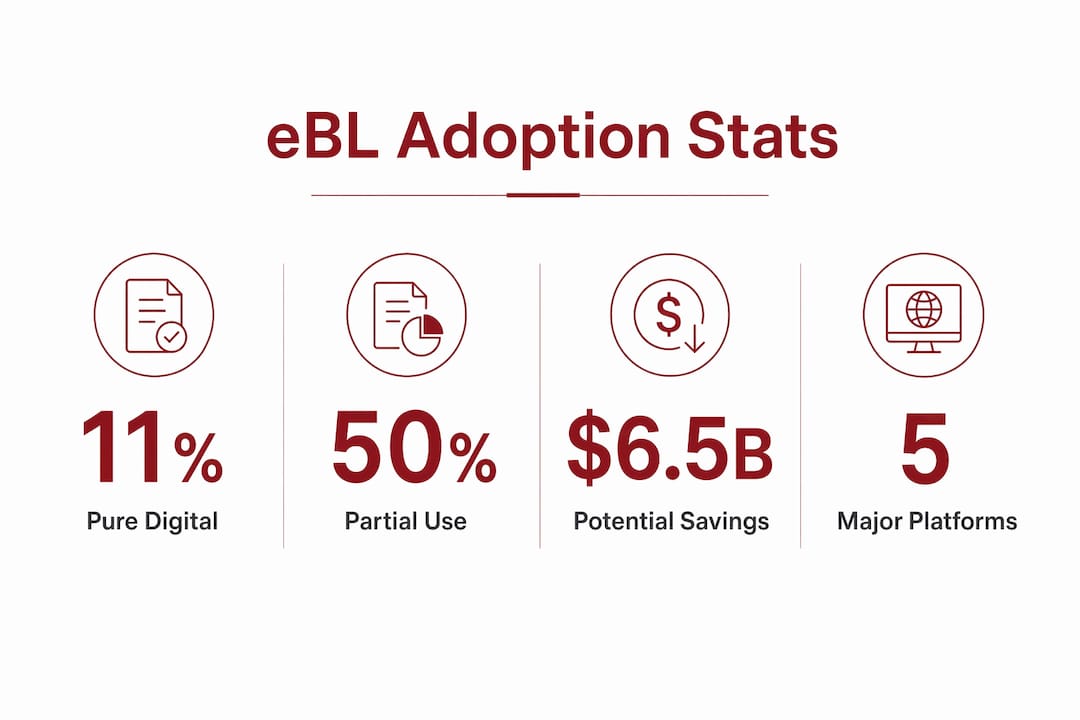
The industry has moved well past the pilot phase. Pure digital eBL adoption reached 11% as of mid-2025, with 50% of trade stakeholders using digital bills in some form. That 50% figure includes hybrid workflows where some trade lanes are digital and others remain paper. The more telling number is that 75% of paper-only users plan to switch, which signals that the tipping point is close.
Blockchain platform GSBN has processed over 550,000 eBLs across more than 100 countries. That scale confirms eBLs are an operational solution, not a theoretical one.
The single biggest structural change in 2026 is the resolution of the platform lock-in problem. Previously, every party in a transaction had to use the same eBL system. DCSA Standard Annex v.2, implemented in june 2026, enables secure cross-platform exchange. Five major eBL platforms adopted the annex at launch, which means a shipper on one platform can now transfer an eBL to a consignee on a different platform without friction.
"The question has shifted from 'is eBL ready?' to 'how long can I wait?' as major DCSA members commit to 100% eBL adoption by 2030."
| Metric | Current Status |
|---|---|
| Pure digital adoption | 11% as of mid-2025 |
| Partial digital use | 50% of trade stakeholders |
| Paper-only users planning to switch | 75% |
| GSBN eBLs processed | 550,000+ across 100+ countries |
| DCSA interoperability annex | Implemented june 2026, five platforms adopted |
| Major carrier target | 100% eBL adoption by 2030 |
What are the economic benefits and risks of using electronic bills of lading?
The financial case for eBL adoption is direct. Full industry-wide adoption could produce $6.5 billion in annual cost savings and unlock $30 billion to $40 billion in global trade growth. Those numbers come from eliminating courier costs, reducing document errors, and cutting the time cargo sits at port waiting for paper originals to arrive.
Demurrage is one of the most concrete cost drivers. Paper bills of lading can take five to seven days to arrive by courier after a vessel docks. During that time, the cargo cannot be released. An eBL transfers in minutes, which directly reduces demurrage charges. For high-volume shippers, that time saving compounds across hundreds of shipments per year.
Fraud reduction is equally significant. Because an eBL enforces exclusive control, the double-financing fraud that plagues paper documents becomes structurally impossible on a compliant platform. Banks and trade finance providers recognize this, which is why cross-platform eBL transactions integrating shipping and banking networks have already been completed successfully. The regulatory compliance implications of that integration are significant for businesses operating across multiple jurisdictions.
The risks are real but manageable. Key risks to monitor include:
- Platform lock-in: Choosing a proprietary platform before interoperability is confirmed can trap your counterparties. Prioritize platforms that have adopted DCSA Standard Annex v.2.
- Jurisdictional gaps: Legal recognition of eBLs varies. The US has state-level variation, and some trade lanes still lack clear statutory support.
- Banking readiness: Not all trade finance banks accept eBLs yet. Confirm your financing bank's eBL policy before committing a trade lane to digital documents.
- Counterparty readiness: Your carrier, port agent, and consignee all need to be on compatible systems for the workflow to function end-to-end.
Pro Tip: Run a hybrid pilot on a single trade lane before full rollout. Choose a lane where your carrier, bank, and consignee are already eBL-capable. This limits exposure while you validate the workflow.
How can logistics professionals implement e bills of lading effectively?
Practical implementation follows a clear sequence. Skipping steps creates gaps that surface at the worst possible moment, usually when cargo is sitting at port.
-
Audit your trade lanes. Identify which lanes have carrier support for eBLs and which jurisdictions along those lanes legally recognize electronic transferable records. Singapore, the UK, Germany, France, and the UAE are strong starting points.
-
Confirm banking and trade finance compatibility. Contact your financing bank and confirm whether they accept eBLs and which platforms they support. The completed cross-platform eBL transaction involving major banking networks shows this integration is achievable, but individual bank readiness varies.
-
Select an interoperable platform. Choose a platform that has adopted DCSA Standard Annex v.2 and holds IGP&I club approval. Avoid platforms that require all counterparties to join the same closed network.
-
Verify legal recognition per trade lane. Work with legal counsel familiar with transportation and logistics law to confirm that eBLs are legally valid for each specific trade lane. Do not assume that MLETR adoption in one country covers the entire route.
-
Integrate via API. Connect your eBL platform to your existing freight management system using the platform's API. This removes manual data re-entry and reduces document errors.
-
Train your operations team. The transfer mechanism for a digital token is different from couriering paper originals. Your team needs to understand who holds the token at each stage and how to transfer it correctly.
-
Manage hybrid lanes deliberately. For trade lanes that are not yet fully digital, maintain a clear protocol for when paper documents are required. Mixing digital and paper workflows without clear rules creates compliance risk.
Bertrand Chen of GSBN has noted that the next frontier is linking eBLs with trade finance, enabling document and payment flows to integrate directly. Building your eBL workflow with that integration in mind from the start positions you ahead of the next wave of efficiency gains. For businesses with blockchain-based trade components, this integration is particularly relevant.
What challenges remain in the full transition to electronic bills of lading?
Legal recognition is the most persistent barrier. The UNCITRAL MLETR provides a model law, but national adoption is uneven. In the United States, recognition operates at the state level, which creates complexity for domestic legs of international shipments. Logistics professionals must verify legal validity lane by lane, not country by country.
Network effects create a second structural challenge. An eBL only delivers full value when every party in the transaction, including the carrier, consignee, port agent, and financing bank, can participate digitally. Compliance frameworks in payments and trade finance are evolving to support this, but gaps remain in certain markets. The DCSA interoperability annex directly addresses the platform fragmentation problem, but it cannot force counterparties to adopt digital workflows.
Organizations driving harmonization include:
- DCSA: Setting technical interoperability standards and coordinating carrier commitments
- ICC: Providing commercial law frameworks and trade finance guidance
- BIMCO: Developing standard contract clauses for eBL use in charter parties
- GSBN: Operating a blockchain-based network that has demonstrated operational scale
The outlook is positive. With five platforms on DCSA Standard Annex v.2 and major carriers committed to 100% eBL adoption by 2030, the network effect problem is being solved from the top down. The remaining work is legal harmonization and banking integration, both of which are active areas of regulatory development.
Key Takeaways
Electronic bills of lading are legally valid, operationally proven, and economically compelling. The 2026 interoperability breakthrough removes the last major structural barrier to mainstream adoption.
| Point | Details |
|---|---|
| Legal validity requires the right framework | eBLs are legally equivalent to paper only in jurisdictions that have adopted UNCITRAL MLETR or equivalent national law. |
| Exclusive control is the defining feature | A true eBL enforces a single digital token holder, preventing fraud and duplicate financing that paper documents cannot stop. |
| Interoperability is now real | DCSA Standard Annex v.2, implemented in june 2026, enables cross-platform eBL exchange across five major platforms. |
| Economic case is quantified | Full adoption could generate $6.5 billion in annual savings and unlock up to $40 billion in global trade growth. |
| Implementation requires lane-by-lane verification | Confirm carrier, bank, and legal readiness for each specific trade lane before committing to a digital workflow. |
Why the window for waiting on eBLs is closing fast
I have watched the eBL conversation shift over the past few years from "is this legally sound?" to "which platform do we use?" That shift is significant. The legal question has been answered in the jurisdictions that matter most for international trade. The platform question is now answerable too, with DCSA Standard Annex v.2 removing the closed-network problem that stalled adoption for years.
What concerns me about the current moment is the assumption that waiting is safe. Major DCSA member carriers have committed to 100% eBL adoption by 2030. That is not a distant target. Logistics professionals who delay building eBL capability now will face a compressed transition window when their primary carriers stop issuing paper originals. The operational disruption of a forced, rushed transition is far more expensive than a deliberate, phased one.
The trade finance angle is the piece most logistics professionals underestimate. The completed cross-platform transaction integrating shipping and banking networks is not just a proof of concept. It is a preview of a world where cargo release and payment settlement happen in the same digital workflow. Businesses that build eBL capability now will be positioned to use that integration when it becomes standard. Those that wait will be retrofitting their processes under pressure.
My practical advice: start with one trade lane, choose an interoperable platform, and get your financing bank on record about their eBL policy. The learning curve is short. The cost of not starting is not.
— HL
Beyondhorizons: Legal Counsel for Your eBL Transition
Adopting electronic bills of lading is not just a technology decision. It is a legal and compliance commitment that spans multiple jurisdictions, contract frameworks, and regulatory regimes.

Beyondhorizons is a Singapore-headquartered law firm with lawyers from Magic Circle and US white shoe firms, ranked on Chambers, Legal 500, and Asia Legal Business. The firm advises on cross-border corporate transactions involving digital trade documents, including eBL legal validity, platform contract review, and trade lane compliance mapping. Whether you are structuring your first eBL pilot or managing a multi-jurisdiction rollout, Beyondhorizons brings the commercial and legal depth that international trade demands. Contact the team to discuss your eBL adoption strategy.
FAQ
What is an electronic bill of lading?
An electronic bill of lading is a digital original document that legally replaces a paper bill of lading by enforcing exclusive control over a single digital token. It is legally equivalent to a paper original in jurisdictions that have adopted UNCITRAL MLETR or equivalent national legislation.
How is an eBL different from a scanned PDF?
A scanned PDF can be copied infinitely and has no mechanism to enforce a single holder, making it legally invalid as a document of title. A true eBL enforces exclusive control so that only one party holds the original at any time, preventing fraud and duplicate financing.
Which countries legally recognize electronic bills of lading?
The UK, Singapore, Germany, France, and the UAE are among the leading jurisdictions that have enacted legislation recognizing eBLs. In the United States, recognition varies by state, so lane-by-lane legal verification is required.
What is the DCSA Standard Annex and why does it matter?
The DCSA Standard Annex for eBL Platform Interoperability v.2, implemented in june 2026, enables secure cross-platform eBL exchange between different systems. It received IGP&I club approval, which is the insurance validation required for commercial shipping acceptance.
What are the main cost benefits of switching to electronic bills of lading?
Full industry-wide eBL adoption is projected to generate $6.5 billion in annual cost savings and unlock $30 billion to $40 billion in global trade growth, primarily by eliminating courier costs, reducing demurrage, and cutting document errors.