
Supply chain contract risk is the gap between what a contract promises and what a supplier actually delivers when conditions change. The single most effective way to close that gap is to write risk-appropriate contract terms, ones that pair objective price-adjustment formulas and clearly defined triggers with real visibility into who is actually supplying you, several tiers down.
TL;DR:
- Contracts relying on generic templates or outdated clauses often fail to address modern geopolitical shocks, sub-tier dependencies, or export controls.
- Implementing clear, objective triggers for price adjustments and force majeure clauses enhances enforceability and reduces dispute risk during disruptions.
- Ensuring transparency of sub-tier suppliers and including audit rights helps identify vulnerabilities before a crisis occurs.
- Risk-sharing pricing mechanisms, such as indexation or cost-plus models, outperform fixed prices under volatile supply chain conditions.
- Active contract management, including lifecycle tracking and cross-border legal expertise, is essential for enforceability and effective risk mitigation.
Table of Contents
- Where Contract Risk Enters the Supply Chain
- Types of Contract Risk and How Each Shows Up in Daily Operations
- Contract Terms That Reduce Disruption Risk
- Risk-Sharing Contracts and Pricing Mechanisms
- Operational Practices That Make Contractual Protections Effective
- Why Cross-Border Legal Counsel Changes the Outcome
- The One Clause I'd Fix First
- Get Your Contracts Reviewed for Real-World Risk, Not Just Legal Form
- Sources
- FAQ
Where Contract Risk Enters the Supply Chain
Most contract risk does not announce itself. It sits quietly in a template that was never updated, a single-source relationship nobody flagged as fragile, or a sub-tier supplier nobody bothered to name. By the time a shortage or sanction hits, the contract is already the wrong tool for the job.
Single-source concentration is the most common entry point. Two "different" vendors frequently draw from the same upstream foundry, mine, or logistics hub, which means a buyer can believe it has diversified when it has not. Practitioner guidance on supply chain diversification makes the point directly: relying on vendor assurances instead of contractual sub-tier disclosure creates an illusion of redundancy that collapses under stress.
Boilerplate templates compound the problem. A force majeure clause copied from a 2015 template rarely anticipates export controls, port congestion, or a sudden sanctions designation. It was written for a different risk environment and never revisited.
Contract risk tends to surface at these points:
- Single-source dependencies where no qualified backup supplier exists in the contract or the sourcing file.
- Sub-tier suppliers that are unnamed, undisclosed, or simply assumed to be "the supplier's problem."
- Generic clause language recycled across contracts regardless of the commodity, region, or supplier tier involved.
- External shocks, tariff changes, sanctions actions, customs enforcement, that fall entirely outside what the contract contemplated.
- Operational signals like recurring late deliveries, sudden invoice pattern changes, or unexplained subcontracting that never trigger a contractual review.
Analysis of recent geopolitical disruptions confirms that contracts lacking sub-tier transparency and contingency planning are consistently the ones that fail fastest when a shock hits. The fix starts with mapping where your existing agreements are silent, not with rewriting everything at once.
Types of Contract Risk and How Each Shows Up in Daily Operations
Contract risk is not one thing. It breaks into distinct categories, and each one leaves a different fingerprint in your operational data long before it becomes a crisis.
- Compliance variance risk. This covers denied-party violations, forced labor exposure, and export control breaches. Watch for mismatched shipping documentation, suppliers who resist audit requests, or sudden changes in a supplier's ownership structure. Compliance failures rarely announce themselves; they surface in customs holds or in a bank's sanctions screening flag.
- Cost variance risk. Tariffs, freight rate spikes, and currency swings erode margins that a fixed-price contract never anticipated. The trigger point for invoking a price adjustment clause should be defined in the contract itself, not negotiated after costs have already moved.
- Availability variance risk. Shortages, capacity loss, or a supplier's own upstream disruption show up as slipping lead times and partial shipments before they show up as a full stoppage. A contract without a defined fallback sourcing obligation leaves the buyer negotiating from a position of urgency rather than leverage.
- Quality variance risk. Specification failures and handling damage often trail a cost-cutting move somewhere in the supply chain, a substituted material, a new subcontractor, a shortcut in packaging. The contract's remedy path (rework, credit, replacement) determines whether this stays a minor issue or becomes a dispute.
Each category demands a different clause response, which is exactly why generic templates fail. A force majeure clause does nothing for a quality defect, and an indemnity clause does nothing for a currency swing.
Contract Terms That Reduce Disruption Risk
Clause drafting is where contract risk management either becomes real or stays theoretical. The terms below are the ones procurement and legal teams should prioritize when reviewing existing agreements or negotiating new ones.
Price adjustment and escalation clauses need an objective index, agreed calculation periods, and defined caps or floors. Well-designed indexation and hybrid escalation methods protect both sides from extreme swings while keeping the relationship commercially viable. In cross-border agreements, index selection matters more than it looks: applying one country's inflation index to costs incurred in another jurisdiction can produce adjustments that make no economic sense, and mismatched indexes are a frequent source of cross-border disputes.
Force majeure clauses should list specific triggering events rather than relying on catch-all language, and should include a stepwise notice and remediation timeline. Generic force majeure wording rarely covers the sanctions, export restrictions, or customs enforcement that actually disrupt supply chains today.
Indemnities and liability caps need to be checked against the buyer's insurance coverage so there is no gap between what the contract assumes and what a policy actually pays.
Beyond the core protective clauses, four mechanisms deserve specific attention:
- Sub-tier transparency and audit rights that require suppliers to disclose their own upstream dependencies, not just certify compliance.
- Supplier code-of-conduct clauses tied to concrete remedies, not aspirational language.
- SLAs and KPIs with acceptance criteria that are measurable, not descriptive.
- Objective formulas and precisely defined terms throughout, since vague or overly complex clauses generate disputes that a clearer draft would have avoided.
Pro Tip: Draft every trigger clause with a number attached to it, a percentage cost increase, a specific delay in days, a named regulatory action. A clause that says "material adverse change" invites a legal argument. A clause that says "a 7% increase in the input index for two consecutive quarters" invites a calculation.
Risk-Sharing Contracts and Pricing Mechanisms
Contracts that allocate cost and demand risk between buyer and supplier, rather than dumping all volatility on one side, tend to survive disruption better than fixed-price agreements. This is not just intuition. Peer-reviewed modeling on risk-sharing contracts in supply chains shows that formal risk-sharing mechanisms can mitigate both demand uncertainty and price volatility when the allocation formula is defined upfront and both parties commit to it.
These mechanisms tend to fall into a few recognizable structures:
- Indexation and cost pass-through, where input cost movements flow through to price on a predefined schedule.
- Cost-plus arrangements, where the supplier's margin is fixed and underlying cost fluctuations are absorbed contractually rather than negotiated case by case.
- Benchmarking resets, where price periodically resets against a market reference rather than an internal index.
The design choices matter as much as the mechanism itself. Symmetrical risk-sharing (both parties gain or lose together) tends to sustain longer relationships than asymmetrical structures that quietly favor one side. Caps and floors keep either party from bearing catastrophic exposure, and audit rights make the underlying cost data verifiable rather than taken on faith.
Risk-sharing works best when both sides can actually produce reliable cost data and agree to a defined audit and adjustment process rather than a vague promise to "discuss" pricing later. Without that data discipline, even a well-drafted risk-sharing clause becomes unenforceable in practice.
Operational Practices That Make Contractual Protections Effective
A well-drafted clause that nobody monitors is functionally the same as no clause at all. Contract risk management guidance is consistent on this point: signed contracts that go unmonitored create exposure and revenue leakage rather than protection, because the value of a contract is only realized through active use.
The operational layer that converts language into control includes:
- Contract lifecycle management (CLM) and obligation tracking to surface upcoming expiries, SLA breach thresholds, and price-adjustment trigger dates before they pass unnoticed.
- A defined forecasting cadence and joint operating reviews with key suppliers, so cost or capacity shifts surface as a conversation rather than a surprise invoice.
- Dashboards and KPIs that track cost variance, on-time delivery, and quality defect rates against contractual benchmarks in real time.
- Remediation playbooks that link directly to specific contract triggers, so a breach of a defined threshold activates a known escalation path rather than an ad hoc scramble.
Modern CLM and AI-assisted contract intelligence tools materially reduce contract leakage by surfacing deviations, missing clauses, and expiry dates at a scale manual review cannot match. For a procurement team managing hundreds of supplier agreements across multiple jurisdictions, this is less a nice-to-have and more the only realistic way to keep pace with the contract's own fine print.
Why Cross-Border Legal Counsel Changes the Outcome
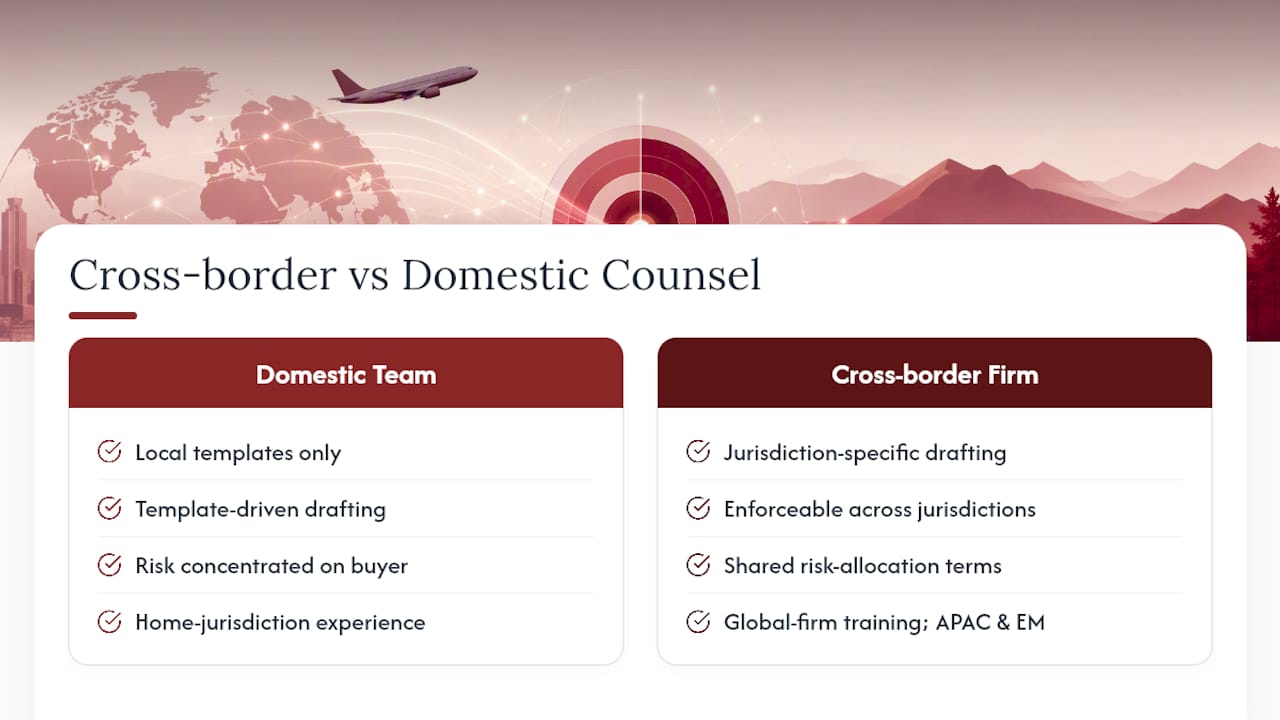
Clause language only protects you if it is enforceable in the jurisdiction where a dispute actually lands, and that is where most in-house drafting quietly breaks down. The firm works from Singapore with lawyers trained in major global law firms and with experience in cross-border trade, tariff restructuring, and regulatory compliance across APAC and emerging markets.
Converting a price-adjustment formula or a sub-tier disclosure requirement from contract language into something a court or arbitration panel will actually enforce takes jurisdiction-specific drafting, not a template swap. Firms with genuine cross-border experience negotiate risk-sharing terms that survive scrutiny in more than one legal system, which is exactly the gap a purely domestic legal team tends to miss.
The One Clause I'd Fix First
If a procurement team asked me to prioritize one change this quarter, it would be the price adjustment clause, not because it is the most dramatic risk, but because it is the one most often left vague, undefined, or entirely absent. A cost variance clause with a real index, a real trigger, and a real calculation period resolves more disputes before they start than any indemnity provision ever will. Sub-tier transparency comes next. You cannot manage a risk you have not named. If your current agreements read like they were drafted for a calmer decade, it is worth having someone read them against today's risk environment before the next disruption does it for you.
— HL
Get Your Contracts Reviewed for Real-World Risk, Not Just Legal Form
Most procurement teams already sense which agreements are exposed, they just do not have the bandwidth or the cross-border expertise to fix them properly. The firm is built to address this gap with a Singapore-based team experienced in redrafting clauses to hold up across jurisdictions, not just on paper.

The engagement path is straightforward. A rapid contract audit identifies where price adjustment, force majeure, and sub-tier disclosure language is missing or unenforceable. Prioritized redlines follow, focused on the clauses carrying the most exposure first. Negotiation support then carries those redlines through to signature with your counterparties. This work sits within Beyondhorizons's commercial contracts practice, backed by broader cross-border corporate counsel for clients operating across multiple regulatory regimes. If your supplier agreements have not been reviewed against current geopolitical and pricing conditions, request a contract audit and find out exactly where your exposure sits before your next renewal cycle forces the issue.
Sources
- Contracting for geopolitical risk — Inside Supply Management (ISM)
- Using risk sharing contracts for supply chain risk mitigation — Computers & Industrial Engineering (Ghadge et al.)
FAQ
What Are the Four Types of Risk in a Supply Chain?
Supply chains typically face compliance variance risk, cost variance risk, availability variance risk, and quality variance risk, each showing up differently in operational data, from customs holds to slipping lead times.
What Are the Different Types of Contract Risk?
Contract risk includes compliance risk (sanctions and export control breaches), cost risk (unaddressed price volatility), performance risk (missed SLAs), and enforceability risk (clauses that fail to hold up in the governing jurisdiction).
What Are Some Examples of Supply Chain Risks?
Common examples include single-source supplier failure, hidden shared sub-tier dependencies, tariff and freight cost spikes, currency swings, and geopolitical events like sanctions or export restrictions that a standard contract never anticipated.
What Does Supply Chain Risk Mean?
Supply chain risk is the possibility that a disruption, whether cost, availability, quality, or compliance related, prevents contracted performance from matching what was actually promised, with financial or operational consequences for the buyer.
How Do You Reduce Contract Risk in a Global Supply Chain?
Prioritize objective price adjustment triggers, sub-tier supplier transparency, and clearly defined force majeure events, then back those clauses with active monitoring through CLM tools and regular supplier reviews so the terms stay enforceable, not just written.