
What do private placement attorneys actually do?
Private placement attorneys are specialized securities lawyers who guide businesses and investors through the full legal lifecycle of a private capital offering. They sit at the intersection of regulatory compliance, document drafting, and investor protection, handling work that generalist corporate counsel simply is not equipped to manage.
Their core services cover:
- Drafting the Private Placement Memorandum (PPM), the detailed disclosure document that satisfies SEC anti-fraud requirements
- Preparing subscription agreements, investor questionnaires, and operating or LP agreements
- Filing Form D with the SEC within 15 days of the first sale under Regulation D
- Managing state-level blue-sky notice filings as the investor list develops
- Reviewing all investor-facing marketing materials for compliance with the chosen exemption
- Advising on Regulation D rules, including Rule 506(b) and Rule 506(c) distinctions
- Providing post-closing counsel on amendments, remedial filings, and ongoing compliance
The Securities Act of 1933 requires that securities sold to the public be registered with the SEC, but private offerings may qualify for exemptions. Those exemptions still carry strict anti-fraud obligations, which is exactly where experienced counsel earns its fee.
Key legal services private placement attorneys manage
A properly drafted PPM is a bespoke risk disclosure document, not a marketing brochure. It must reflect the specific deal structure, sponsor background, use of proceeds, waterfall mechanics, and jurisdiction mix of your offering. An inadequate PPM is the most common evidence cited in investor disputes, and Regulation D's anti-fraud provisions apply whether or not the offering is registered.

Beyond the PPM itself, a full private placement document package typically includes:
| Document | Purpose |
|---|---|
| Private Placement Memorandum | Core risk disclosure and deal terms |
| Subscription Agreement | Investor commitment and representations |
| Investor Questionnaire | Accredited investor verification |
| Operating or LP Agreement | Governance and economic terms |
| Form D Filing | Federal SEC notice within 15 days of first sale |
| State Blue-Sky Filings | State-level notice compliance per investor location |
State blue-sky filings are a frequently underestimated obligation. Noncompliance can trigger fines, rescission claims, and enforcement actions at the state level, even when the federal filing is clean. Experienced counsel tracks these filings as the investor list grows throughout the raise.

Pro Tip: Ask your attorney whether their engagement includes review of your pitch deck and investor emails. Marketing materials that contradict or omit PPM disclosures create separate legal exposure under SEC anti-fraud rules.
What does it cost to hire a private placement attorney?
Most securities law firms offer flat-fee pricing for private placement engagements tied to the offering's maximum size rather than hourly billing. This model benefits clients directly: you know the total cost before drafting begins, and the number does not change as the work progresses.
What a flat-fee engagement typically covers:
- The full document package (PPM, operating agreement, subscription agreement, investor questionnaire)
- Federal Form D filing and state notice filings
- Review of investor-facing marketing materials
- Six months of post-launch counsel for amendments and ongoing compliance questions
The cost range reflects offering complexity, structure, and size. Simple single-asset offerings cost less than multi-asset funds, blind pools, or deals with cross-border investors. Initial consultations are often free or low cost, giving you a genuine opportunity to assess fit before committing.
One caution worth taking seriously: bargain providers who cut corners create real legal exposure. The cost of defending an inadequate PPM in an investor dispute far exceeds the savings from choosing a cheaper provider at the outset.
How to choose the right private placement attorney
Specialization is the single most important criterion. A securities lawyer who focuses exclusively on Regulation D private placements brings pattern recognition that a generalist corporate attorney cannot replicate, regardless of overall experience. The questions to ask during an initial consultation reveal this quickly.
Key criteria for evaluating private placement legal counsel:
- Regulation D experience: Has the attorney drafted PPMs specifically for Rule 506(b) and 506(c) offerings? Can they explain the difference in investor verification requirements without hesitation?
- Document scope: Does the engagement include the full package (PPM, agreements, Form D, state filings) or just the PPM itself?
- Fee transparency: Is the fee quoted as a flat amount before work begins, with no hourly overruns?
- Post-launch coverage: Does the engagement include post-closing counsel for amendments and compliance questions?
- Current regulatory knowledge: Can the attorney speak to 2026 SEC guidance, including digital asset and tokenized securities considerations? Navigating tokenized offerings requires specialized knowledge that traditional corporate counsel often lacks.
Red flags to watch for include boilerplate documents that do not reflect your specific deal structure, vague scope of work, and attorneys who cannot clearly explain the difference between Rule 506(b) and 506(c). Reliance on templates is the most common source of inadequate disclosure and the most common evidence in investor disputes. Well-regarded securities counsel acts as a strategic partner, helping you anticipate regulatory scrutiny and investor concerns before they arise.
How the private placement process unfolds from engagement to closing
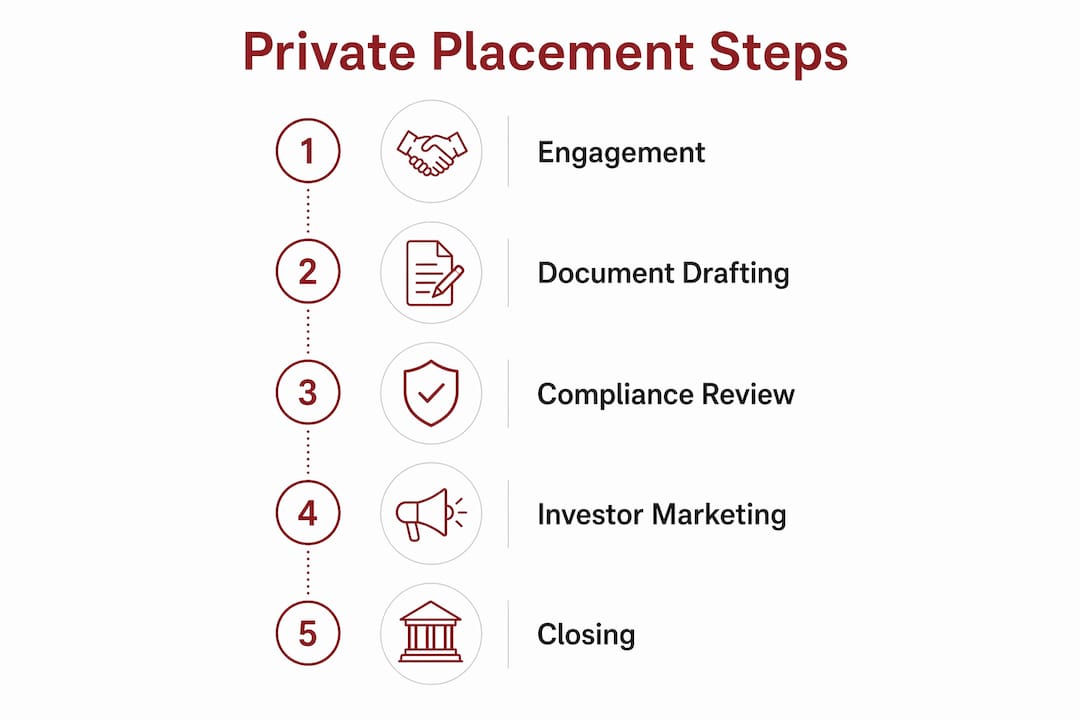
Most straightforward Regulation D offerings move from initial engagement to launch in three to four weeks. Complex structures, including multi-asset funds, blind pools, or offerings with cross-border investors, take longer, and a good attorney will tell you that upfront.
A typical timeline looks like this:
- Initial consultation: Free or low-cost call to assess deal structure, exemption choice, and document needs. You leave with a clear scope and a flat-fee quote.
- Deal structure interview: Attorney walks through waterfall mechanics, sponsor compensation, distribution structure, and disclosure decisions. Most clients refine their deal during this session.
- First draft delivery: Attorney delivers the full document package, usually with a review call to walk through major decisions and open items.
- Client review and revision: Sponsor reviews, provides feedback, and the attorney incorporates changes. One to two revision rounds is typical.
- Launch: Offering goes live. The attorney files Form D with the SEC within 15 days of the first sale and begins tracking state blue-sky filings as investors subscribe.
- Post-launch counsel: Ongoing compliance support for six months covers amendments, investor questions, and any remedial filings needed.
For offerings with cross-border elements or digital asset components, the timeline and document complexity increase. Counsel familiar with both US securities law and international regulatory frameworks adds real value at this stage. Beyondhorizons brings exactly that combination, with lawyers ranked on Chambers and Legal 500 and deep experience in cross-border startup funding and capital structures across APAC and emerging markets.
Businesses and investors raising capital under Regulation D need specialized securities counsel who drafts bespoke documents, manages all federal and state filings, and provides ongoing compliance support within a transparent flat-fee structure.
Key Takeaways
| Point | Details |
|---|---|
| Specialization over generalism | Choose a securities lawyer focused on Regulation D, not a generalist corporate attorney. |
| Full document package | A proper engagement covers PPM, agreements, Form D, state filings, and post-launch counsel. |
| Flat-fee pricing | Most private placement engagements are quoted as a flat fee tied to maximum offering size. |
| Form D deadline | Regulation D requires Form D filing with the SEC within 15 days of the first sale. |
| Bespoke drafting matters | Template PPMs create legal exposure; disclosure must reflect your specific deal structure and risks. |