
Select an Incoterm by matching three variables: the transport mode, who acts as importer of record, and who carries insurance and risk exposure. For containerized multimodal shipments where the buyer arranges carriage, FCA is usually the safest default. When the seller delivers but the buyer handles import formalities, DAP fits better. Avoid DDP unless the seller can lawfully clear imports in the destination country. Before drafting anything, confirm the transport mode and who will register as importer of record.
TL;DR:
- Selecting an Incoterm requires matching the transportation mode, the responsible party for import clearance, and the obligation for insurance and risk exposure.
- The most suitable default for containerized multimodal shipments where the buyer arranges carriage is FCA, while DAP is better when the seller delivers but the buyer handles import formalities; avoid DDP unless the seller can lawfully clear imports.
- Incoterms allocate obligations, risk transfer, and costs, but do not determine price, ownership, or governing law, making precise contractual terms essential for avoiding disputes.
- Clear documentation and explicit references to Incoterms year, exact delivery location, importer of record, and contingency clauses are crucial for enforceability and dispute prevention.
- Legal compliance issues, sanctions, and local licensing requirements can turn an Incoterm decision into a legal risk, especially with DDP or complex customs regimes, requiring careful legal review before shipping.
Table of Contents
- The Incoterms Selection Process, Step by Step
- What Incoterms Actually Allocate (and What They Don't)
- Matching Incoterm Families to Real Business Situations
- DDP vs. DAP, FOB vs. FCA, CIF vs. CIP: Resolving the Common Mix-Ups
- A Framework for Weighing Cost, Risk, and Customs Capability
- How to Lock Down Your Chosen Incoterm in the Contract
- Three Scenarios: Applying the Checklist to Real Shipments
- When Incoterms Selection Becomes a Legal Risk, Not Just a Logistics Choice
- Why the Simplest Incoterms Advice Is Usually Wrong
- How Beyondhorizons Helps Clients Choose and Document Incoterms
- Get Contract-Ready Incoterms Clauses Before Your Next Shipment
- Where to Go for the Official Incoterms Rules
- Sources
The Incoterms Selection Process, Step by Step
Picking the right rule isn't guesswork once you break it into a sequence. Skip a step, and you end up with a term that looks fine on paper but blows up the moment goods hit a border.
- Identify the transport mode. Some rules (FAS, FOB, CFR, CIF) apply only to sea and inland waterway transport. Others (EXW, FCA, CPT, CIP, DAP, DPU, DDP) work across any mode, including multimodal and containerized freight. Using FOB for a container that never touches a ship's rail creates ambiguity that courts and arbitrators have wrestled with for decades.
- Decide who arranges and pays for main carriage, and whether insurance is required. A buyer with strong freight relationships and negotiated container rates may prefer an F-term. A seller who wants control over routing and timing may lean toward a C or D term instead.
- Confirm who will act as importer of record. This is where deals quietly fall apart. Many jurisdictions require a locally registered entity or licensed customs broker to clear imports, and a foreign seller often cannot legally fill that role.
- Map your answers to the E, F, C, or D family, then pick the specific three-letter term. Once you know the transport mode and who handles customs on each end, the family narrows itself down. Committing to the specific term comes last, not first.
- Specify the exact named place and the Incoterms® year in the contract. "FCA Rotterdam" is not the same as "FCA Rotterdam Container Terminal, Gate 4." The ICC's Incoterms® 2020 checklist and flowcharts exist precisely because sellers and buyers approach this decision from opposite vantage points, and a shared reference point prevents each side from optimizing for itself.
Pro Tip: Run the decision flow twice, once from the seller's incentives and once from the buyer's. If both sides land on the same term independently, you've found a genuinely balanced allocation rather than one party's negotiating win.
Online selector tools, like the Incoterms calculator from DDPChain, can help visualize obligations side by side, but treat them as educational starting points. They won't catch a sanctions restriction or a licensing gap in the destination market, and that's where legal review earns its keep.
What Incoterms Actually Allocate (and What They Don't)
Incoterms allocate three things between seller and buyer: obligations, risk transfer, and costs. They do not set the price, determine the governing law, resolve payment terms, or transfer ownership of the goods. That distinction trips up more contract drafters than any other single misunderstanding in international trade.
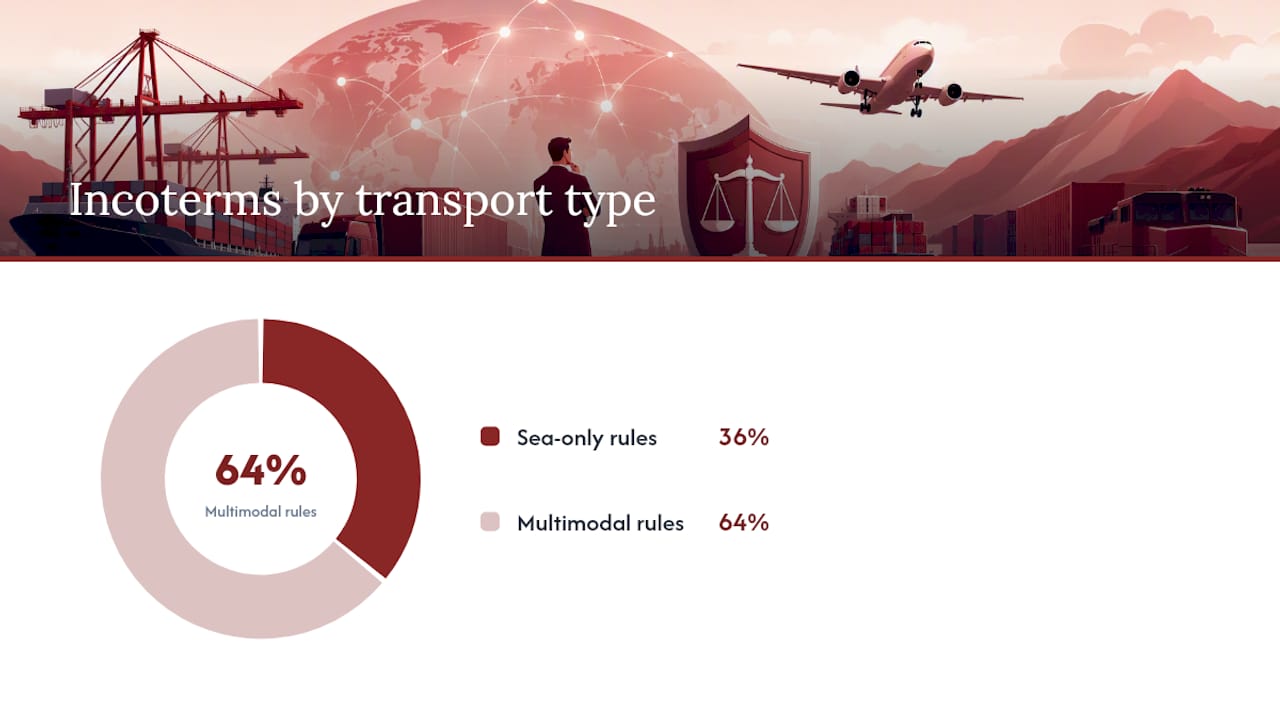
Each of the 11 rules under Incoterms® 2020 is structured around ten numbered obligations for the seller (the "A" side) and ten mirrored obligations for the buyer (the "B" side), covering everything from packaging and export licenses to notice requirements and cost allocation. Reading the A/B pairing for your chosen term tells you exactly who does what, and where one party's job ends and the other's begins.
The 11 rules break down as follows:
- EXW (Ex Works): seller makes goods available at their own premises; buyer takes on nearly everything else.
- FCA (Free Carrier): seller delivers to a carrier or named point nominated by the buyer.
- FAS (Free Alongside Ship): seller delivers alongside the vessel at the port of shipment; sea/inland waterway only.
- FOB (Free On Board): seller delivers goods on board the vessel; sea/inland waterway only.
- CPT (Carriage Paid To): seller pays carriage to the named destination; risk transfers earlier.
- CIP (Carriage and Insurance Paid To): like CPT, plus seller must insure to a higher minimum level.
- CFR (Cost and Freight): seller pays freight to the named port; sea/inland waterway only.
- CIF (Cost, Insurance and Freight): like CFR, plus a minimum insurance requirement.
- DAP (Delivered at Place): seller delivers, ready for unloading, at the named destination.
- DPU (Delivered at Place Unloaded): like DAP, but seller also unloads the goods.
- DDP (Delivered Duty Paid): seller delivers and clears the goods for import, duties paid.
None of that eleven-item list functions as a standalone contract. It's a shorthand for a set of default obligations that still needs a governing law clause, a payment mechanism, and dispute resolution terms wrapped around it. The rule only does its job when paired with the Incoterms year and a precise named place, a point the ICC's own guidance repeats for good reason: ambiguity here is one of the most common sources of shipping disputes.
Matching Incoterm Families to Real Business Situations
Grouping the 11 rules into four families makes the decision far less abstract. Each family answers a different question about how much the seller is willing to touch after goods leave the factory floor.
E, the minimal-obligation family. EXW asks the seller to do almost nothing beyond making goods available at their premises. It sounds attractive to sellers wanting a clean handoff, but it creates real complications on the export side: the buyer, not the seller, may be legally responsible for export formalities they have no local standing to complete. Most trade counsel steer first-time exporters away from EXW for this reason alone.
F, the buyer-arranges-carriage family. FCA, FAS, and FOB all put the buyer in charge of main carriage. FCA is the one worth defaulting to for containerized or multimodal freight, since FOB and FAS were built for an era when cargo passed over a ship's rail at a dockside crane, not when it's sealed into a container weeks before loading.
C, the seller-pays-carriage family. CPT, CIP, CFR, and CIF all have the seller paying for main carriage, but risk transfers to the buyer earlier than the seller's payment obligations end. That's the single most misunderstood feature of the C family: paying for the freight does not mean carrying the risk during it. Insurance minimums also diverge sharply here. Under Freightos's breakdown of the Incoterms rules, CIP requires broader insurance cover than CIF, reflecting the 2020 revision's push toward stronger buyer protection on multimodal routes.
D, the seller-delivers-to-destination family. DAP, DPU, and DDP push the furthest obligation onto the seller. DDP goes one step further than DAP by requiring the seller to clear the goods for import and pay duties, which sounds like a premium service until you hit the practical legal ceiling most sellers run into: you generally cannot clear imports in a country where you have no registered entity or licensed broker.
One figure worth sitting with: the ICC's own checklist and flowchart resource was built specifically because sellers and buyers evaluating the same shipment from opposite sides routinely arrive at different preferred terms. That divergence is the checklist's entire reason for existing, and it's exactly why a shared, contract-ready decision process matters more than either party's instinct.
DDP vs. DAP, FOB vs. FCA, CIF vs. CIP: Resolving the Common Mix-Ups
Three comparisons account for most of the confusion in Incoterms selection. Get these right and you'll avoid the majority of drafting disputes that land on a trade lawyer's desk.
DDP vs. DAP. The core question is who becomes importer of record. Under DDP, that's the seller, which means the seller must be able to lawfully clear customs, pay duties, and often hold a local registration or licensed broker relationship in the destination country. Trade compliance guidance from the ICC Academy on DDP and DAP consistently flags this as a point where sellers overcommit. DAP shifts import clearance to the buyer while the seller still delivers to the named place, which is often the more realistic allocation when the seller has no local presence.
FOB vs. FCA. FOB was designed for an era of loose cargo loaded directly onto a vessel. Once your shipment is a sealed container handed to a carrier at an inland terminal, the "ship's rail" risk-transfer point that FOB assumes doesn't really exist anymore. FCA solves this by transferring risk at the point the carrier takes custody, whether that's a container yard, a warehouse, or a rail terminal, making it the better fit for containerized freight.
CIF vs. CIP. Both require the seller to insure the goods on the buyer's behalf, but CIP sets a materially higher insurance minimum than CIF, per Freightos's Incoterms guide. If your contract says CIF, don't assume it carries CIP-level protection. That mismatch shows up most often in insurance claims after a loss, exactly the wrong time to discover it.
To keep contract language unambiguous, build the obligation directly into the clause rather than relying on the three-letter term alone:
- Spell out who nominates the carrier and by what date.
- State the insurance minimum in currency terms, not just "as required by the applicable rule."
- Name the exact facility, gate, or terminal, never just a city.
Pro Tip: *If your counterparty insists on DDP and you're the seller, counter with DAP plus an explicit buyer assistance clause requiring cooperation on import documentation.
A Framework for Weighing Cost, Risk, and Customs Capability
Choosing an Incoterm ultimately comes down to trade-offs between five factors, and the right answer changes depending on which one matters most to your business right now.
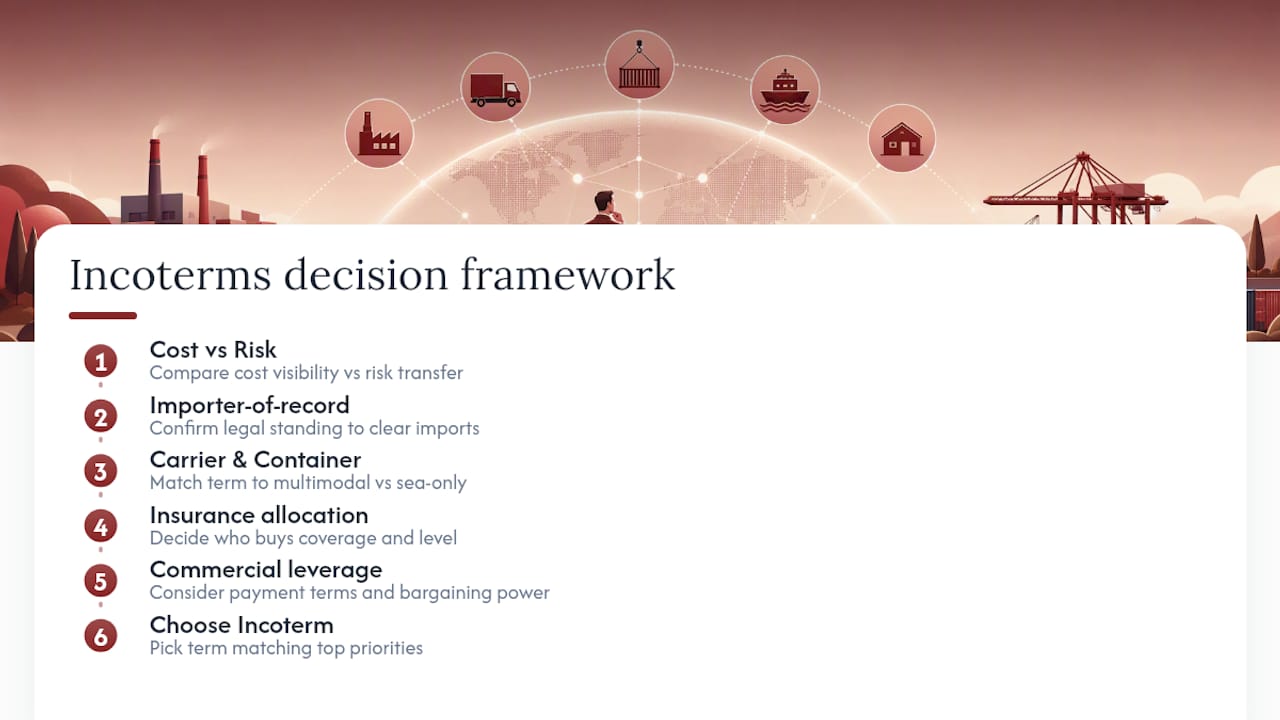
Cost visibility versus risk exposure. A term that hands more cost responsibility to the seller (like DAP or DDP) often looks appealing to a buyer wanting predictable landed costs. But cost predictability and risk exposure aren't the same thing, and a seller absorbing more cost doesn't automatically mean the buyer is protected if goods are damaged in transit. Read the risk-transfer clause separately from the cost clause every time.
Importer-of-record capability. Before agreeing to DDP or even DAP with import assistance, check whether the party taking on that role actually has the legal standing to do it. Programs like the EU's Authorised Economic Operator status exist because customs authorities want assurance that the entity clearing goods meets a compliance bar, and not every seller or buyer qualifies.
Carrier and container realities. If your freight moves through multiple carriers and modes before reaching the buyer, sea-only terms like FOB or CIF create a mismatch between the rule's assumptions and your actual logistics chain. Multimodal-friendly terms (FCA, CPT, CIP, DAP) fit better here, almost without exception.
Insurance allocation. Decide who buys coverage and at what level before you pick the term, not after. If the buyer already carries a cargo insurance policy through its own broker, a C-term's built-in insurance requirement might be redundant cost. If neither side has coverage in place, CIP's higher minimum offers more protection than CIF.
Commercial leverage and payment terms. A buyer paying by letter of credit with strong negotiating power may push for terms that shift more cost and risk to the seller. A seller in a tight capacity market with high demand can push back toward F or C terms. Incoterms selection isn't just a logistics decision. It's a negotiating lever that reflects who needs the deal more.
How to Lock Down Your Chosen Incoterm in the Contract
An Incoterm chosen correctly still fails if it's drafted loosely. Four elements turn a good decision into an enforceable one.
- Quote the Incoterms year and the exact named place, every time. Write "DAP Warehouse B, 12 Commerce Rd, Incoterms® 2020," not just "DAP" or "Delivered." The ICC's guidance on place of delivery and risk transfer treats this omission as one of the most preventable causes of shipment disputes, and it costs nothing to get right.
- State who is importer of record if it isn't obvious from the term itself. Even under DAP, clarify explicitly who pays duties and files import declarations, since local rules occasionally shift interpretation.
- Add delivery notification, insurance, and documentation requirements. Specify which transport documents (bill of lading, air waybill, CMR note) and insurance certificates each side must provide, and by when.
- Build in contingency mechanics. Cover what happens if sanctions rules change mid-shipment, if duties spike unexpectedly, or if import clearance is refused. A reallocation clause, spelling out who absorbs the cost if the deal can't close as planned, saves both sides from a dispute nobody budgeted for.
| Drafting element | What to include | Why it matters |
|---|---|---|
| Incoterms year + named place | Specific address, gate, or terminal, plus "Incoterms® 2020" | Prevents disputes over exactly where risk transferred |
| Importer of record | Named party responsible for import clearance and duties | Removes ambiguity DDP/DAP alone can leave open |
| Documentation requirements | Transport docs, insurance certificates, notice deadlines | Keeps both sides accountable on paperwork timing |
| Contingency clause | Reallocation mechanics if clearance is refused or duties change | Protects against regulatory shifts mid shipment |
For contracts spanning multiple jurisdictions, pairing this checklist with broader commercial agreement drafting guidance for cross-border deals helps make sure the Incoterms clause doesn't sit in isolation from governing law and dispute resolution provisions.
Three Scenarios: Applying the Checklist to Real Shipments
A factory seller shipping a full container load to a buyer who arranges carriage. The transport mode is containerized and multimodal, the buyer has a freight forwarder relationship, and the buyer will handle import clearance at destination. This points toward FCA, with the named place set at the seller's factory gate or a nearby container yard. The clause should specify exactly when the carrier takes custody and require the seller to notify the buyer once the container is loaded and sealed.
A seller offering door delivery but without a local entity in the buyer's country. The seller wants to offer a premium, "delivered" service, but has no registered presence or licensed broker to clear imports. DDP is off the table here, however appealing it looks commercially. DAP, paired with an explicit buyer assistance clause requiring cooperation on import documentation and duty payment, delivers nearly the same customer experience without exposing the seller to a customs violation it isn't equipped to handle.
A platform or e-commerce seller shipping low-value parcels directly to consumers. Operational realities differ sharply from container freight. Carriers frequently offer bundled delivered-duty-paid services for small parcels precisely because the volume and value make a broker relationship economical at scale. DDP becomes genuinely feasible here, but only because the carrier, not the seller, is functionally acting as the licensed importer through pre-arranged customs programs.
When Incoterms Selection Becomes a Legal Risk, Not Just a Logistics Choice
Most Incoterms decisions are commercial. Some are legal landmines dressed up as shipping terms, and the difference matters more than most contract drafters assume.
DDP is the clearest example. In many jurisdictions, import clearance legally requires a locally registered entity or a licensed customs broker acting on the importer's behalf. A foreign seller quoting DDP without either of those in place isn't just taking on operational risk. It may be agreeing to a legal obligation it has no lawful way to fulfill, which can void the clearance attempt entirely or trigger penalties that fall back on the buyer anyway.
Sanctions exposure compounds the problem. The European Commission's own factsheet on sanctions and the Incoterms EXW rule flags how restrictive measures can alter which party is legally permitted to handle export or import formalities for certain goods or destinations, regardless of what the commercial contract says. An Incoterm that worked fine on last year's shipment can become unworkable overnight if the goods or the destination fall under a new sanctions program.
When a seller is asked to quote DDP but has no local legal entity, the standard drafting fix is a DAP-based clause paired with an explicit buyer assistance obligation, plus a fallback mechanism that reallocates responsibility if import clearance is ultimately refused. That structure protects both parties without pretending the seller has import capabilities it doesn't actually have.
A few triggers should send any Incoterms question to counsel rather than a shipping desk:
- Shipments involving high-duty goods where the cost of a customs misstep is material.
- Any transaction touching sanctioned or export-controlled goods or destinations.
- Complex or unfamiliar customs regimes, especially where local licensing requirements aren't well documented.
- Disputes over where risk or delivery actually transferred, particularly after a loss or damage claim has already been filed.
Businesses moving regularly through regulated trade corridors often benefit from a standing relationship with trade and tariff counsel rather than one-off contract review, since regulatory conditions shift faster than most standard contracts get updated.
Why the Simplest Incoterms Advice Is Usually Wrong
Most guidance on Incoterms selection treats it as a binary choice: pick the term that minimizes your risk, or pick the one that minimizes your cost. That framing misses the actual decision, which is rarely about minimizing anything. It's about matching legal capability to commercial ambition.
The DDP trap is the clearest proof of this. Sellers reach for DDP because it sounds like the most customer-friendly, premium option, the shipping equivalent of white-glove service. But offering DDP without the legal standing to clear imports isn't generous. It's a promise the seller often can't keep, and buyers rarely find that out until a shipment is stuck at a border. The conventional advice to "just be more customer-focused" ignores that the friendliest-sounding term is frequently the riskiest one on the table.
What gets underestimated just as often is how much the named place matters compared to the three-letter code itself. Business professionals spend disproportionate energy debating FCA versus FOB while leaving the named place vague, "the port," "our facility," when the specific gate, dock, or address is where risk transfer disputes actually get litigated. The letters get the attention. The address does the legal work.
If there's one habit worth building into every cross-border sale contract, it's treating Incoterms selection as a legal capability check first and a cost negotiation second. Ask what your counterparty can lawfully do before asking what you'd prefer them to do.
— HL
How Beyondhorizons Helps Clients Choose and Document Incoterms
Every trade lane carries its own regulatory texture, and Beyondhorizons builds its diagnostic approach around that reality rather than a generic checklist. Working across aerospace, robotics, blockchain, and wellness sector clients moving goods through Singapore, the broader APAC region, and emerging markets, the firm maps each client's transport mode, customs exposure, and counterparty leverage before recommending a term.
HL's cross-border practice draws on experience structuring trade and regulatory arrangements for listed companies, government-linked entities, and regional banks, the kind of clients who can't afford an ambiguous named place buried in a shipping schedule. If your current contracts leave the Incoterm undefined, outdated, or mismatched to how goods actually move, that's worth a conversation before the next shipment, not after a dispute.
Get Contract-Ready Incoterms Clauses Before Your Next Shipment
Getting the Incoterm right on paper is only half the job. The clause still has to hold up when a customs officer questions the importer of record, or when a shipment gets delayed and both sides are arguing over who bears the cost. That's the gap Beyondhorizons closes: precise, contract-ready drafting from lawyers who've structured cross-border trade terms for listed companies and regional banks, not a generic template pulled from a shipping guide.

The firm's commercial contracts counsel covers Incoterms clause drafting and review, customs compliance and importer-of-record strategy, and broader trade and tariff advisory for businesses moving goods across borders. Engagement options flex to the job: a fixed-fee review for a single contract, project-based drafting for a new trade lane, or a standing retainer for companies shipping regularly through multiple jurisdictions. If your last Incoterms clause was copied from a template three years ago, it's worth having it checked against current sanctions and customs rules. Get in touch with Beyondhorizons to review your contract terms before your next shipment goes out.
Where to Go for the Official Incoterms Rules
The ICC's Incoterms® 2020 page is the authoritative source for the full text of all 11 rules, including the detailed A/B obligation lists that a summary article can only condense. The ICC's checklist and flowchart resource walks through seller and buyer decision trees side by side, useful for confirming your reasoning before you commit to contract language.
For the DDP versus DAP question specifically, the ICC Academy's article on the topic goes deeper into the practical limits sellers run into. And for anyone drafting the named-place language itself, the ICC Academy's guidance on delivery and risk transfer is worth reading before finalizing any clause.
This article is general information, not a substitute for advice from a qualified lawyer. Consult a qualified legal professional about your own circumstances before acting on anything here.
Sources
- Incoterms® 2020 - ICC
- Incoterms® 2020 Checklist + Flowcharts – Choosing the right Incoterms® rule
- Incoterms 2020 — DAP or DDP? (ICC Academy)
- Incoterms 2026: Meaning, Chart & List Of Incoterms - Freightos