
Garden leave is legally enforceable in Singapore, but only when the employment contract contains an express clause allowing it. There is no statutory garden leave regime under the Employment Act, so employers cannot impose it unilaterally. When properly drafted, the employee stays on full pay with CPF contributions continuing, remains bound by confidentiality and fidelity duties, and is barred from starting competing work until the notice period ends.
TL;DR:
- Enforceability of garden leave in Singapore depends on an explicit clause in the employment contract; unilateral imposition without one is invalid.
- Garden leave's duration and scope must be proportionate to the protected proprietary interest, typically limited to the notice period for senior roles.
- Salary, allowances, and CPF contributions continue during garden leave, and employees must remain available for handovers and uphold confidentiality duties.
- Interactions with annual and sick leave during notice periods vary: approved leave does not shorten notice, while offsetting leave can truncate the last working day.
- Proper drafting, including specifying trigger events, activities permitted, and remedies, is crucial for defending garden leave clauses against legal challenges.
Table of Contents
- What Garden Leave in Singapore Actually Means
- Employee Rights and Employer Obligations During the Period
- How Notice Periods, Annual Leave and Sick Leave Interact With Garden Leave
- Drafting a Garden Leave Clause That Actually Holds Up
- How Singapore Courts Assess and Enforce These Clauses
- Beyond Horizons Perspective: When Garden Leave Gets Complicated
- Does Garden Leave Hurt Your Career or Reputation?
- Garden Leave Versus Other Post-Employment Options
- Notable Disputes and What They Signal
- Tax Treatment of Salary Paid During Garden Leave
- The Real Test for Any Garden Leave Clause
- Getting Your Garden Leave Clause Right From the Start
- Where to Read More
- Sources
What Garden Leave in Singapore Actually Means
Garden leave describes a period, usually equal to the notice period, during which an employer tells a departing employee to stay away from the workplace while remaining employed and paid. The name comes from the old British image of an executive tending the garden at home while technically still on the books. It is not resignation, not termination, and not the same as a post-termination non-compete.
The distinction matters because Singapore courts treat garden leave and non-compete clauses differently under the restraint-of-trade doctrine. During garden leave, the employee is still under contract, still owes fidelity duties, and still draws a salary. A non-compete kicks in after the relationship ends, when the employee owes the company nothing and is trying to earn a living elsewhere. Courts have historically been readier to enforce garden leave precisely because it is a "softer" restraint. The employee is inconvenienced, not unemployed.
Enforceability turns on one requirement above all others: an express clause in the signed contract. Without that clause, an employer generally has no unilateral right to sideline an employee while continuing to pay them. Attempting it anyway invites a claim for breach of contract, since the employee's obligation to work and the employer's obligation to provide work are both part of the deal unless the contract says otherwise.
Even with a clause, Singapore courts apply the same reasonableness test used for other restraints of trade. Two things need to line up:
- The employer must show a legitimate proprietary interest worth protecting, such as confidential client data, trade secrets, or client relationships built on the employee's personal goodwill.
- The duration and scope of the restriction must be proportionate to that interest, not simply as long as the employer can get away with.
A three-month garden leave clause for a portfolio manager with access to trading strategies and client books is a very different proposition from a six-month clause imposed on a junior analyst with no client contact. The Law Gazette's analysis of garden leave enforcement notes that this proportionality question sits at the center of most disputes that reach the courts.
Employee Rights and Employer Obligations During the Period
Full pay is the baseline. An employee on garden leave in Singapore continues to receive salary, contractual allowances, and other benefits exactly as if they were still coming into the office, and CPF contributions continue on the same basis as normal employment where the clause is silent on reducing them. This is what separates garden leave from suspension without pay or outright dismissal, and it is also the main reason courts find it easier to uphold.
Pro Tip: If your contract is silent on bonus or commission treatment during garden leave, resolve it in writing before the leave starts rather than after a dispute arises. Ambiguity here is one of the most common sources of friction between departing employees and HR.
Obligations run in both directions. The employee typically must:
- Remain available for handover tasks, training a successor, or answering reasonable queries from the employer.
- Continue observing confidentiality and fidelity duties, since the employment relationship has not ended.
- Refrain from starting or actively soliciting business for a competitor during the leave period.
Employers, in turn, generally restrict physical and system access while continuing every financial obligation under the contract. This is not a punitive gray zone. According to QuickHR's guidance on garden leave, pay continuation and CPF contributions are consistently cited as the baseline employer obligation, alongside the practical step of revoking system logins to protect data.
Bonuses and commissions get murkier. Where the contract is silent, employers commonly prorate discretionary bonuses based on time actually worked before garden leave began, though this is a matter of contractual interpretation rather than a fixed rule. Personal projects, job interviews, and passive investments are generally fine during garden leave. Actively working for a competitor, soliciting clients, or poaching colleagues is not, and doing so can void the salary continuation obligation depending on how the clause is written. Medical leave taken during garden leave is typically treated the same as ordinary sick leave, subject to the usual medical certificate requirements.
How Notice Periods, Annual Leave and Sick Leave Interact With Garden Leave
Garden leave duration almost always tracks the contractual notice period. A three-month notice clause typically produces, at most, a three-month garden leave clause. Stretching garden leave meaningfully beyond the notice period without separate contractual basis invites the same proportionality challenge that applies to non-competes.
Where things get genuinely confusing for both HR teams and departing employees is how annual leave interacts with notice and garden leave. The Ministry of Manpower draws a sharp distinction between two scenarios that look similar but produce very different results:
- Approved annual leave taken during notice remains paid leave, and it does not shorten the notice period. The last day of employment stays exactly where it was originally set.
- Offsetting notice with annual leave is treated differently: this leave becomes unpaid, and it brings the employee's last day forward by the number of days offset.
That second point trips up a lot of employers who assume any leave "used up" during notice shortens the clock the same way. It does not, unless both parties agree to structure it as an offset rather than approved leave. Getting this wrong creates payroll headaches and, occasionally, disputes over final pay calculations.
Annual leave entitlement itself is governed by MOM's rules on eligibility and pro-ration, which matter when calculating exactly how much leave an employee has banked heading into their notice period.
Sick leave follows its own track. Employees who fall genuinely ill during notice or garden leave remain entitled to paid sick leave under the MOM eligibility rules, provided they meet the service-length and medical certificate requirements. This applies whether the employee is actively working out notice or sitting on garden leave. Employers cannot treat a legitimate medical certificate as a breach of garden leave obligations.
Drafting a Garden Leave Clause That Actually Holds Up
A garden leave clause that survives a courtroom challenge is built, not improvised. Employers who treat it as boilerplate copied from another contract are the ones most likely to find it unenforceable when it matters. Building a defensible clause means covering each of the following elements deliberately:
- Trigger events. Specify exactly when garden leave can be invoked, whether that's on resignation, on notice of termination, or both.
- Explicit duration. State the maximum period, tied clearly to the notice period rather than left open-ended.
- Pay and CPF continuation. Confirm salary, allowances, and CPF contributions continue in full, removing any ambiguity that could support a constructive dismissal claim.
- Permitted and prohibited activities. List what the employee may do (personal matters, interviews) and may not do (competing work, client solicitation).
- Availability requirements. Define what handover or contact obligations remain reasonable during the leave.
- Early termination mechanics. Allow the employer to shorten or end garden leave early if circumstances change, without penalty.
- Remedies for breach. Set out what happens, contractually, if the employee breaches confidentiality or competes during the leave period.
Pro Tip: Draft the duration as a range tied to seniority and access to sensitive information rather than a flat company-wide policy. A clause that applies the same restriction to a receptionist and a CFO is exactly the kind of overreach that invites a reasonableness challenge.
On the operational side, HR teams should issue written notice confirming the start and end date of garden leave, restrict system and premises access promptly, and keep a documented rationale for the specific duration chosen. That documentation becomes important if the clause is ever challenged, since courts assessing reasonableness want to see that the restriction was calibrated to an actual risk, not just copied from a template.
The most common red flags are overbroad durations that bear no relation to the notice period, vague language around what the employee "must" do during leave, and unpaid offset arrangements imposed without the employee's agreement. Combining garden leave with a lengthy separate non-compete is another frequent misstep. Commentary from Zegal on garden leave practices and structuring solid commercial contract clauses both point to the same lesson: precision in the clause language does more to protect an employer than length ever does.
How Singapore Courts Assess and Enforce These Clauses
When a garden leave dispute reaches court, the available remedies mirror those for other contractual breaches: damages for losses caused by a breach, or an injunction restraining an employee from working for a competitor while garden leave is in effect. Injunctions are the sharper tool because they act before damage is done, but courts only grant them where the underlying clause is reasonable in the first place.
The restraint-of-trade doctrine gives courts room to decline enforcement entirely if a clause looks like it protects the employer's convenience rather than a genuine business interest. A clause that simply keeps a competent employee off the market for months, with no connection to confidential information or client relationships, is vulnerable on exactly this ground.
The public-interest and reasonableness limb of the analysis, as the Law Gazette's feature on garden leave enforcement sets out, weighs the employer's proprietary interest against the employee's right to earn a living. Clauses drafted with a clear, demonstrable link between duration and risk tend to survive scrutiny. Clauses that read as generic deterrents tend not to.
Three practical factors consistently improve enforceability: clear and specific drafting rather than borrowed boilerplate, evidence that the employee genuinely had access to sensitive information or client goodwill, and a duration proportionate to the seniority of the role.
Beyond Horizons Perspective: When Garden Leave Gets Complicated
Garden leave rarely causes problems on its own. The disputes we see involve two restraints stacked together, a garden leave period followed immediately by a separate non-compete, where the combined length becomes disproportionate to any single interest being protected. Regional moves complicate this further: an employee serving garden leave in Singapore while negotiating a role in Hong Kong or Jakarta raises questions about which jurisdiction's courts would even hear an enforcement dispute.
Employers should think about seeking an injunction the moment there is credible evidence that a departing employee is actively working for a competitor during garden leave, not after the damage is already visible. Employees, for their part, should have any garden leave or combined restraint clause reviewed before signing, not after resigning. The cost of a contract review is trivial next to the cost of discovering, mid-negotiation with a new employer, that a clause blocks the move entirely.
— HL
Does Garden Leave Hurt Your Career or Reputation?
Garden leave carries a reputational cost that is often underestimated by employees eager to accept a generous exit package. Being visibly absent from work for weeks or months, while technically still employed, can read to a new employer as a gap that needs explaining, even when the employee did nothing wrong.
The practical fix is straightforward: be upfront about it. Most hiring managers in Singapore's competitive sectors, finance, technology, and professional services among them, understand garden leave as a standard feature of senior transitions rather than a red flag, provided the candidate explains it clearly and the timeline matches what LinkedIn or references show.
Where garden leave genuinely damages career progression is when it drags on for reasons outside the employee's control, such as a former employer using the leave period punitively or dragging out an already-long notice period through repeated delays. In those cases, the employee's ability to start a new role gets pushed back with no upside. This is one more reason duration matters so much in how a clause is drafted: a proportionate three-month period reads as normal, while an unusually long one starts raising questions in interviews that have nothing to do with the employee's actual performance. Employees negotiating exit terms should treat the length of garden leave as a real bargaining point, not a formality to accept without comment.
Garden Leave Versus Other Post-Employment Options
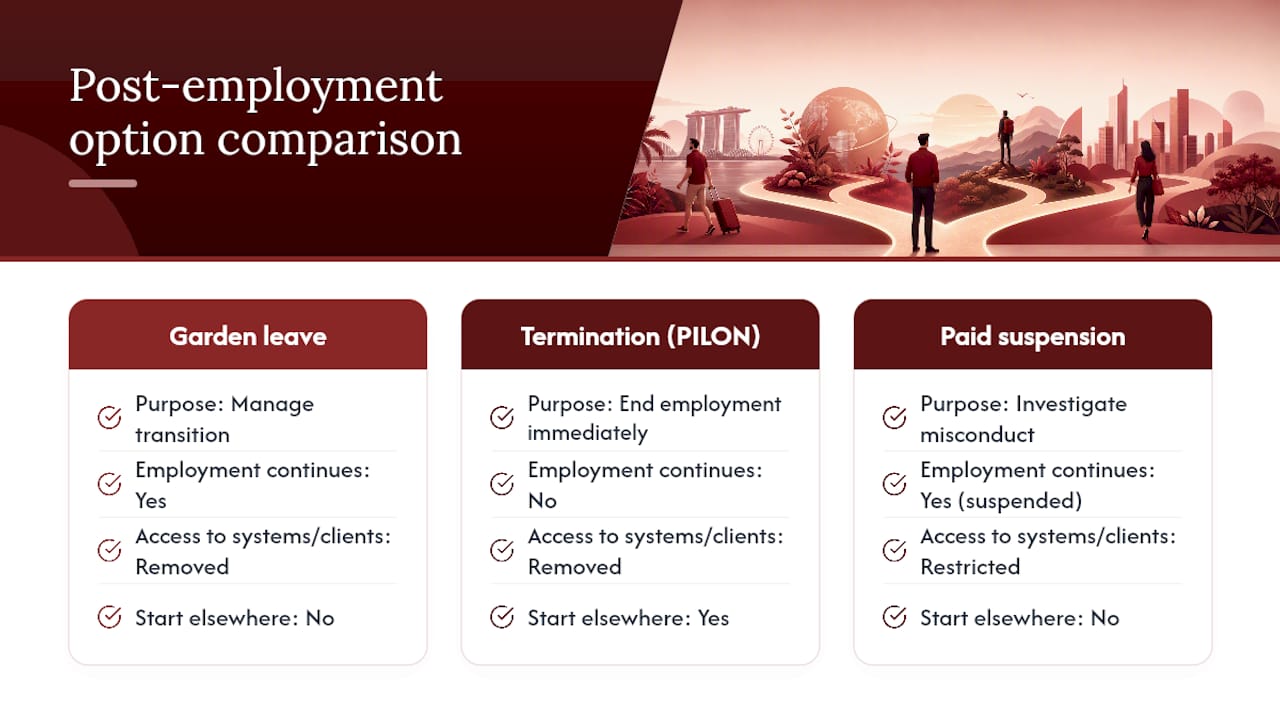
Garden leave is one of several tools available when an employment relationship is ending, and it is not always the right one. Immediate termination with payment in lieu of notice ends the relationship cleanly and lets the employee start elsewhere right away, but it also ends the employer's ability to enforce ongoing fidelity duties, since those duties depend on the employment relationship continuing.
Paid suspension differs from garden leave mainly in purpose. Suspension is usually tied to an investigation into alleged misconduct, with the employment relationship's future still undecided. Garden leave assumes the relationship is already ending on agreed terms and simply manages the transition period.
A straightforward working notice period, where the employee keeps working normally until the last day, remains the default and the cheapest option operationally, but it gives a departing employee full access to systems, clients, and colleagues right up until departure. For roles with sensitive information or key client relationships, that access is exactly what garden leave is designed to remove.
The choice among these options comes down to what risk the employer is actually managing. If the concern is information leakage or client poaching, garden leave fits. If the concern is investigating specific misconduct, suspension fits better. If there is no real proprietary risk, a clean termination with notice pay is often simpler and cheaper for everyone involved than manufacturing a garden leave arrangement that a court might later question anyway.
Notable Disputes and What They Signal
Singapore's case law on garden leave sits within the broader body of restraint-of-trade jurisprudence rather than forming a separate, heavily litigated category on its own. The Law Gazette's review of garden leave enforcement and resistance highlights that much of the uncertainty in this area comes from how garden leave clauses interact with separately drafted non-compete provisions, rather than from garden leave standing alone.
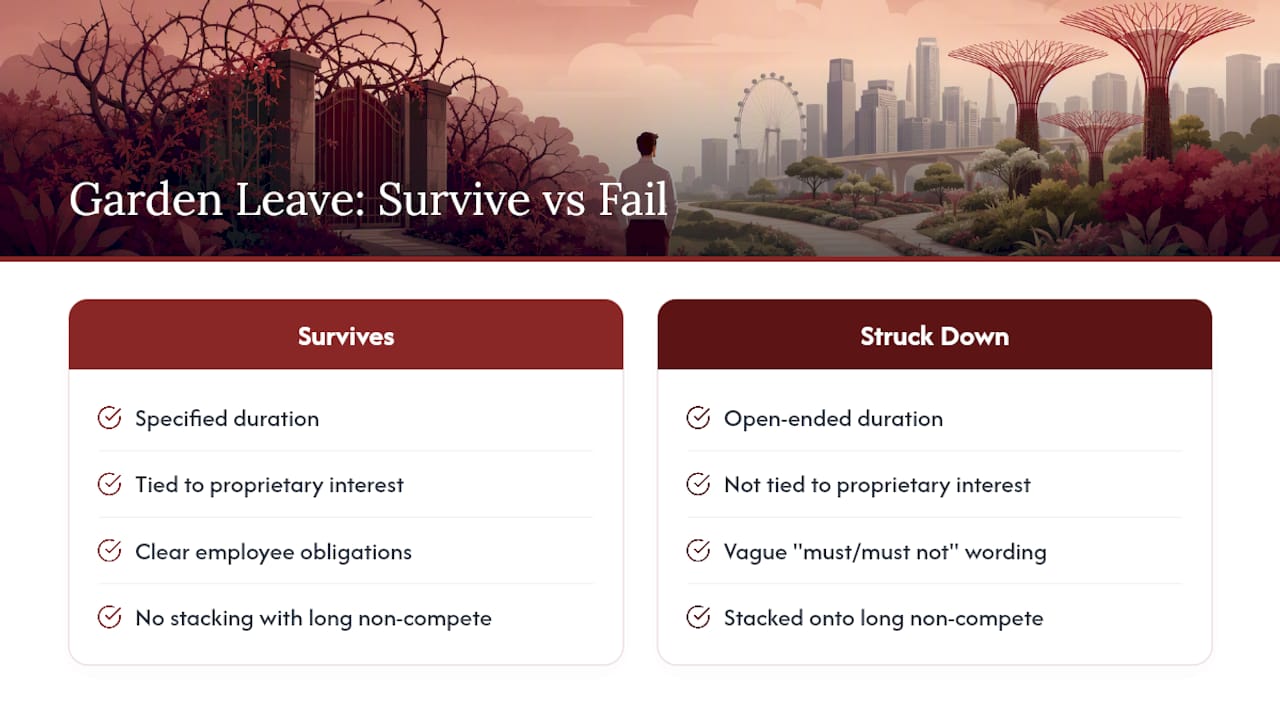
The recurring pattern across the disputes that do surface is drafting failure, not judicial hostility to the concept itself. Clauses that survive challenge tend to specify duration clearly, tie the restriction to an identifiable proprietary interest, and avoid vague language about what the employee "must" or "must not" do during the leave period. Clauses that get challenged successfully usually share the opposite traits: open-ended durations, obligations that shift after the fact, or an attempt to stack garden leave on top of a lengthy separate non-compete without adjusting the combined length downward.
This matters practically for both sides of the employment relationship. Employers drafting new contracts should treat every garden leave clause as something that might eventually face scrutiny, not as a formality nobody will ever read closely. Employees signing a contract with a garden leave clause, particularly at the senior or specialist level where these clauses are most common, should assume it will be enforced as written and negotiate the specifics before signing rather than after resigning.
Tax Treatment of Salary Paid During Garden Leave
Salary received during garden leave is treated the same as ordinary employment income for tax purposes in Singapore. There is no special exemption or different tax category simply because the employee is not physically attending work. It remains taxable employment income reportable in the year it is received, and employers continue standard payroll withholding and reporting obligations exactly as they would for any employee actively working.
CPF contributions follow the same logic on the employer side. Where the employment contract maintains CPF contributions during garden leave, those contributions are calculated on the same basis as normal salary, subject to the usual CPF ceilings and the employee's residency status.
Complexity increases for employees on garden leave who are also negotiating a new role with a foreign employer, particularly one involving relocation. Cross-border tax residency rules can get tangled when an employee is technically still a Singapore employee on payroll while physically present in another jurisdiction preparing to start a new role. Employers structuring senior exits involving international moves, and employees receiving offers that span this transition, should treat the tax residency question as something to clarify early rather than assume it will sort itself out at year-end filing.
The Real Test for Any Garden Leave Clause
Most advice on garden leave in Singapore focuses on whether a clause exists in the contract, as if the presence of the clause settles the matter. It does not. An express clause is the entry ticket, not the guarantee. The judgment this article's research actually supports is narrower and more useful: enforceability depends far more on proportionality between duration and demonstrable business risk than on whether a lawyer once drafted the clause correctly on paper.
Where conventional advice falls short is treating garden leave as a template problem, something you copy from a precedent contract and adjust the number of months. That approach ignores the fact that courts look past the words to the actual interest being protected. A clause that made sense for a chief investment officer rarely makes sense unchanged for a mid-level product manager.
If you take one thing from this guide, prioritize matching duration to role seniority and genuine access to sensitive information before anything else. Get that calibration right, and most of the other drafting details fall into place. Get it wrong, and no amount of careful wording elsewhere in the contract will save the clause if it is challenged.
— HL
Getting Your Garden Leave Clause Right From the Start
Most disputes over garden leave in Singapore trace back to the same root cause: a clause drafted once, filed away, and never tested against the specific role it governs. Legal professionals work directly with employers to draft garden leave provisions calibrated to actual risk, rather than generic language borrowed from templates that may not hold up if challenged.

The firm's Singapore employment law practice advises on contract drafting, notice period structuring, and dispute resolution for both employers writing clauses and senior employees reviewing offers before they sign. For roles involving cross-border moves, where garden leave intersects with relocation and dual restraint questions, that combination of local employment expertise and cross-border experience is exactly the gap that generic HR templates cannot close. If you are drafting a new senior employment contract, reviewing an existing garden leave clause, or facing a dispute over one, seek specialist contract review and get specific guidance before the clause becomes a problem rather than after.
Where to Read More
- Termination with notice — Ministry of Manpower
- Annual leave eligibility and entitlement — MOM
- Sick leave eligibility and entitlement — MOM
- The law and practice of garden leave — Law Gazette
- Garden leave in Singapore: rules and guidelines — QuickHR
- Notice periods for property agents in Singapore
This article is general information, not a substitute for advice from a qualified lawyer. Consult a qualified legal professional about your own circumstances before acting on anything here.
Sources
- Termination with notice — Ministry of Manpower (MOM)
- Annual leave: eligibility and entitlement — MOM
- Sick leave: eligibility and entitlement — MOM
- The law and practice of garden leave: rights, duties, enforcement and resistance — Law Gazette
- Garden leave in Singapore: Meaning, rules and MOM guidelines — QuickHR