
Employers in Singapore may lawfully terminate employment by serving written notice, paying salary in lieu, or, for proven misconduct, dismissing without notice. Each path carries distinct obligations: written notice matching statutory or contractual terms, a documented due inquiry before any summary dismissal, and prompt final pay with CPF reconciliation. Skip these steps and you risk a wrongful dismissal claim at the Tripartite Alliance for Dispute Management (TADM).
TL;DR:
- Employers must ensure they follow the correct notice, salary in lieu, and documentation procedures to avoid wrongful dismissal claims.
- The minimum statutory notice periods increase with employee length of service, with a default four-week structure, but contracts can extend these minimums.
- Summary dismissal is only justified with proved misconduct following a thorough, documented due inquiry; suspicion alone is insufficient.
- A wrongful dismissal can occur even with proper notice if the motivation is discriminatory, retaliatory, or otherwise improper, which shifts the burden of proof to the employer.
- Final pay must include all owed salary, unused leave, CPF contributions, and must be paid on time; proper documentation and timely payment prevent disputes.
Table of Contents
- What Should Employers Do Before Terminating an Employee in Singapore?
- How Do Statutory Notice Periods Work Under the Employment Act?
- When Can an Employer Dismiss Without Notice for Misconduct?
- What Makes a Dismissal Wrongful Even With Proper Notice?
- What Are the Rules for Responsible Retrenchment?
- What Must Be Included in Final Pay After Termination?
- How Do TADM Mediation and the Employment Claims Tribunals Work?
- What Documentation Should HR Prepare for Every Termination?
- Is There Severance Pay Beyond the Final Pay Package?
- How Does Termination Affect CPF Contributions and Taxes?
- Can You Rehire a Former Employee or Enforce a Non-Compete?
- Do the Termination Rules Differ for Contract, Part-Time, and Foreign Workers?
- When Should You Bring In Employment Counsel for a Termination?
- What Three Mistakes Do Employers Keep Making?
- Sources
What Should Employers Do Before Terminating an Employee in Singapore?
Before you draft a termination letter, work through a short sequence that protects both the business and the employee's statutory rights.
- Check the contract and the Employment Act. Confirm the notice period stated in the employment contract, then compare it against statutory minimums. The longer period usually applies unless the contract expressly says otherwise.
- Decide between notice and salary in lieu. You can shorten or skip the notice period entirely by paying salary in lieu, which is often the cleaner option when trust has broken down.
- Pause if misconduct is alleged. Do not dismiss on the spot. Hold a documented due inquiry that gives the employee a real chance to respond before you decide anything.
- Prepare the paperwork. Draft the termination letter, calculate final pay, reconcile CPF contributions, and keep every piece of evidence in case the matter ends up at TADM.
Pro Tip: Build your evidence file the day you start considering termination, not the day you send the letter. TADM mediators respond far better to a clear chronology than to documents assembled after the fact.
How Do Statutory Notice Periods Work Under the Employment Act?
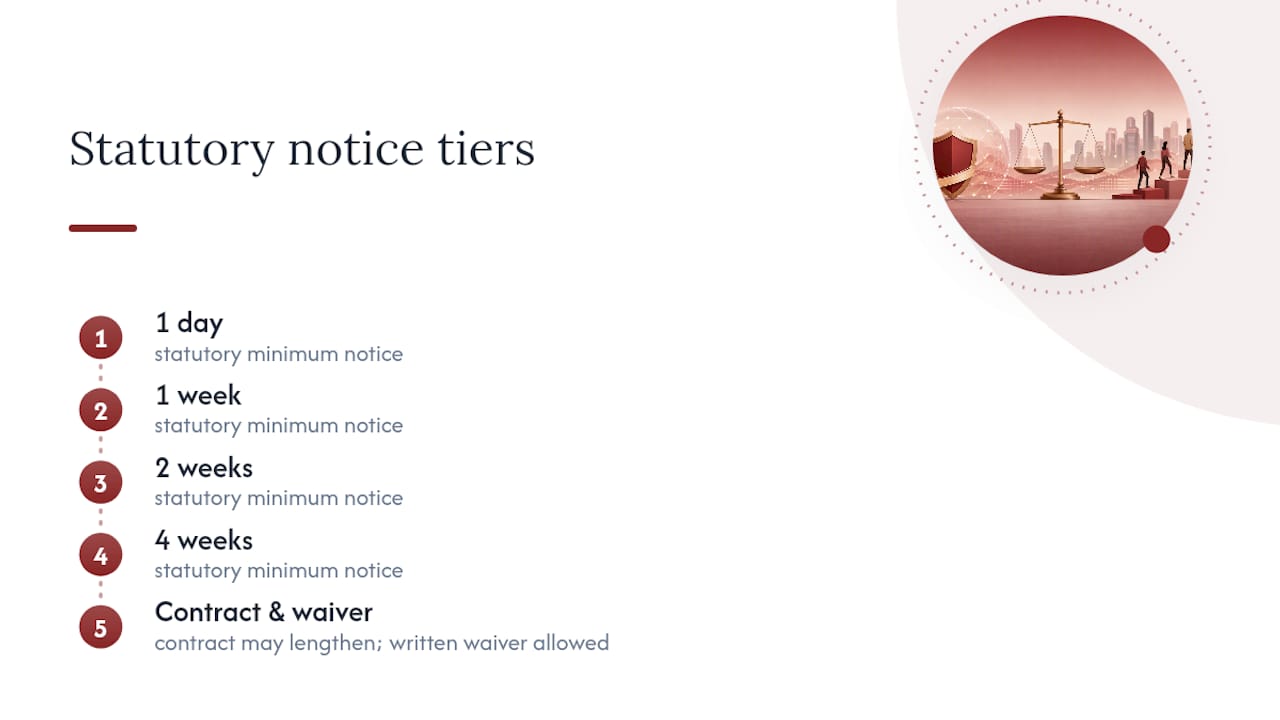
The Employment Act sets minimum notice periods based on length of service, and these apply whenever the employment contract is silent or offers less protection than the statute:
The statutory minimum notice periods under the Employment Act increase with length of service, starting from a very short notice period for recent hires to multiple weeks for long-serving employees.
Contract terms can extend these minimums, but they can never shorten them. If an employment contract specifies eight weeks' notice for a senior manager, that eight weeks governs, not the statutory four. Both parties can also agree in writing to waive notice altogether, which is common when an employee has already secured a new role and both sides want a clean exit.
Salary in lieu of notice is calculated on the gross rate of pay the employee would have earned during the notice period, and CPF contributions follow the same logic used for regular salary. If the employee remains on the books through the notice period rather than receiving a lump sum, CPF is payable as usual because they are still considered employed. Get this calculation wrong and you invite a salary dispute on top of whatever prompted the termination in the first place.
Statistic to note: the Employment Act's four-tier notice structure (1 day, 1 week, 2 weeks, 4 weeks) is the default baseline for every employment contract in Singapore unless the contract itself sets a longer period.
When Can an Employer Dismiss Without Notice for Misconduct?
Summary dismissal, meaning termination without any notice or salary in lieu, is legitimate only when misconduct is proved, not merely suspected. MOM guidance is explicit that employers must hold a due inquiry before dismissing, and skipping that step is one of the fastest routes to a wrongful dismissal finding.
Conduct that can justify summary dismissal typically includes:
- Theft, fraud, or dishonesty involving company property or funds
- Serious insubordination or a direct refusal to follow lawful instructions
- Physical violence or serious harassment in the workplace
- Repeated, deliberate breaches of clear company policy after prior warnings
A defensible due inquiry follows a consistent structure: written notice of the specific allegations, a documented timeline and the evidence supporting each allegation, a genuine opportunity for the employee to respond in writing or in person, and a final written outcome explaining the reasoning behind the decision. Retain that full record, including the employee's own statements, for at least two years.
Pro Tip: Never let the inquiry and the dismissal decision sit with the same person who raised the original complaint. Even a fair outcome looks compromised if the accuser also acted as judge.
What Makes a Dismissal Wrongful Even With Proper Notice?
Serving correct notice does not automatically protect an employer. The Tripartite Guidelines on Wrongful Dismissal make clear that a termination can still be wrongful if the real motive behind it was improper, regardless of how clean the paperwork looks.
Common triggers for a wrongful dismissal finding include:
- Dismissing an employee because of race, religion, age, or a similar protected characteristic
- Terminating someone shortly before a bonus, commission, or vesting date to avoid paying it
- Retaliating against an employee for raising a workplace complaint or cooperating with an investigation
- Making conditions so hostile that an employee is effectively forced to resign, which tribunals treat as dismissal in substance
The burden of proof sits with the employer once an employee raises a credible claim, not the other way around. That single fact should shape how HR documents every termination decision. Keep performance records contemporaneous rather than reconstructed after the fact, note the business rationale in writing at the time of the decision, and avoid vague termination letters that simply cite "loss of confidence" without specifics. A surprising number of otherwise lawful notice terminations unravel at TADM mediation purely because the employer cannot produce a paper trail showing the decision predated the employee's complaint.
What Are the Rules for Responsible Retrenchment?
Retrenchment differs from dismissal because it targets the role, not the person. Legitimate business reasons include restructuring, redundancy from automation, or a genuine downturn, but the Tripartite Advisory on Managing Excess Manpower and Responsible Retrenchment sets clear expectations for how employers should carry it out.
Fair retrenchment practice generally involves:
- Using objective, documented selection criteria rather than subjective judgment calls
- Exploring redeployment or retraining within the business before cutting the role
- Consulting affected employees and unions where applicable, with reasonable advance notice
- Paying any retrenchment benefit promptly and in line with what the contract or company policy promises
Employers that skip consultation or select employees on vague grounds tend to face the most pushback at mediation, even when the underlying business case for cutting headcount is genuinely sound.
What Must Be Included in Final Pay After Termination?
Final pay covers more than the last month's salary. It should include any unpaid salary up to the last working day, salary in lieu of notice if that route was chosen, and payment for unused annual leave calculated at the employee's gross rate.
- Unpaid salary for days already worked
- Salary in lieu of notice, where applicable
- Payment for unused annual leave
- CPF contributions for any salary paid during a notice period where the employee remained employed
MOM guidance sets a clear timing rule: employers should pay affected employees on the last day of employment, or within three working days for dismissals. Miss that window and you add a salary dispute to whatever else is already in play.
The most common payroll mistakes are calculating leave at basic pay instead of gross rate, forgetting CPF on salary paid during notice, and delaying the final payslip while HR finalizes paperwork. None of these errors are complicated to avoid, but each one gives a departing employee a legitimate reason to file a claim that otherwise would never have existed.
How Do TADM Mediation and the Employment Claims Tribunals Work?
Most dismissal and salary disputes in Singapore start at TADM, which handles mediation before any case reaches a tribunal.
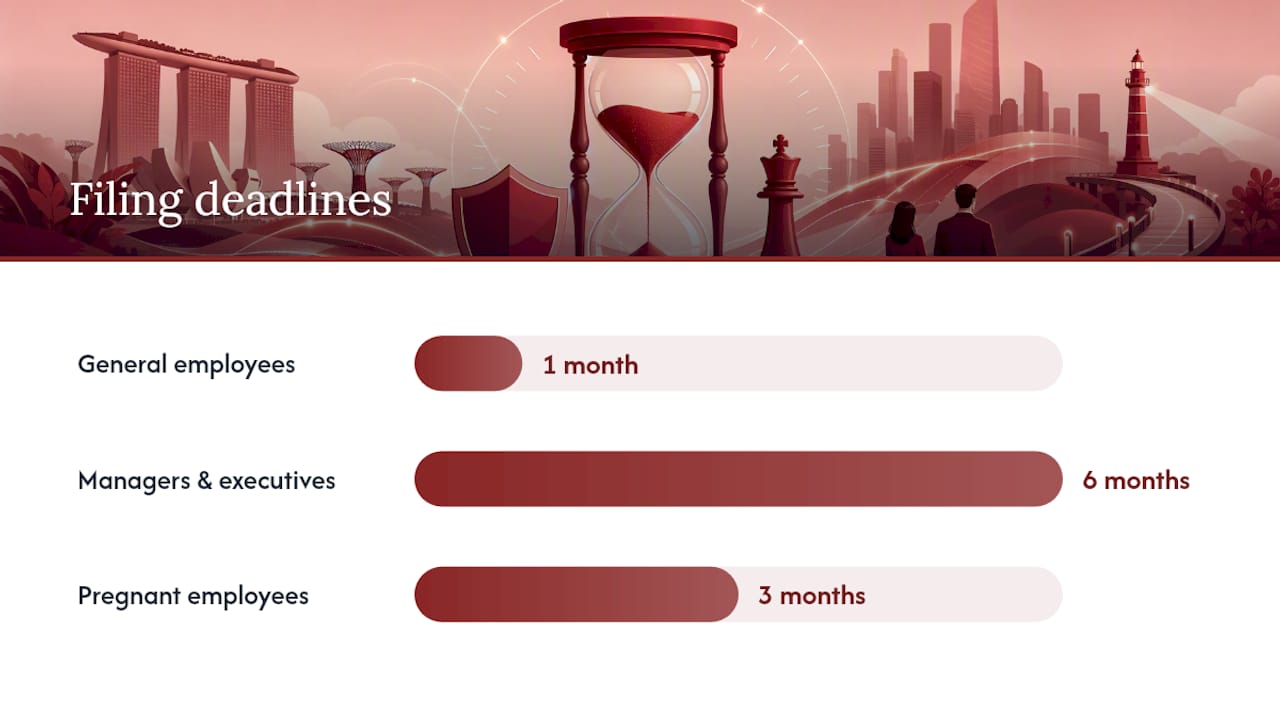
Filing timelines matter. Employees generally have one month from their last day of employment to file a wrongful dismissal claim. Managers and executives dismissed with notice need at least six months of service to qualify, while pregnant employees have a separate three-month qualifying window in certain circumstances. Employers should track these deadlines closely, since a claim filed just inside the window still obligates you to respond.
At mediation, TADM aims for a resolution both sides can live with, and a large share of disputes settle there without ever reaching a tribunal. Coming prepared with a clean evidence bundle, a written chronology, and the due inquiry record makes a settlement far more likely to land on reasonable terms for the employer.
If mediation fails, the case moves to the Employment Claims Tribunals for salary matters, or to the relevant tripartite panel for wrongful dismissal claims where the available remedies typically include reinstatement or monetary compensation. Which remedy applies depends heavily on how well the employer can show the dismissal decision was made for a legitimate reason and followed a fair process.
- Gather the employment contract, termination letter, and all related correspondence
- Compile the due inquiry record if misconduct was involved
- Prepare a written timeline connecting the business rationale to the decision date
- Have final pay calculations ready to show compliance regardless of the dispute's outcome
What Documentation Should HR Prepare for Every Termination?
Every termination file should contain three components regardless of the reason for exit: a due-inquiry record, a carefully worded termination letter, and a mediation-ready evidence bundle.
- Due-inquiry template. Structure it as notice of allegations, timeline and evidence list, the employee's written and oral responses, and a final findings memo with clear reasoning.
- Termination letter language. State the effective date, notice arrangement, and final pay details plainly. Avoid vague risk phrases like "not a good fit" or "loss of confidence" without supporting specifics, since these read as pretexts at mediation.
- Mediation bundle. Upload the contract, correspondence, inquiry records, and payroll calculations to TADM promptly once a claim is filed, since a disorganized submission slows the process and weakens your position.
Our employment team regularly assembles these bundles for Singapore-based and cross-border employers navigating exactly this kind of dispute.
Is There Severance Pay Beyond the Final Pay Package?
Severance pay in Singapore is not a universal statutory entitlement the way notice pay is. It typically applies in retrenchment situations, where the employment contract or a collective agreement specifies a retrenchment benefit, often expressed as a number of weeks or months of salary per year of service.
Employees terminated for misconduct or through a standard notice termination generally have no automatic right to severance beyond their final pay and any contractual notice obligation. Eligibility usually turns on tenure. Many company policies set a minimum service period, commonly around two to three years, before an employee qualifies for a retrenchment benefit at all.
Where no contractual retrenchment clause exists, tripartite guidance encourages employers to still consider an ex gratia payment as part of responsible retrenchment practice, particularly for long-serving staff. This is a recommendation rather than a legal requirement, but employers who ignore it entirely tend to face more resistance during TADM mediation if the retrenchment is later challenged. Reviewing your employment contracts and HR policy manual for any retrenchment or severance clause should be one of the first steps whenever a redundancy exercise is being planned, since the contractual language will determine your actual exposure long before any dispute reaches mediation.
How Does Termination Affect CPF Contributions and Taxes?
CPF obligations do not simply stop the moment you decide to terminate someone. Contributions remain payable on any salary earned up to the employee's last day of actual employment, including salary paid during a working notice period.
If notice is replaced with a lump sum payment in lieu of notice, that payment is generally treated differently from ordinary wages for CPF purposes, since the employee is no longer considered to be in service during that period. Employers should confirm the correct treatment for each payment category, since misclassifying a payment can lead to either underpaying CPF, which creates compliance exposure, or overpaying it unnecessarily.
On the tax side, employers must report the employee's final year of income accurately, including any salary in lieu of notice, unused leave payout, and any retrenchment or ex gratia payment, through the standard IRAS reporting channels. Retrenchment benefits paid as compensation for loss of employment are often treated favorably for tax purposes, but the exact treatment depends on how the payment is structured and documented in the termination letter. Getting the wording of the termination letter right, so it accurately reflects what each payment represents, matters as much for tax reporting as it does for any later mediation.
Can You Rehire a Former Employee or Enforce a Non-Compete?
Nothing in Singapore employment law prevents rehiring a former employee, and many employers do exactly that once a role reopens or business needs shift. The more common question HR teams face is what restrictions, if any, survive after the employment relationship ends.
Non-compete and non-solicitation clauses are enforceable in Singapore only to the extent they are reasonable, both in scope and duration, and genuinely necessary to protect a legitimate business interest such as confidential information or client relationships. A clause that bars an employee from working anywhere in a broad industry for several years is far less likely to hold up than one narrowly tied to a specific client list or a defined geographic area for a matter of months. Courts will strike down restrictions that go further than necessary to protect the employer's actual interest.
Employers who want restrictive covenants to actually work should draft them at the hiring stage, not scramble to add them during an exit negotiation, and should tailor the clause to the specific employee's role rather than using a single boilerplate version across the entire workforce. If a departing employee's role involved sensitive client relationships or proprietary systems, a properly scoped covenant is worth the drafting time. If it did not, an overly broad clause is more likely to create legal risk for the employer than genuine protection.
Do the Termination Rules Differ for Contract, Part-Time, and Foreign Workers?
The core framework under the Employment Act applies broadly, but a few distinctions matter depending on the employment type.
Fixed-term contract employees are generally entitled to the contract running its full course unless it includes an early termination clause. Ending a fixed-term contract early without such a clause can expose the employer to a claim for the remaining value of the contract, not just standard notice pay.
Part-time employees covered by the Employment Act receive the same statutory notice protections as full-time staff, calculated proportionately where relevant, and the same due inquiry standard applies before any summary dismissal.
Foreign employees on a work pass carry an added layer: employers must cancel the relevant work pass promptly after termination and settle any repatriation obligations where they apply, on top of the usual termination steps. Delays here can trigger separate compliance issues with the Ministry of Manpower beyond the employment dispute itself.
Across every category, the same underlying principle holds. Match the termination process to what the specific contract and pass conditions require, rather than applying a single generic template to every departing employee.
When Should You Bring In Employment Counsel for a Termination?
Not every termination needs a lawyer involved before the letter goes out. A straightforward resignation acceptance or an uncontested notice termination rarely does. But certain situations carry enough downside risk that getting counsel involved early is worth the cost many times over.
That includes senior executive exits where contractual notice periods and equity vesting intersect, any termination where misconduct allegations are contested, retrenchment exercises affecting multiple roles at once, and any case where the employee has already raised a discrimination or retaliation concern before the termination decision was made.

We offer access to experienced lawyers who handle termination matters as part of a broader cross-border employment practice rather than as an add-on service. This approach allows the team drafting your termination letter to also advise on CPF and tax treatment of payout, or step in if a dispute proceeds to TADM mediation.
Beyondhorizons employment lawyers advise on drafting defensible termination letters, structuring due inquiries, running responsible retrenchment exercises, and representing employers through TADM mediation and, where needed, the Employment Claims Tribunals. If you are facing a termination that carries real legal exposure, whether that is a contested misconduct case or a multi-role retrenchment, visit the Singapore employment law practice page to get counsel involved before the letter goes out, not after a claim lands.
What Three Mistakes Do Employers Keep Making?
Three errors show up again and again in termination disputes. The first is rushing the due inquiry, or skipping it entirely, because the misconduct seems obvious to management. It rarely seems that obvious to a mediator reviewing the file six weeks later.
The second is paying final pay late. A three-day delay past the statutory window turns a clean exit into a salary claim. The third is treating documentation as an afterthought rather than a running habit, which leaves employers reconstructing a chronology from memory once a claim is already filed.
The fix for all three is the same: build the paper trail as decisions happen, not after someone objects. Employers who engage counsel early, before the termination letter goes out rather than after TADM sends a mediation notice, consistently spend less time and money resolving disputes than those who wait.
— HL
This article is general information, not a substitute for advice from a qualified lawyer. Consult a qualified legal professional about your own circumstances before acting on anything here.