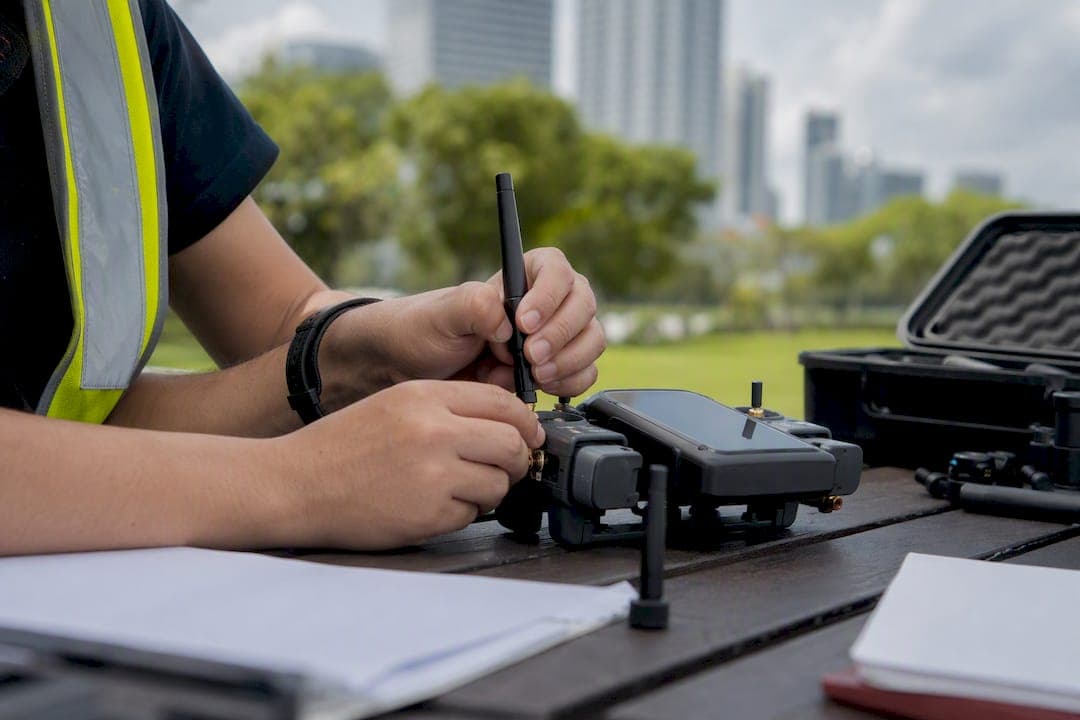
For commercial and BVLOS drone operations in Singapore, you need a CAAS Operator Permit, and if the mission goes beyond visual line of sight, a Class 1 Activity Permit on top of it. You will also need to meet Broadcast Remote Identification or CFMS FlyItSafe tracking obligations and, in many cases, put pilots through Unmanned Aircraft Pilot Licence assessments. CAAS enforces all of it with fines and, for serious breaches, imprisonment
TL;DR:
- Operators must prepare an operations manual, safety management system, and evidence of hardware compliance before applying for permits, with risk classification critical to approval speed.
- BVLOS approval requires extensive safety assessments, detect-and-avoid capabilities, redundancy, and reliability demonstrations, scaled according to risk tier.
- From February 14, 2025, all commercial drones over 250 grams must broadcast identification or follow CFMS tracking protocols, with violations punishable by fines and imprisonment.
- The permit application process involves multiple stages, with shorter approval times available within designated zones for low-risk flights below 400 feet AMSL.
- Building a comprehensive safety case, maintaining accurate records, and engaging early with legal and safety teams are essential to avoid delays and enforcement actions.
Table of Contents
- What Do Singapore's Drone Regulations Actually Require?
- Compliance Checklist: What Corporate Teams Must Prepare Before Applying
- Operator and Activity Permits: Stages, Timelines and Fees Explained
- How Does BVLOS Certification and Risk Categorization Work?
- Remote ID, CFMS and FlyItSafe: What Operators Must Do on Every Flight
- When Is a UAPL Required and How Do You Get One?
- Organizational Readiness and Safety Management: Structuring Documentation CAAS Will Sign Off
- Enforcement, Common Pitfalls and Practical Mitigation Steps
- What Does the Application Timeline Actually Look Like?
- HL's View: When to Brief the Board and When to Instruct External Counsel
- Beyond Horizons Services for Aviation, Robotics and Advanced Air Mobility
- Sources
What Do Singapore's Drone Regulations Actually Require?
The Civil Aviation Authority of Singapore, or CAAS, is the sole regulator for unmanned aircraft operations, and it treats commercial drone work as an aviation safety matter, not a hobby activity. That distinction shapes everything downstream. Singapore drone guidelines separate operators into two broad regimes: low-risk visual line of sight work that moves through a lighter permitting track, and higher-risk operations, including any beyond visual line of sight (BVLOS) flight, that require an Operator Permit before a Class 1 Activity Permit will even be considered.
The statutory backbone is the Air Navigation (101 — Unmanned Aircraft Operations) Regulations 2019, which defines permit exclusions, weight thresholds, and the offences that trigger enforcement. Corporate teams researching drone laws Singapore imposes on commercial fleets should treat this regulation as the primary legal text, not the summary pages that reference it.
Compliance Checklist: What Corporate Teams Must Prepare Before Applying
CAAS assesses organizational readiness before it looks at a single flight plan. Before filing anything, compliance and operations leads should confirm they can produce:
- An operations manual covering standard procedures, contingency handling, and crew responsibilities.
- A safety management system (SMS) with documented risk assessment and incident escalation paths.
- A continuing airworthiness plan, plus maintenance and telemetry data retention policies.
- Hardware proof: B-RID capability or a CFMS tracker, and design specifications showing redundancies and detect-and-avoid capability where required.
- Personnel records: UAPL or training certificates, plus named accountable persons and flight examiners.
- Administrative registrations on eSOMS/CAPELS, an active CFMS subscription, and a clear statement of proposed operating area, height, and risk category.
Pro Tip: Draft your proposed risk category before you contact CAAS, not after. Applicants who arrive without a defensible risk classification tend to trigger extra rounds of document requests that stretch timelines by weeks.
Operator and Activity Permits: Stages, Timelines and Fees Explained
CAAS runs Operator Permit applications through five stages: pre-application (where CAAS gauges organizational maturity), formal application, document evaluation, demonstration and validation, and finally certification. According to CAAS's own operator and activity permits guidance, this staged approach applies specifically to commercial and higher-risk operators, not casual users.
Once you hold an Operator Permit, the type of Activity Permit you need depends on the mission:
- Class 1 Activity Permits cover high-risk operations, including any BVLOS flight, and require the fuller evidentiary package.
- Class 2 Activity Permits apply to lower-risk visual line of sight work that still sits outside the exclusions in the Air Navigation Regulations.
Fees for the Operator Permit, Activity Permits, CFMS tracker hardware, and the ongoing CFMS subscription are published on the CAAS permits page, and permits carry fixed validity periods requiring renewal rather than one-time approval. One genuinely useful shortcut: CAAS has cut the approval window reduced to a few working days for qualifying operations up to 400 feet AMSL inside designated areas. That speed only applies within those scoped zones.
How Does BVLOS Certification and Risk Categorization Work?
BVLOS approval runs through the Operator Permit into a Class 1 Activity Permit, and CAAS scales its expectations to the risk tier: low, medium, or high. The evidentiary bar rises sharply as risk climbs.
At minimum, expect CAAS to want:
- A system safety assessment identifying failure modes and their consequences.
- Demonstrated detect-and-avoid capability and navigation integrity appropriate to the operating environment.
- Redundancy and failure-management proof for critical systems, particularly for medium and high-risk profiles.
- Reliability demonstrations, which become mandatory rather than optional once you move past low-risk classification.
Industry presentations to ICAO's Asia-Pacific region describe this as a case-by-case evaluation rather than a checkbox exercise, and CAAS itself frames high-risk operations that way: the streamlined pathways exist for lower-risk, scoped work only. Engage risk categorization guidance before you draft your operations manual. Retrofitting a safety case to match a risk tier CAAS disagrees with is the single most common cause of iterative delay in BVLOS applications.
Remote ID, CFMS and FlyItSafe: What Operators Must Do on Every Flight
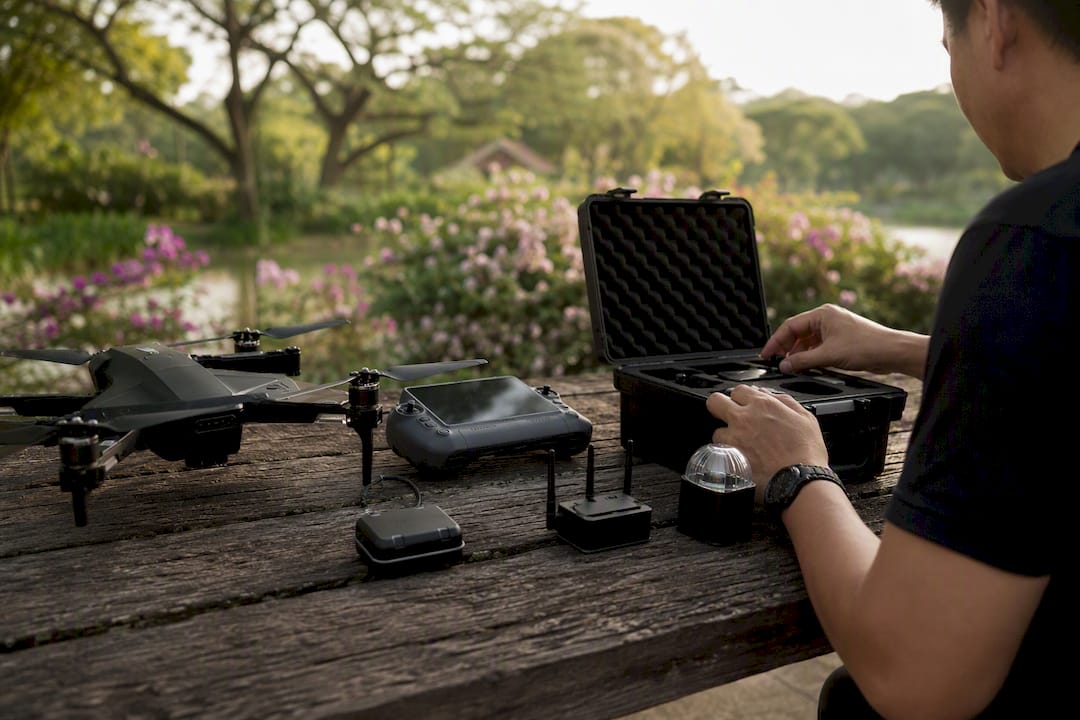
From February 14, 2025, any unmanned aircraft over 250 grams flying commercially must broadcast identification, position, height, speed, and take-off point and time under the Broadcast Remote Identification mandate, formally Aviation Specifications 10. Operator Permit holders who fly through the CFMS FlyItSafe app during approved operations are generally exempt from B-RID itself, but they still carry CFMS tracker obligations and must follow FlyItSafe's Call Approval process in designated zones.
On every commercial flight, that translates into four steps:
- Attach and power the CFMS tracker or confirm B-RID transmission before takeoff.
- Verify the broadcast signal is live and correctly registered against your Operator Permit.
- Log the flight through FlyItSafe, including Call Approval confirmation where the zone requires it.
- If B-RID or the tracker fails mid-flight, land as soon as safely possible and document the failure for your SMS records.
Fines for B-RID and tracking violations reach up to S$10,000 and/or six months' imprisonment, and CAAS treats false or misleading broadcast data as a distinct offence from simple non-compliance.
When Is a UAPL Required and How Do You Get One?
A UAPL is required for certain operations regardless of the aircraft's weight, which surprises operators who assume licensing scales purely with drone size. CAAS strongly encourages routing training through a CAAS-approved Unmanned Aircraft Training Organisation (UATO) rather than informal instruction.
The application path runs through several steps:
- Register on CAPELS and obtain a Personal Identification (PID) number.
- Book and pass the CAAS theory test.
- Complete a practical assessment through your approved UATO.
- View and manage your digital licence through SGFlight once issued.
Keep training records and practical assessment certificates on file. CAAS enforcement checks routinely ask for proof of UAPL status on the spot, and missing documentation carries its own fines separate from any operational breach.
Organizational Readiness and Safety Management: Structuring Documentation CAAS Will Sign Off
CAAS audits go well beyond whether your drone flies safely. Auditors probe continuing airworthiness records, crew competency evidence, and whether your safety management system actually functions day to day rather than existing as a filed document. Many BVLOS applications stall not on hardware, but on thin operational-control narratives that fail to show who decides what when something goes wrong mid-flight.
A governance structure that survives audit scrutiny typically includes:
- A named accountable executive with authority over safety decisions.
- Documented maintenance and airworthiness processes tied to actual flight logs.
- An incident response protocol with defined escalation timelines.
- Telemetry retention policies that match CFMS data obligations.
- A recurring internal audit cadence, not a one-time compliance sweep.
Pro Tip: Build your procurement contracts with compliance clauses baked in from the start. Hardware vendors and subcontractors who can't guarantee B-RID or telemetry standards become your liability the moment CAAS asks who was accountable. Beyond Horizons structures procurement guardrails into commercial agreements precisely to prevent this gap.
Enforcement, Common Pitfalls and Practical Mitigation Steps
Statutory penalties under the Air Navigation Regulations scale with the offence: operating without a required UAPL, breaching B-RID obligations, or failing to produce documents on request can each attract separate fines, with the more serious breaches carrying potential imprisonment alongside financial penalties.
The pitfalls that trip up otherwise capable operators tend to repeat:
- An SMS that exists on paper but has never been tested against a real incident scenario.
- Telemetry gaps where CFMS or B-RID data doesn't match flight logs.
- Reliability demonstrations for BVLOS that were rushed or scoped too narrowly for the actual risk category.
- Operational records that don't match what was submitted at the application stage.
Mitigate these with adequate insurance coverage, contractual indemnities with vendors and subcontractors, disciplined recordkeeping, and immediate remedial action whenever an internal or CAAS audit flags a gap.
What Does the Application Timeline Actually Look Like?
A realistic project plan for an Operator Permit plus Class 1 Activity Permit runs through distinct phases:
- Secure internal sign-off from legal, safety, procurement, and an executive sponsor before drafting anything.
- Assemble the document pack: operations manual, system safety assessment, UA design specifications, a compliance checklist, and a demonstration plan.
- Submit through the CAAS pre-application stage to confirm organizational readiness before formal filing.
- Budget three working days for designated-area, low-risk Activity Permit approvals, but plan for a longer, case-by-case timeline on medium or high-risk BVLOS work.
- Assign internal governance checkpoints: legal review, safety sign-off, and executive approval before each submission milestone.
HL's View: When to Brief the Board and When to Instruct External Counsel
Treat any BVLOS or advanced air mobility program as an enterprise regulatory project the moment it touches liability allocation, cross-border data flows, or third-party procurement, not just when a drone leaves visual range. The legal questions that surface most often in these projects are rarely about the aircraft itself: who owns liability when a CFMS tracker fails, how telemetry data gets governed across borders, and whether vendor contracts actually protect the operator when CAAS asks hard questions during an audit.
If your program involves BVLOS, cross-border data, or institutional investors, request a regulatory-readiness review before you file, not after CAAS pushes back.
— HL
Beyond Horizons Services for Aviation, Robotics and Advanced Air Mobility
Beyond Horizons is the practical alternative to assembling a patchwork of general counsel and ad hoc consultants for a drone regulatory program. Where most Singapore corporates piece together compliance advice from CAAS forums and generalist firms, Beyond Horizons puts lawyers trained at Magic Circle and US white shoe firms directly on aviation, robotics, and cross-border regulatory matters, work that has earned the team rankings in Chambers, Legal 500, and Asia Legal Business.

Clients ranging from US-listed companies to Singapore government-linked entities and regional banks rely on Beyond Horizons for exactly the kind of layered problem a BVLOS program creates: permit strategy, contract structuring with hardware and data vendors, and cross-border expansion counsel when operations extend past Singapore's borders. The firm's aviation law practice works alongside regulatory compliance counsel to build the operations manuals, safety cases, and procurement protections CAAS auditors expect to see.
If your team is preparing an Operator Permit or Class 1 Activity Permit application, request a regulatory readiness review before you file.
Sources
- Operator and activity permits | Civil Aviation Authority
- Air Navigation (101 — Unmanned Aircraft Operations) Regulations 2019 - Singapore Statutes