
Retrenchment payments in Singapore are not a legal entitlement unless your contract, collective agreement, or company policy says otherwise. The prevailing norm, backed by tripartite guidance, is to pay retrenchment benefits based on a period of salary per year of service for employees with eligible tenure. If you're an employee, ask your employer for an itemized breakdown before you sign anything. If you're the employer, check whether you must notify MOM within 5 working days.
TL;DR:
- Employees need to verify that retrenchment benefits are based on established formulas, typically one month of salary per year of service, unless there’s a contractual or collective agreement clause.
- Employers must notify the Ministry of Manpower within five working days if they have ten or more staff facing retrenchment, following proper documentation and fair process steps.
- Retrenchment benefits are generally not taxable, but payments for notice in lieu and similar sums are taxed employment income, requiring careful breakdown on payslips.
- Most disputes stem from vague contract language or missing documentation; having clear, itemized records of salary calculations and past practices grants stronger negotiation leverage.
- Consulting legal professionals before finalizing settlement terms and ensuring compliance with MOM and tax regulations helps prevent future disputes or non-compliance risks.
Table of Contents
- What Counts as Retrenchment in Singapore (and What Doesn't)
- Who Qualifies for Retrenchment Benefits, and When Ex-Gratia Applies
- Calculating Your Retrenchment Payment: Formulas and Worked Examples
- What Employers Must Do: Notice, MOM Notification, and Fair Process
- Tax and CPF Treatment: What's Actually Taxable
- Disputing a Retrenchment Package: Evidence and Deadlines
- Before You Sign: A Checklist for Employees and Employers
- Why Precise Contract Language Prevents Retrenchment Disputes
- The Real Gap in Most Retrenchment Advice
- Get Legal Clarity Before You Finalize a Retrenchment Package
- Sources
What Counts as Retrenchment in Singapore (and What Doesn't)
Retrenchment happens when a role disappears for business reasons, not because of anything the employee did. The Ministry of Manpower identifies genuine retrenchment through markers like company reorganization, redundancy of a job function, or a decision not to fill a vacancy after someone leaves. That distinction carries real weight, because retrenchment and dismissal for cause trigger completely different obligations and different levels of financial exposure for the employer.
A few examples make the line clearer:
- A finance team is merged after an acquisition and two analyst roles are eliminated. That's retrenchment.
- An employee is let go for repeated policy violations. That's dismissal for cause, and retrenchment benefits typically don't apply.
- A company relocates a factory overseas and the local production line closes. That's retrenchment, even if the company later hires for a different role.
Employers who mislabel a dismissal as retrenchment (or vice versa) to sidestep obligations often end up defending that choice at the Tripartite Alliance for Dispute Management.
Who Qualifies for Retrenchment Benefits, and When Ex-Gratia Applies
Tripartite guidance treats 2 years of service as the practical threshold. Employees who cross it are typically considered eligible for retrenchment benefits under prevailing norms; those under 2 years commonly receive an ex-gratia payment instead, which is a goodwill gesture rather than a right.
Three things actually create entitlement:
- A contractual clause. If your employment contract names a specific retrenchment benefit, that clause is enforceable regardless of tenure.
- A collective agreement. Unionized workplaces often lock in a fixed formula, commonly 1 month of salary per year of service.
- Company practice. If an employer has consistently paid retrenchment benefits to past staff at a certain rate, that pattern can become a legitimate expectation employees can point to during mediation, even without a written clause.
Documentation of how previous retrenchments were handled at your company is often the strongest card an employee holds.
Calculating Your Retrenchment Payment: Formulas and Worked Examples
The math itself is simple once you know which number to plug in. The commonly cited range is 2 weeks to 1 month of salary for every year of service, and unionized companies with a collective agreement frequently apply the full month.
Statistic to remember: for eligible employees, the standard calculation multiplies monthly (or biweekly) salary by completed years of service, then adjusts for partial years, usually on a pro-rated basis.
One detail trips up a lot of employees: use the salary earned before any recent pay cut rather than a reduced figure, as tripartite guidance advises against employers reducing retrenchment payouts through recent salary cuts.
Here's how the two common formulas play out for real tenures:
- 3 years of service, $5,000 monthly salary. At 2 weeks per year: $5,000 ÷ 2 × 3 = $7,500. At 1 month per year: $5,000 × 3 = $15,000.
- 7 years of service, $6,500 monthly salary. At 2 weeks per year: $6,500 ÷ 2 × 7 = $22,750. At 1 month per year: $6,500 × 7 = $45,500.
Most companies round to the nearest full month or apply a cap stated in the employment contract, so check whether your offer letter or collective agreement mentions a ceiling before assuming the higher figure applies.
What Employers Must Do: Notice, MOM Notification, and Fair Process
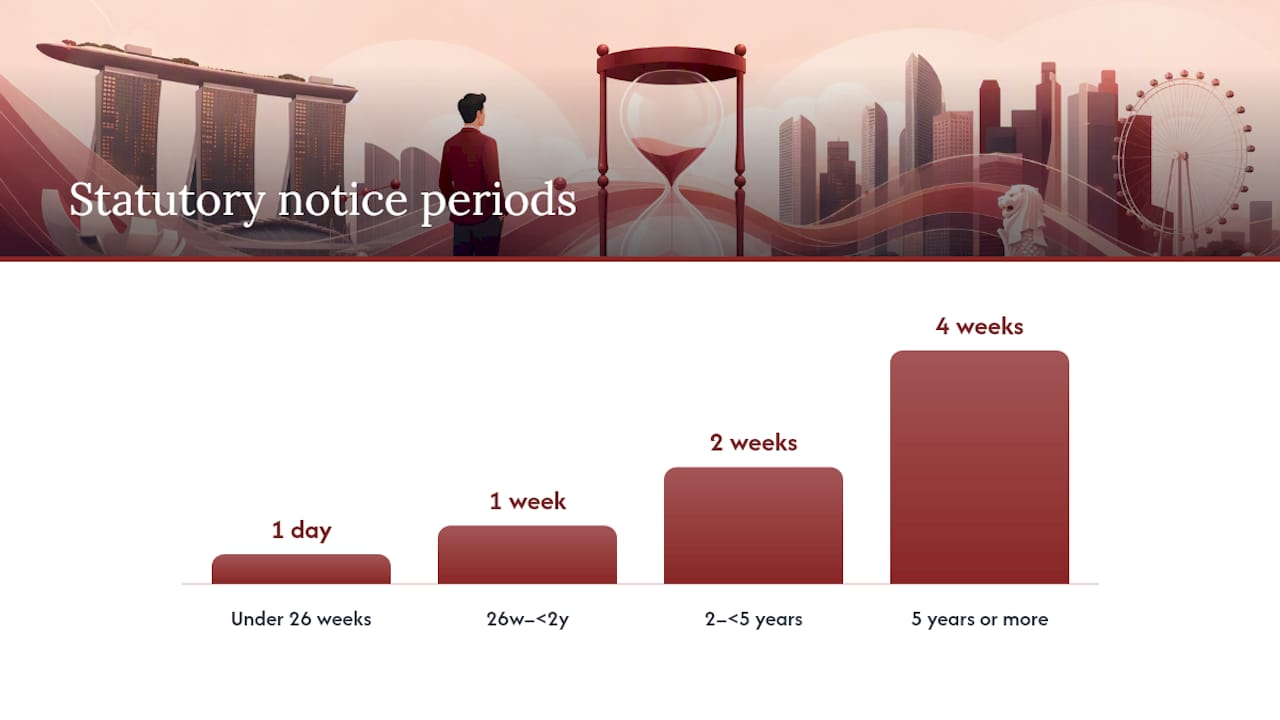
Notice periods follow the Employment Act unless the contract specifies something longer: 1 day for under 26 weeks of service, 1 week for 26 weeks to under 2 years, 2 weeks for 2 to under 5 years, and 4 weeks for 5 years or more.
Employers with 10 or more employees carry an additional duty: they must notify MOM within 5 working days of informing the affected employee. Skipping this step is a compliance breach, not a paperwork formality.
Beyond the statutory minimum, responsible practice includes:
- Applying consistent, documented selection criteria rather than ad hoc decisions.
- Consulting unions or staff representatives before finalizing the list.
- Offering outplacement support through programs like those run by Workforce Singapore.
- Keeping records of every consultation step in case of a later dispute.
Pro Tip: Pay in lieu of notice attracts CPF contributions because it's treated as employment income, while the retrenchment benefit itself generally does not. Keep those two line items separate on the payslip, not bundled into one number.
Tax and CPF Treatment: What's Actually Taxable
IRAS draws a clean line: compensation for loss of office is generally not taxable because it's treated as capital in nature. Payments tied to past service, including notice in lieu, ex-gratia sums framed as a service reward, gratuity, and leave encashment, count as taxable employment income.
Key figure: taxable components are taxed in the year the employee becomes legally entitled to them, not the year the check clears, which matters if your termination date falls near the end of a calendar year.
CPF contributions follow the same logic: they apply to taxable employment income but not to a genuine retrenchment benefit. That's exactly why mislabeling matters so much.
- Ask your employer for a line-by-line breakdown, not a single lump figure.
- Confirm which portion falls under Auto-Inclusion Scheme reporting and when it hits your tax filing.
- Flag any payment described vaguely as "retrenchment benefit" that actually compensates for notice or leave; relabeling a taxable payment to dodge CPF is a compliance risk employers should avoid, not a convenient shortcut.
Disputing a Retrenchment Package: Evidence and Deadlines
Some retrenchments don't hold up to scrutiny. Watch for warning signs and move quickly if you spot them.
- Check for red flags. A role re-advertised weeks after you're let go, or selection criteria that shifted after the fact, both suggest the retrenchment label may not be genuine.
- Preserve evidence immediately. Save your contract, recent payslips, the termination letter, and any emails or messages referencing the decision, before access to company systems is cut off.
- Approach TADM. The Tripartite Alliance for Dispute Management handles mediation for employment claims, and there are statutory time windows for filing, so don't sit on it.
- Use union support if available. NTUC assists members with both mediation and job placement after a dispute.
- Bring in a lawyer for complex cases. If cross-border employment terms, equity compensation, or a non-compete clause are involved, ask specifically whether the settlement wording is enforceable and whether it waives claims you didn't intend to give up.
Before You Sign: A Checklist for Employees and Employers
Get this right before ink hits paper, because a full-and-final settlement is difficult to reopen later.
If you're the employee, verify your exact years of service, confirm which salary figure was used (pre-cut, if relevant), and make sure notice pay is shown separately from the retrenchment benefit itself. Read any waiver clause carefully. Some settlements quietly attach new restrictions, like an expanded non-compete, in exchange for the payout.
If you're the employer, prepare an itemized payout schedule, file the MOM notification if you have 10 or more staff, and keep a written record of your selection criteria and consultation steps.
- Contract and any collective agreement
- Recent payslips and salary history
- Records of prior retrenchment payouts at the company
- All written communications about the decision
Pro Tip: Both sides benefit from the same document: a clear, itemized breakdown separating taxable pay from the non-taxable retrenchment benefit. It resolves more disputes before they start than any negotiation tactic.
Why Precise Contract Language Prevents Retrenchment Disputes
Most retrenchment disputes trace back to vague drafting, not bad faith. A contract that names a specific formula, or a settlement letter that itemizes every component, closes off the ambiguity that fuels TADM claims months later.
Employers running mass layoffs, managing staff across multiple jurisdictions, or structuring complex benefit packages benefit from legal review before notices go out, not after a dispute lands. Employees facing a settlement with unfamiliar clauses, particularly non-compete language or equity clawbacks, should ask a lawyer whether the breakdown matches statutory and IRAS treatment, and whether any waiver language extends further than they realize.
The Real Gap in Most Retrenchment Advice
Most guidance on this topic treats the "2 weeks to 1 month per year" figure as the whole story. It isn't. That range is a norm, not a rule, and treating it as a ceiling or a floor misses what actually drives outcomes: documentation. The employee who saved old payslips showing a salary before a pay cut, or who can point to how the company handled the last round of layoffs, walks into a negotiation with far more leverage than the exact tenure math suggests.
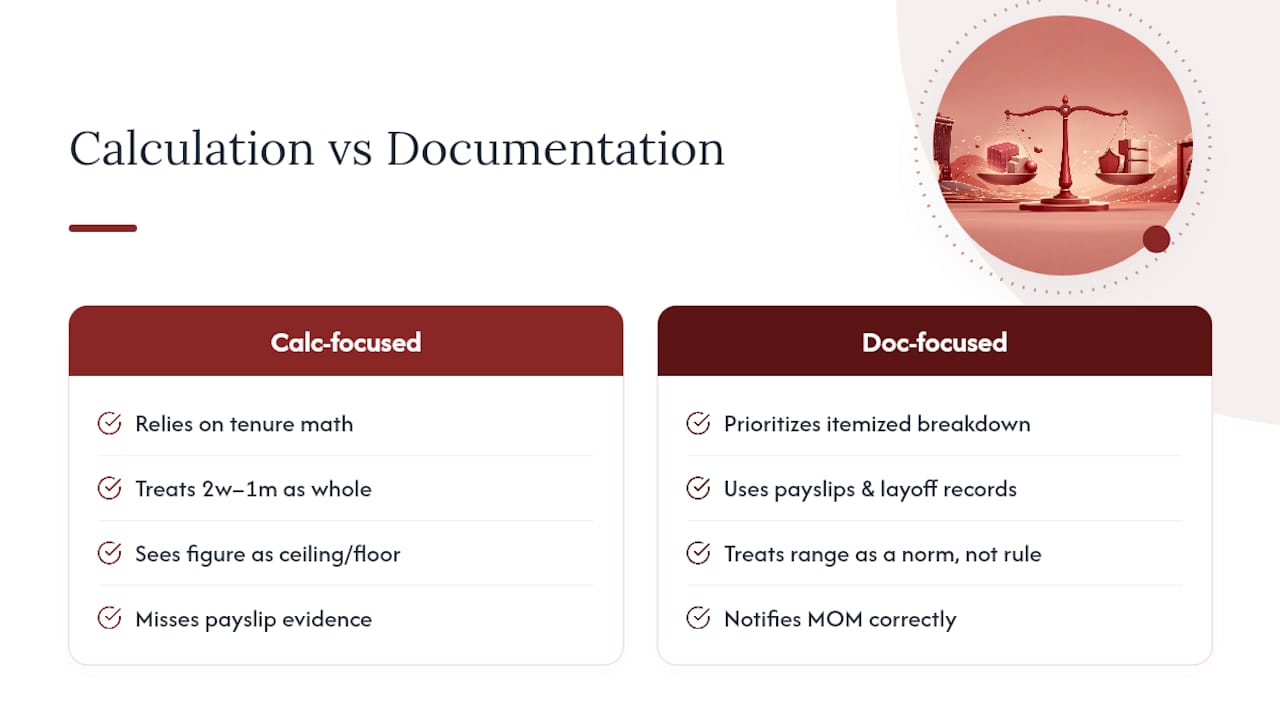
Where conventional advice falls short is in treating retrenchment as a calculation problem. It's really a documentation problem with a calculation attached. Employers who skip the MOM notification, apply selection criteria inconsistently, or bundle taxable notice pay into a single "retrenchment benefit" line aren't just risking a dispute. They're creating the exact paper trail that makes a TADM claim easier to win.
If you take one thing from this guide, prioritize the itemized breakdown before anything else. Everything else, the tenure math, the tax treatment, the negotiation, flows cleanly once that breakdown exists in writing.
— HL
Get Legal Clarity Before You Finalize a Retrenchment Package
Working through a retrenchment exercise without a lawyer reviewing the numbers is like signing a lease without reading the renewal clause. This firm gives Singapore employers and employees a direct line to lawyers experienced in cross-border staffing structures, enabling itemized breakdowns, MOM notifications, and settlement wording that hold up if questioned later.

The firm handles contract drafting, MOM compliance checks, and settlement structuring for companies running retrenchment exercises, along with representation if a case reaches TADM. Their lawyers bring experienced backgrounds to matters that involve multiple jurisdictions or complex benefit structures, exactly the cases where a generic template falls apart. Whether you're an employer restructuring a team or an employee reviewing a settlement letter, request a consultation with our employment law team before you sign anything.
This article is general information, not a substitute for advice from a qualified lawyer. Consult a qualified legal professional about your own circumstances before acting on anything here.
Sources
- Responsible retrenchment — Ministry of Manpower (MOM)
- IRAS — Retrenchment benefits (tax treatment)
- Employment Act 1968 — Notice period provisions (Singapore Statutes Online)
- Transcript: Tripartite advisory notes (Telescope) — retrenchment norms