
An outsourcing partnership is defined as a collaborative, strategic relationship between a business and an external service provider designed to drive innovation, agility, and competitive advantage beyond a traditional vendor role. The industry term for this model is “strategic outsourcing,” and it has moved well past its origins in cost arbitrage. 86% of organizations using strategic outsourcing models achieve shorter time to market. That figure signals a fundamental shift: the best business outsourcing solutions today are built on shared goals, not just shared savings. For APAC leaders operating across complex, multi-jurisdiction markets, getting this model right is one of the highest-leverage decisions available.
What makes an outsourcing partnership succeed?
The difference between a vendor relationship and a true outsourcing partnership comes down to governance, ownership, and shared context. Vendors complete tasks. Partners carry accountability for outcomes. That distinction shapes every structural decision you make.
Four components separate high-performing partnerships from underperforming ones:
-
Joint governance with shared accountability. Experience Level Agreements (XLAs) are replacing traditional Service Level Agreements (SLAs) because XLAs measure business outcomes, not just task completion. A partner meeting 99% uptime SLAs while delivering zero business value is a governance failure, not a success.
-
Onshore delivery liaison. Physical proximity and a strong onshore delivery lead bridge the gap from vendor to partner by enabling proactive collaboration. Without this role, communication defaults to reactive ticket management.
-
Shared business context. Partners need access to your brand values, customer data, and strategic priorities. Shared context converts an outsourced team from a cost center into a capability asset.
-
Cultural alignment. In APAC, where business relationships carry significant weight across markets like Japan, Indonesia, and Vietnam, cultural fit is not a soft consideration. It directly affects trust and delivery quality.
Pro Tip: Before signing any outsourcing agreement, map the governance structure on paper. If you cannot name who owns each outcome, the partnership will default to a vendor dynamic within six months.
The governance gap is the most common failure point. Rigid SLA frameworks lock both parties into metrics that stop reflecting business reality as conditions change. Joint strategic reviews, held at least quarterly, prevent this drift.
How have outsourcing partnerships evolved in 2026?
The market has shifted decisively from tactical cost arbitrage to capability building. 80% of companies now struggle to source specialized digital talent internally. That shortage is the primary engine driving APAC businesses toward external partnerships, not cost reduction.
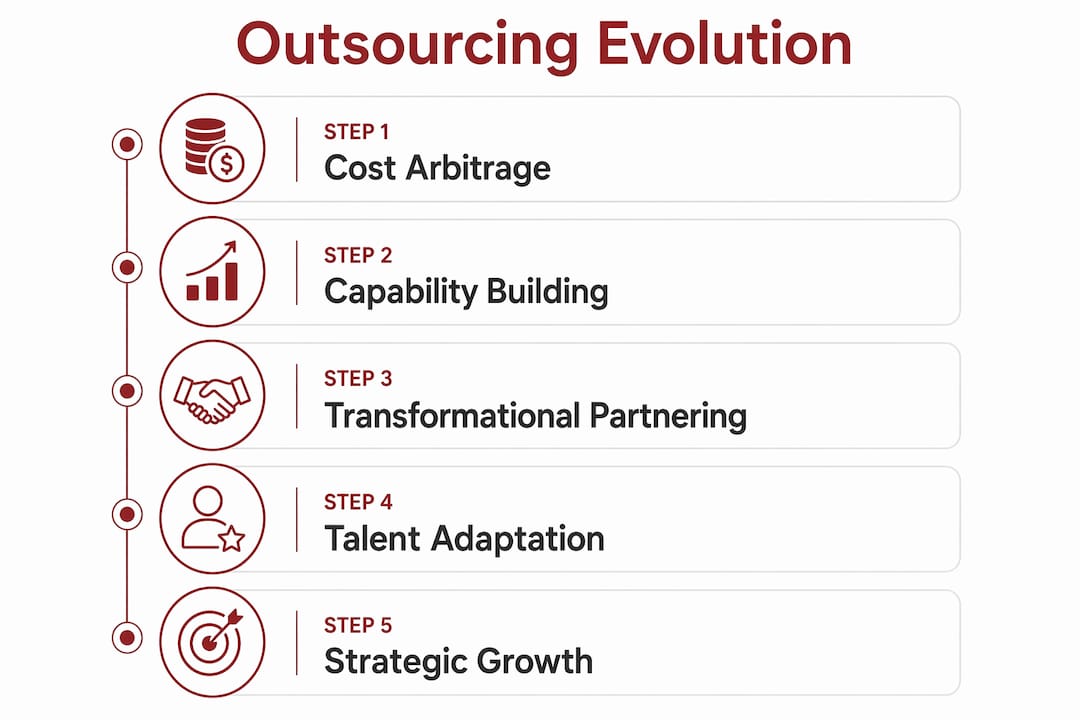
| Model | Primary driver | Success metric | Governance tool |
|---|---|---|---|
| Traditional outsourcing | Cost reduction | SLA compliance | Vendor contract |
| Strategic outsourcing | Capability access | Business outcomes | XLA + joint governance |
| Transformational partnership | Innovation and agility | Revenue from innovation | Shared OKRs |
The insurance sector illustrates this shift clearly. 83% of insurance firms maintained steady outsourcing through recent market volatility, and 64% plan to increase their outsourcing activity with a focus on capability building rather than cost reduction. That is not a sector-specific trend. It reflects a broader recognition that specialized expertise cannot be built fast enough internally to keep pace with digital transformation.
“Strategic partnerships move beyond transactional outsourcing to insource innovation and scalability, aligning with digital business goals. The organizations that treat their outsourcing relationships as extensions of their own teams consistently outperform those that treat them as interchangeable suppliers.”
The rise of transformational partnerships also reflects a talent reality specific to APAC. Markets like Singapore, Australia, and India face acute shortages in areas like AI engineering, data privacy compliance, and advanced manufacturing. Accessing those skills through a well-structured global outsourcing relationship is faster and more cost-effective than building internal teams from scratch.
How should APAC leaders build effective outsourcing partnerships?
Building a high-value outsourcing collaboration model requires deliberate sequencing. Rushing to sign a contract before defining objectives is the single most common mistake APAC leaders make.
-
Define your objective with precision. Leaders must clearly define whether they are pursuing cost reduction, capability access, or innovation acceleration. Each objective requires a different partner profile, contract structure, and governance model. Conflating them produces a partnership that serves none of them well.
-
Select partners on strategic fit, not price. Evaluate a potential partner’s track record in your industry, their familiarity with APAC regulatory environments, and their ability to embed within your team culture. Price is a constraint, not a selection criterion.
-
Establish XLAs and joint governance from day one. Joint governance structures and XLAs create the conditions for agility and continuous improvement. Build them into the contract before work begins, not as an afterthought when SLAs start failing.
-
Embed an onshore delivery lead. Onshore delivery leads act as primary drivers of trust and ownership, enabling outsourced teams to become proactive problem solvers embedded in your business flows. In APAC markets, this role is particularly critical given time zone complexity and language diversity.
-
Run continuous relationship management. Schedule quarterly strategic reviews. Measure outcomes against shared objectives, not just contracted deliverables. Adjust scope, metrics, and governance as your business priorities shift.
Pro Tip: Treat the first 90 days of any new outsourcing relationship as a trust-building phase, not a delivery phase. Use that window to share brand context, introduce internal stakeholders, and align on communication rhythms before holding the partner accountable for output targets.
The global employment and contractual dimensions of these partnerships deserve equal attention. Cross-border outsourcing arrangements in APAC involve employment law, data transfer regulations, and IP ownership questions that vary significantly by jurisdiction. Getting legal structure right at the start prevents costly disputes later.

How do outsourcing partnerships drive innovation and competitive advantage?
The business case for strategic outsourcing partnerships extends well beyond cost. 75% of organizations generate most of their sales from innovations enabled by outsourcing partnerships. That is not a marginal benefit. It means external partners are contributing directly to top-line growth.
The mechanisms behind this are concrete:
-
Faster time to market. Partner teams that understand your business context can prototype, test, and deploy faster than internal teams constrained by organizational bureaucracy.
-
Operational efficiency through specialization. A partner focused exclusively on, say, AI-driven customer analytics brings depth that a generalist internal team cannot match.
-
Continuous improvement culture. Long-term outsourcing partnerships yield faster innovation, improved customer outcomes, and lower total cost of ownership through stable, aligned collaboration. The compounding effect of a partner who knows your business deeply is significant.
-
Brand extension. When outsourced teams are given access to internal data, brand guidelines, and customer insights, they function as an extension of your organization. Shared context via brand immersion converts outsourced resources into strategic extensions that unlock long-term innovation value.
Statistic callout: 75% of organizations generate most of their sales from innovations enabled by outsourcing partnerships. This figure reframes outsourcing from a cost decision to a growth strategy.
The APAC context adds another dimension. Regional markets reward speed and adaptability. A well-structured outsourcing collaboration model gives APAC businesses the ability to scale capabilities quickly across markets without the overhead of building permanent local teams in every jurisdiction. That agility is a genuine competitive advantage in a region where market conditions shift faster than most internal planning cycles.
Key takeaways
Effective outsourcing partnerships require clear objectives, joint governance through XLAs, onshore delivery leadership, and shared business context to move beyond vendor relationships and drive measurable innovation.
| Point | Details |
|---|---|
| Define objectives first | Identify whether you need cost reduction, capability access, or innovation before selecting a partner. |
| Replace SLAs with XLAs | Experience Level Agreements measure business outcomes, not just task completion, and produce better results. |
| Embed an onshore liaison | A local delivery lead builds trust, improves communication, and converts vendors into true partners. |
| Share brand context | Giving partners access to internal data and brand values turns them into strategic extensions of your team. |
| Review governance quarterly | Joint strategic reviews prevent governance gaps and keep partnership objectives aligned with business reality. |
What we have learned about outsourcing in APAC
The most persistent mistake we see APAC leaders make is treating outsourcing as a procurement decision rather than a relationship decision. They spend months negotiating price and SLA terms, then hand off a contract and expect results. Six months later, they are frustrated that the partner “doesn’t understand the business.” The partner doesn’t understand the business because no one invested in making that happen.
The onshore delivery liaison role is the single highest-return investment in any outsourcing arrangement. I have seen partnerships that looked structurally identical produce completely different outcomes based solely on whether there was a strong, empowered onshore lead. That person carries context in both directions. They translate business priorities to the delivery team and surface delivery realities to leadership before they become problems.
The governance gap is equally underestimated. Rigidity in governance leads to partnerships that stop evolving when the business does. The fix is not more detailed contracts. It is scheduled, structured conversations where both parties review whether the current arrangement still serves the original objective. Most leaders skip these reviews when things are going well. That is exactly when they matter most.
The APAC market also demands cultural fluency that most outsourcing frameworks ignore. A governance model that works in Singapore will not automatically translate to Vietnam or the Philippines. Leaders who build cultural alignment into their partnership design from the start consistently outperform those who treat it as a secondary concern.
IP and data privacy protections deserve the same attention as governance structure. In cross-border arrangements across APAC, data residency rules, IP ownership, and confidentiality obligations vary by jurisdiction. Getting these right at the contract stage is far less expensive than resolving disputes after delivery has begun.
— HL
Beyondhorizons and your outsourcing partnership strategy
Beyondhorizons works with business leaders across APAC who are building or restructuring outsourcing arrangements that cross borders, involve complex regulatory environments, or require precise contractual frameworks. The firm’s lawyers, ranked on Chambers, Legal 500, and Asia Legal Business, bring experience from Magic Circle and US white shoe firms to the commercial realities of APAC markets.

Whether you are structuring a first outsourcing agreement or renegotiating an arrangement that has outgrown its original design, Beyondhorizons provides cross-border corporate counsel that aligns legal structure with business strategy. The firm’s global collaboration expertise covers the full range of outsourcing partnership considerations, from governance design to IP protection to employment law across APAC jurisdictions.
FAQ
What is an outsourcing partnership?
An outsourcing partnership is a strategic, collaborative relationship between a business and an external provider focused on shared outcomes, innovation, and capability building rather than simple task delegation. It differs from traditional vendor arrangements through joint governance, shared accountability, and long-term alignment.
How do XLAs differ from SLAs in outsourcing?
Service Level Agreements measure task completion and uptime, while Experience Level Agreements measure business outcomes and value delivery. XLAs are increasingly used in transformational outsourcing partnerships because they align partner incentives with actual business results.
What are the biggest risks of outsourcing partnerships?
The primary risks are governance gaps, lack of shared business context, and cultural misalignment. Leaders who treat outsourcing as a “set-and-forget” arrangement consistently underperform those who invest in continuous relationship management and shared context.
How should APAC leaders choose an outsourcing partner?
Leaders should evaluate partners on strategic fit, APAC regulatory familiarity, cultural alignment, and industry track record. Price is a constraint to manage, not the primary selection criterion, particularly when the objective is capability access or innovation acceleration.
How do outsourcing partnerships drive innovation?
75% of organizations generate most of their sales from innovations enabled by outsourcing partnerships. Partners with deep specialization and access to internal brand context contribute directly to product development, customer outcomes, and time-to-market improvements.