
The strongest alternatives to Magic Circle law firms in 2026 are Ali Legal, Farringford Legal, Asenda Law, and CANDEY. Each offers a distinct value proposition that the traditional Magic Circle model, built around A&O Shearman, Clifford Chance, Freshfields Bruckhaus Deringer, Linklaters, and Slaughter and May, simply cannot match for every client or career path. Here is a quick orientation before the deeper profiles:
- Ali Legal: A tech-forward boutique known for cross-border commercial work, transparent pricing, and a lean team of senior lawyers drawn from elite firms.
- Farringford Legal: Positions itself as a high-quality alternative for corporate and finance clients who want Magic Circle caliber advice without the institutional overhead.
- Asenda Law: Focuses on mid-market and growth-stage companies, offering flexible fee structures and direct partner access that larger firms rarely provide.
- CANDEY: A litigation and dispute resolution specialist with a reputation for taking on complex, high-stakes cases that require creative legal thinking rather than assembly-line process.
The Magic Circle firms are genuinely elite, and no one should pretend otherwise. But "elite" does not always mean "right fit." For clients who want senior attention, faster turnaround, and pricing that reflects actual work done rather than brand premium, these four alternatives deserve serious consideration.
Table of Contents
- What are the best Magic Circle law firm alternatives?
- How do these alternatives compare side by side?
- How do you choose the right alternative firm for your needs?
- How is AI reshaping the alternatives to traditional law firms?
- Key Takeaways
- The future of legal careers does not run through the Magic Circle alone
- Beyondhorizons brings Magic Circle pedigree to cross-border work
What are the best Magic Circle law firm alternatives?
The four firms profiled here represent different corners of the alternative market. Understanding what each one actually does, and for whom, is the most useful starting point for any comparison.
Ali Legal
Ali Legal operates as a technology-enabled boutique with a deliberate focus on cross-border commercial transactions. The firm's senior lawyers carry credentials from Magic Circle and top-tier US firms, which means clients get the analytical rigor of Big Law without the billing structure that comes with it. Pricing is typically fixed-fee or capped, which removes the uncertainty that hourly billing creates for clients managing tight deal budgets.
Core features:
- Cross-border corporate and commercial advisory
- Technology-integrated workflows that reduce turnaround time
- Senior-led teams with no delegation to junior associates on substantive work
- Transparent, fixed-fee pricing on most matters
Pros: Direct access to experienced lawyers; pricing predictability; faster response times than large institutional firms.
Cons: Smaller bench depth than a full-service Magic Circle firm; may not suit the largest, most complex multi-jurisdictional transactions requiring dozens of lawyers simultaneously.

Who it's for: Growth-stage companies, founder-led businesses, and mid-market corporates that need sophisticated legal advice without paying for institutional overhead.
Pricing: Fixed-fee and capped-fee arrangements; specific rates are not publicly listed.
Farringford Legal
Farringford Legal targets corporate and finance clients who have worked with Magic Circle firms and found the experience impersonal or the cost disproportionate to the complexity of their matter. The firm's pitch is straightforward: Magic Circle quality of legal reasoning, delivered by a smaller team that actually knows your business. Its lawyers bring backgrounds from leading UK and international firms, and the firm handles M&A, finance, and commercial contracts across multiple jurisdictions.
Core features:
- M&A, structured finance, and commercial contracts
- Relationship-led model with consistent lawyer assignment
- Multi-jurisdictional capability without a sprawling global office network
- Flexible engagement structures including project-based and retainer arrangements
Pros: High-quality drafting and negotiation; genuine partner involvement throughout; more agile than large institutional firms on mid-sized deals.
Cons: Limited brand recognition outside the UK; may face credibility questions from counterparties unfamiliar with the firm on very large transactions.
Who it's for: Private equity sponsors, family offices, and mid-market corporates running cross-border transactions in the £5 million to £100 million range.
Pricing: Project-based and retainer arrangements; specific rates are not publicly listed.
Asenda Law
Asenda Law occupies the space between boutique and mid-market firm, with a particular strength in serving growth companies and entrepreneurs who need legal counsel that scales with them. The firm emphasizes direct partner access from day one, which is a meaningful differentiator for founders who have experienced the trainee-heavy service model at larger firms. Practice areas span corporate, employment, and commercial law, with a growing technology sector focus.
Core features:
- Corporate, employment, and commercial law for growth companies
- Partner-led service model across all matter types
- Technology sector focus with familiarity in SaaS, fintech, and digital businesses
- Flexible billing including fixed fees and monthly advisory arrangements
Pros: Consistent senior attention; commercial mindset aligned with entrepreneurial clients; competitive pricing relative to Magic Circle and Silver Circle firms.
Cons: Less depth in highly specialized areas like structured finance or complex regulatory work; smaller international footprint.
Who it's for: Startups, scale-ups, and founder-led businesses that need a trusted legal partner rather than a transactional service provider.
Pricing: Fixed fees and monthly advisory arrangements; specific rates are not publicly listed.
CANDEY
CANDEY stands apart from the other three because its core strength is litigation and dispute resolution rather than transactional work. The firm has built a reputation for taking on high-value, complex disputes where creative legal strategy matters more than institutional scale. Its lawyers have handled cases involving fraud, commercial contract disputes, and international arbitration, often against opponents represented by Magic Circle firms. That track record carries weight.
Core features:
- High-value commercial litigation and international arbitration
- Fraud and asset recovery work
- Willingness to take on cases with unconventional fee structures, including conditional fee arrangements
- Lean, senior-led team focused on case strategy rather than process management
Pros: Deep litigation expertise; creative fee structures including conditional arrangements; genuine appetite for complex, contested matters.
Cons: Narrower practice scope than full-service firms; transactional clients will need to look elsewhere for M&A or finance work.

Who it's for: Businesses and individuals facing high-stakes disputes who want a specialist litigator rather than a generalist firm that also does litigation.
Pricing: Hourly, fixed-fee, and conditional fee arrangements depending on matter type; specific rates are not publicly listed.
The Silver Circle firms such as Macfarlanes, Ashurst, and Travers Smith also represent a credible tier below the Magic Circle, offering higher revenue per lawyer and broader practice areas than their larger counterparts. For clients and lawyers who want institutional scale with slightly better work-life balance, Silver Circle firms remain a strong option. The four boutique alternatives above, however, serve a different need: clients who want senior attention, pricing transparency, and a firm that treats their matter as a priority rather than one of hundreds.
How do these alternatives compare side by side?
The comparison below focuses on the criteria that actually drive decisions: what the firm does best, who it serves, and what you give up by choosing it over a Magic Circle firm.
| Firm | Core features | Key differentiator | Pros | Cons | Who it's for | Pricing |
|---|---|---|---|---|---|---|
| Ali Legal | Cross-border commercial, tech-enabled workflows | Fixed-fee model with senior-only teams | Pricing certainty; fast turnaround | Limited bench for very large deals | Mid-market corporates, founders | Fixed/capped fees; rates not publicly listed |
| Farringford Legal | M&A, finance, commercial contracts | Relationship-led; consistent lawyer assignment | Partner involvement throughout | Lower brand recognition on large deals | PE sponsors, family offices, mid-market | Project and retainer; rates not publicly listed |
| Asenda Law | Corporate, employment, commercial for growth companies | Partner access from day one | Commercial mindset; competitive pricing | Less depth in specialized finance/regulatory | Startups, scale-ups, founders | Fixed fees, monthly advisory; rates not publicly listed |
| CANDEY | Commercial litigation, arbitration, fraud | Conditional fee arrangements; specialist litigators | Creative fee structures; complex dispute appetite | Narrow scope; no transactional practice | Businesses in high-stakes disputes | Hourly, fixed, conditional; rates not publicly listed |
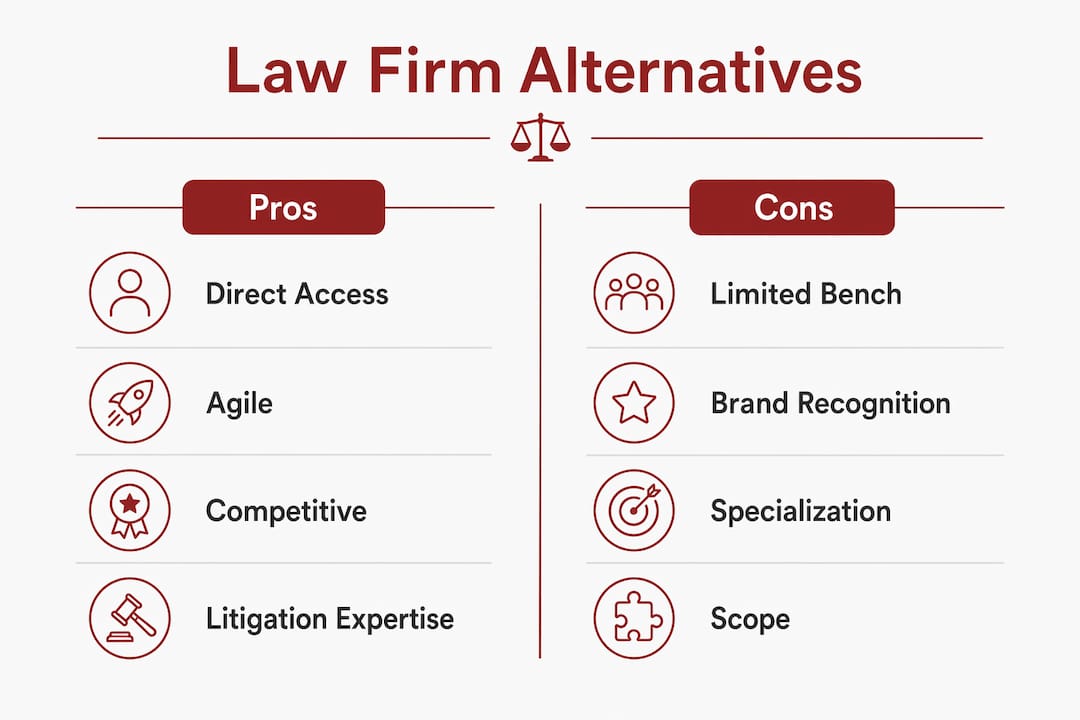
A few patterns emerge from this comparison. Ali Legal and Farringford Legal both target transactional work, but Ali Legal leans harder into technology and pricing transparency while Farringford emphasizes relationship continuity. Asenda Law is the clearest choice for growth-stage companies that need a legal partner rather than a deal-by-deal vendor. CANDEY is in a category of its own for dispute work.
The Legal 500 notes that Magic Circle firms offer thorough training, international exposure, and access to major clients, but also long hours and less direct client contact than smaller firms. That trade-off is exactly what these four alternatives are designed to address, each in its own way.
For a broader view of alternative legal service providers across different practice areas, the comparison of legal agency alternatives offers additional context on how the market is segmenting.
How do you choose the right alternative firm for your needs?
Choosing among these alternatives requires more than reading a comparison table. The right firm depends on the nature of your matter, your budget structure, and what you actually value in a legal relationship.
Key considerations when evaluating alternatives:
- Practice area fit: CANDEY is the only choice for serious litigation. For transactional work, Ali Legal, Farringford Legal, and Asenda Law each cover different segments of the market. Match the firm's core strength to your specific legal need before anything else.
- Geographic presence: If your matter involves US counterparties or US-governed contracts, confirm the firm has genuine US law capability or strong US-qualified counsel, not just a relationship with a US correspondent firm.
- Fee structure: Fixed fees and capped arrangements protect clients on matters with defined scope. Hourly billing still makes sense for open-ended advisory work. Ask each firm how they price matters similar to yours before engaging.
- Team stability: On a multi-month transaction, the lawyer you meet at pitch should be the lawyer doing your work. Ask directly who will handle day-to-day matters and whether that person will remain on the file throughout.
- Technology adoption: Firms that use AI-assisted drafting, contract review tools, and matter management platforms can deliver faster, more consistent work. This is no longer a differentiator reserved for tech-native firms. Ask what tools the firm uses and how they affect pricing.
- Reputation and rankings: Chambers and Legal 500 rankings remain the most reliable independent signals of quality for UK and cross-border firms. A firm without any ranked lawyers is not automatically weaker, but rankings give you a starting point for due diligence.
Pro Tip: Ask any prospective firm to walk you through a matter similar to yours that they handled in the past 18 months. The specificity of their answer tells you more about their real capability than any credentials page.
For career-stage considerations, the calculus shifts. Aspiring lawyers evaluating where to train should weigh the breadth of work, the quality of mentorship, and the realistic path to partnership or senior roles. Boutique firms often offer more client responsibility earlier, while mid-market firms provide broader exposure across practice areas. The boutique firm model tends to suit lawyers who want to specialize early and build deep expertise in a niche rather than rotating through departments.
How is AI reshaping the alternatives to traditional law firms?
The most significant force reshaping the alternatives market in 2026 is not any individual firm. It is the arrival of AI-native law firms that are built around artificial intelligence from the ground up, with every workflow, pricing model, and staffing decision designed assuming AI handles the first pass of the work.
These firms are attracting serious capital. Norm Law, valued at $1.2 billion, has raised over $260 million from investors including Blackstone, Bain Capital, Vanguard, Citi, and Khosla Ventures. That level of investment signals that institutional money believes the traditional Big Law billing model is genuinely vulnerable, not just theoretically.
The pricing contrast with traditional firms is stark. Soxton, one of the AI-native firms, charges $100–$200 per contract and $50–$100 per attorney conversation on a usage-based model, with no billable hour. Talairis reports that its actual work product typically runs 10%–15% of what a comparable Big Law firm would charge. For context, some Big Law associates bill at $1,000 per hour or more.
The structural innovation enabling outside investment is the management services organization (MSO) model. This legal framework separates the technology and business operations from the law firm itself, allowing firms like Soxton, General Legal, and Moritz to accept venture capital while staying compliant with US legal practice restrictions. Not every AI-native firm uses this structure. Talairis, for example, kept its AI, data, and firm entirely lawyer-owned, arguing that when AI and data are inextricable from the legal work itself, a back-office separation does not hold up.
The talent migration story is equally telling. Elite lawyers frustrated by slow technology adoption and rigid partnership hierarchies are moving to these firms. As Sam Shaddox, co-founder of Talairis Law Group, put it: "The AI-forward attorneys are chafing at the slow pace of firm adoption and archaic thinking. They're migrating to the firms that are leading the way on AI, or leaving Big Law entirely to chart their own path." General Legal's 14 full-time lawyers are almost entirely Big Law alumni, recruited in part because mid-level associates were frustrated by a partnership track offering little control and years of deferred reward. All full-time lawyers receive equity in the company.
For clients and legal professionals evaluating alternatives in 2026, the digital-first legal model is no longer a niche experiment. It is becoming a credible mainstream option, particularly for corporate work that is high-volume, well-defined in scope, and amenable to AI-assisted drafting and review.
Key Takeaways
The best alternative to a Magic Circle law firm depends on your specific need: transactional work, dispute resolution, growth-company advisory, or AI-native efficiency.
| Point | Details |
|---|---|
| Four leading alternatives | Ali Legal, Farringford Legal, Asenda Law, and CANDEY each serve distinct client profiles and practice areas. |
| Pricing transparency | Boutique alternatives typically offer fixed, capped, or conditional fees rather than open-ended hourly billing. |
| AI disruption is real | Norm Law raised over $260 million; AI-native firms charge a fraction of Big Law rates using usage-based pricing. |
| Choosing the right firm | Match practice area strength, geographic reach, fee structure, and technology capability to your specific matter. |
| Beyondhorizons option | Beyondhorizons offers cross-border corporate counsel with Magic Circle and US white-shoe pedigree, Chambers and Legal 500 rankings, and AI-enabled delivery for clients operating across APAC and beyond. |
The future of legal careers does not run through the Magic Circle alone
The conventional wisdom in legal circles has long been that Magic Circle firms represent the only credible path to a prestigious legal career. That assumption is worth examining carefully, because the evidence in 2026 points in a different direction.
Prestige in the legal profession is increasingly defined by the quality and complexity of the work, not the name on the door. A lawyer who builds deep expertise in blockchain regulation, aviation finance, or cross-border M&A at a well-regarded boutique or AI-native firm is not sacrificing prestige. In many cases, that lawyer is gaining something the Magic Circle model rarely offers: genuine ownership of client relationships and meaningful equity participation in the firm's success.
The talent migration from Big Law to AI-native and boutique firms is not a fringe phenomenon. It reflects a structural shift in how legal work gets done and how lawyers are compensated for doing it. The firms attracting this talent are not cutting corners on quality. They are cutting the overhead, the hierarchy, and the billing model that made Big Law expensive without necessarily making it better.
For aspiring lawyers, the practical implication is this: the firm you join shapes your early career, but the skills you build and the clients you serve define your long-term trajectory. A training contract at a boutique firm with genuine partner mentorship and early client responsibility can produce a more capable lawyer than three years of document review at a Magic Circle firm. The path matters less than what you do on it.
The firms that will define legal prestige in the next decade are the ones that combine genuine legal expertise with technology capability and commercial judgment. That combination is not the exclusive property of any legacy institution.
Beyondhorizons brings Magic Circle pedigree to cross-border work
If you are looking for the analytical depth of a Magic Circle or US white-shoe firm without the institutional pricing and impersonal service model, Beyondhorizons offers a genuinely different option. The firm's lawyers trained at and practiced in Magic Circle and top-tier US firms, and the team holds rankings in Chambers, Legal 500, and Asia Legal Business. Clients include US-listed companies, Singapore government-linked entities, regional banks, and growth-stage businesses operating across APAC.

Beyondhorizons handles cross-border corporate transactions across sectors including aerospace, blockchain and digital assets, robotics and automation, and advanced air mobility. The firm's AI-enabled delivery model means faster turnaround and more transparent pricing than traditional institutional firms. For businesses expanding into or out of APAC, navigating emerging market regulatory environments, or structuring complex cross-border deals, Beyondhorizons provides the senior attention and commercial judgment that the matter actually requires. Reach out directly to discuss your matter and get a clear picture of how the firm can help.